Aquaponics gardening: The miracle of the veg and the fishes
A model aquaponics gardening system in Cork, where fish and edible plants grow together, demonstrates one way to help feed the planet sustainably, retired priest and keen gardener, Fr Tom Kearney, tells
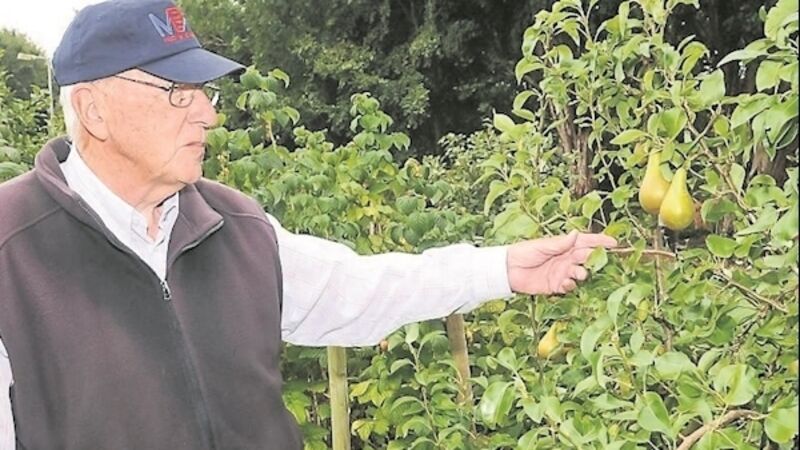
ALTHOUGH it’s winter and gardens are dormant, this autumn there was a veritable Garden of Eden, laden with temptation, at the Society of African Missions, in Wilton, on the outskirts of Cork city.
Two varieties of almost-ripe pears hung heavy like jewels on young trees, rubbing shoulders with fruiting raspberry canes. Better still were the grapes in the adjoining polytunnel. A vine of black grapes, and one of green, yielded an impressive crop of fruit. Both were delicious, the grapes small, but sweet and fragrant. The tunnel also yielded tomatoes, salads, herbs, and garlic. Standing in the polytunnel, Fr Tom Kearney threw some pellets into the fish tanks, to a flurry of gaping mouths and splashing tails, as the rainbow trout fed.
There are fish in the polytunnel, too: Fr Kearney has been experimenting with a farming technology called aquaponics. Aquaponics has been heralded as a promising way of cultivating both fish and edible plant crops on our increasingly crowded planet. The method is a “closed loop” system: the fish poo fertilises the plants and the plants filter and clean the water for the fish. It’s possible to produce an abundance of food with very little water and no soil.
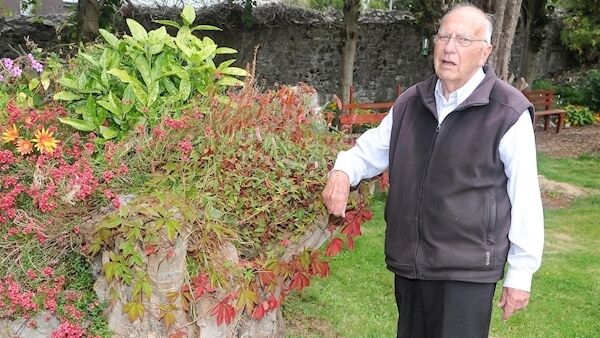
Fr Kearney has two 1,000-litre tanks of fish, topped with gravel beds fed with a pumped supply of the fish-tank water. Little can grow in the winter, but all summer and autumn, the retired missionary and his helpers harvested lettuce, strawberries, garlic, onions, parsley, and chard from the soil-free beds. The aquaponics system is in its first year, but the vegetable garden was started (on a patch of waste ground full of builders’ rubble) by Fr Kearney five years ago, as a hobby for his retirement.
“It keeps me going; I’d be locked up if I didn’t have this place,” he says with a wry smile, leaning on his cane as he surveys his work. “I can’t sit around. I like being outside.”
Fr Kearney isn’t new to experiments in farming. He served with the Society of African Missions (SMA) in Nigeria for 27 years, arriving in the pre-independence African state in 1958, and founded a scheme to raise rabbits for meat in the community he served.
“There was no decent food in a lot of areas,” he says. “Corn and cassava were the staple, and there was spinach and aubergines and plantains and fruit, which wasn’t too bad. But there was no protein, because you couldn’t keep cattle or horses, because of the Tsetse fly. So, I started keeping rabbits and chickens in fairly big numbers”
Eventually, Fr Kearney’s community enterprise employed 80 local people, had a capacity of 2,000 rabbits, and was supported by the Nigerian government’s minister for agriculture, as well as the NGO, Gorta, which donated freezer equipment to the farm to enable them to add more value by selling oven-ready rabbits.
Experiments in tillage also yielded results: “We planted cotton, and, for the first time, we discovered you could grow rice where we were. There wasn’t enough rainfall for paddy fields, but we discovered a variety of upland rice that grew well,” Fr Kearney says.
WHEN Fr Kearney arrived in Nigeria, the country was at the beginning of a population explosion: from 43m in 1958 to 202m today. Other countries were, too, and the planet is projected to have a population of nine billion by 2050. That’s a lot of mouths to feed; Fr Kearney feels that a system as efficient, and also chemical-free, as aquaponics, could help. It’s an ideology that he says is closely linked to his religious faith.
“There are ways of growing food without polluting the world,” he says. “The messages in the bible are, in the beginning, look after the earth, and then, till the earth and make it better. That’s not what’s happening with the material culture we now have, which is about getting as much out of the earth as you can. There’s something very wrong somewhere, and any little we can do to balance it, we should do.”
Following his time in Africa, Fr Kearney served in Tuam, Co Galway, and on Achill Island, before retiring to live at SMA Wilton. He’s matter-of-fact about the infirmities of age and knows he won’t be able to continue to tend to his garden beyond a “couple more years,” and this makes the future of the project uncertain.
“There are no younger men in the house to take it on, so I don’t know what will happen to it,” he says. “There was talk that a local school could get involved, but they’re on holiday during the summer months. There’s not a lot of work in it, really, but you are kind of tied to it. I check it every morning. If one of the pumps goes off, you could come in and the fish could all be dead.”
Fr Kearney’s aquaponics system was recently featured on an episode of RTÉ’s ‘Nationwide.’ Several parishioners, members of the SMA’s Peace and Justice group, have stopped by the garden to visit Fr Kearney. One, Eileen O’Riordan, has been helping out and her husband, Seán, an engineer, supplied the tanks for the fish and got involved in researching aquaponics.
Eileen has even cooked a dinner of fish and salad, both sourced from the aquaponic system, alongside potatoes grown in the polytunnel. Now, Eileen and Seán are making sample batches of wine from both varieties of grapes harvested from the tunnel. She proudly shows off pictures of the process, from picking buckets of grapes to squeezing them. “We’re very amateur and it’s all a learning curve, really,” she says. Two bottles each of red and white are fermenting in the O’Riordan’s home.
Some of the parishioners aren’t keen on the idea that the wine could be consecrated and used to celebrate a mass, but Fr Kearney responds in typically forthright manner. “Of course we could do it,” he says. “If it’s wine, it’s wine; when I was in the missions and I couldn’t get the stuff we have here, I had to make do,” he says.
What will they call their wine? Chateau de SMA Wilton? “Chateau Kearney,” Eileen responds with a smile.
CONNECT WITH US TODAY



Be the first to know the latest news and updates