Songbirds join forces to see off predators
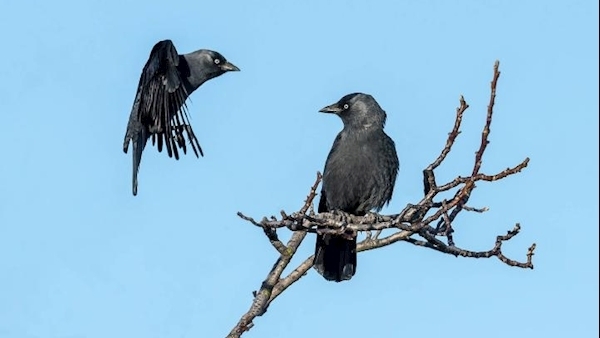
Irish songbirds will club together to ward off hawks falcons or cuckoos, enemies much larger than themselves. Terns mob foxes encroaching on their breeding colony, dive-bombing and striking the intruders on the head.
They have even been known to harass polar bears. Confronting such powerful opponents is dangerous but, by enlisting the help of the avian neighbourhood-watch, a bird can deter a predator it could never hope to see off on its own.
“Stupid people are the most dangerous cause they risk their lives for strangers,” declared Don Corleone in The Godfather. When putting its neck on the line, in defence of others, a bird’s behaviour may appear altruistic but mobbing actually springs from enlightened self-interest; you scratch my back and I’ll scratch yours.
Avian posse-formation involves social co-operation, an adaptive behaviour which helped make our own species spectacularly successful. It’s a subject, therefore, of special interest to scientists such as Jenny Coomes of UCC. She is the lead author of a paper,just published, on the mobbing activity of jackdaws.
The process is triggered by a ‘recruitment call’, the avian equivalent of a wartime air- raid siren. A bird not perceiving the threat directly must decide whether to heed the call-to-arms. Jackdaws recognise the voices of their neighbours; do the calls of some individuals carry more weight than those of others?
Is there a bandwagon effect; would several birds calling together prove more effective in assembling a posse than just one? Is mob formation quasi-democratic?
Jenny Coomes sought to answer such questions by probing the “cognitive processes underpinning” jackdaw anti-predator behaviour. Working at a site in Cornwall, she and colleagues recorded the ‘scold’ calls of 21 male jackdaws at two breeding colonies.
Various combinations of the recordings were then played on remote loudspeakers during the nesting season, noting the number of recruits to mobs and “whether the recruits themselves scolded”. Most of the jackdaws were colour-ringed so that individual birds could be recognised in the field. One moving to within 20m of a loudspeaker was deemed to be a ‘recruit’.
The results of the experiment show that more jackdaws joined a mob when playbacks of three to five birds calling together were transmitted, instead of just the call of a single individual. Clearly, size matters when drumming up support. Also, the number of posse members recruited “substantially increased if the recruits themselves produced calls”. This suggests that jackdaws may “use a form of counting when deciding whether to join a mob”.
Jenny says the birds appeared to be influenced by the calls of known individuals when opting to join a vigilante group.
Our findings are strongly consistent with the argument that individual call discrimination enables jackdaws to appraise the number of callers.
"We did not find clear evidence that the number of recruits was higher in response to five versus three callers,” she says. Alex, the famous grey parrot, known as “the sage in a cage”, could count up to six. Jackdaws’ arithmetical ability may be more limited. However, it’s also possible that calls from three birds are sufficient to trigger mobbing behaviour.

CONNECT WITH US TODAY



Be the first to know the latest news and updates