Lethal weapons that are pick of the bunch
Plants can be deadly as well as beautiful. Fiann Ó Nualláin has advice on growing your own pesticides

Lethal weapons that are pick of the bunch

Plants can be deadly as well as beautiful. Fiann Ó Nualláin has advice on growing your own pesticides

Last week’s article was about growing gooseberries and it touched upon the use of plant chemicals known as pyrethrins, derived from Chrysanthemum cinerariifolium, as the control for caterpillars and gooseberry sawfly — and as promised I said I would expand. So if we are to really have an impact on climate change the onus in any endeavour in life will be to go as natural as possible.


That includes the garden — not everyone is organic (yet) and it is all too easy to pick an off-the-shelf toxin in a plastic container and think of it as an essential to a healthy garden and not a big red flag.

Natural pesticide

Making the swap to a more environmentally friendly approach shouldn’t be such a big effort as quite a lot of garden problems can be treated with garden-grown plant chemicals or something borrowed from the pantry or kitchen cupboards — easily whipped up to an effective treatment in the kitchen sink or on the shed table. We just need to share our successes and that knack or knowhow. I use a garlic spray on most problems — it’s insecticidal and antimicrobial — so hits all angles but sometimes a more targeted approach is called for.

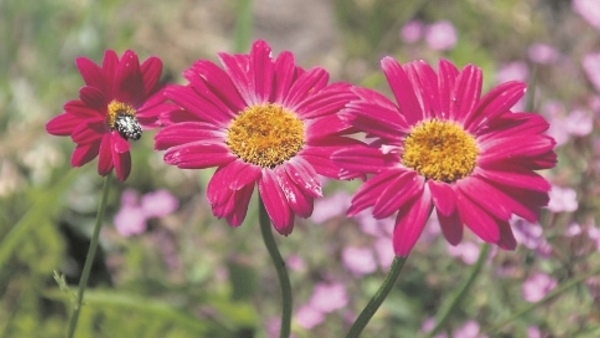
I grow Chrysanthemum cinerariaefolium, aka Dalmatian pellitory. I was first introduced to it as companion plant to border plants most affected by beetles and mites and later discovered that it is a plant long harvested as a natural pesticide — especially safe amongst food crops.

This attractive perennial garden plant with a floral profusion contains in its pretty flower heads the potent broad-spectrum insecticide chemicals (pyrethrins) which are effective against aphids, ants, the Colorado beetle, flea beetles, Japanese beetle, cabbage worm, gooseberry sawfly, most caterpillars, mites, ticks, and even indoors against silverfish.

It is potent; it paralyses on contact and that can “shock to death” many pests. It soaks in further and disrupts the nervous system causing system failure. A second spritz may be required for the more resilient bugs.

It is often mixed with other natural chemicals from garlic, lavender, clove and soap so that the other toxin in the mix properly penetrates the frozen bug. I use it on polytunnel crops and occasionally in the allotment if there is an issue on my fruiting plants.

Natural and synthetic

Pyrethrins degrade quickly in daylight and their residue does not linger long on plants or persist in soil or water. So the tradition is that you can apply pyrethrins up to the day before harvest.

I can’t vouch for the commercially available pyrethroids which are synthetically produced compounds (laboratory- not flower-derived) that mimic the chemical structure and actions of natural pyrethrins.

Both the natural and the synthetic types are broad-spectrum and the caveat in that is harmful to bees and ladybirds (via direct contact), potentially toxic to pond fish and may even cause problems for cats. If you are allergic to ragweed the natural-sourced variety may cause you problems too.

It is often advised not to use if asthmatic — but that’s more if grinding the dried flowers to a powder (accidental inhalation) rather making into a liquid spray.

How to make at home

Pick the flowers that are in full bloom (they have a higher concentration) then you can hang them upside down in a dark spot for several days to dry out. The dried flowers can be crumbled to a powder which can be dusted on to plants or kept in a jam lidded jam jar to use as the basis of a liquid spray — it is not an exact science as the chemical accumulations can vary from flower to flower never mind garden location to garden location but the guide is two teaspoons to a pint.

I have a “shed blender” for all my concoctions and I sometimes don’t have the time or opportunity to follow the age-old handed-down recipe to theletter, so a handful of fresh flowerheads, a pinch of clove spice (the eugenol is toxic to insects), a clove or two of crushed garlic and a pint of water — blitz, blitz then decant and spray away — does the trick in a pinch, as they say.

It’s still a chemical alb it “organic”, so I do wear gloves and avoid spraying it on myself. Exercise caution at all times when using.

I generally use my homemade spray at night, after the bees have left the garden but while pests are still munching and present; the early daylight theoretically degrades before bees return but if I have to give a second morning spay then I cover the plant with a paper bag or makeshift hood — this keeps sunlight out and the chemicals stay active longer and stops the bee or ladybird finding a way in. The plant is bee-pollinated so it is only the extracted chemical that is a potential issue.

Growing your own

Chrysanthemum cinerariaefolium will happily grow in well-drained garden soil. Its natural habitat is calcareous dry soil or rocky locations. It thrives on alkaline soil just like most veg. It does prefer full sun.

I now grow it in containers amended with grit, as some years, particularly ones with wet summers, the plants can die after flowering — but it is regarded as perennial and can cope well here.

Originally from Croatia, it is quite hardy otherwise — it has no big frost issues. It is suitable for maritime exposure too. Best sown in spring to mid-summer, it flowers over the summer months.

More in this section

Revoiced

Newsletter

Sign up to the best reads of the week from irishexaminer.com selected just for you.

Cookie Policy Privacy Policy Brand Safety FAQ Help Contact Us Terms and Conditions

© Examiner Echo Group Limited