Island Roy of the rovers
As a way of promoting tourism, the idea of towns and cities twinning with other towns and cities has few equals. Cultural links are established and people begin to visit each other’s locales.
Friendships are made, businesses increase turnover, and everyone wins. Skibbereen recently twinned with Scituate near Boston. Galway is twinned with St Louis, Chicago, and Seattle.
Dozens of others. So towns and cities, fair enough — but an island and a planet?
The 90-acre Island Roy in Co Donegal did exactly that when it was chosen in 2010 to be paired with Mars.
The idea was instigated by US arts group the League of Imaginary Scientists as part of its Lovely Weather Art and Climate Change Public Art Project.
This group worked with Donegal County Council Public Art to run a project which involved locating a place in Donegal which would have a geographical feature on Mars named after it.
After the public sent in their suggestions, Island Roy was chosen as its name is derived from Red Island or Oileán Ruaidh, which finds a relative in the Red Planet.
When Nasa’s Mars exploration rover Opportunity duly picked up a rock sample on the 2,363rd Martian day of its mission on Mars it examined the rock’s texture and composition.
The nickel-iron meteorite was then informally named Oileán Ruaidh.
Island Roy is nestled in the southern reaches of Mulroy Bay near the village of Carrigart in the far north of the country. About 20km from Letterkenny.
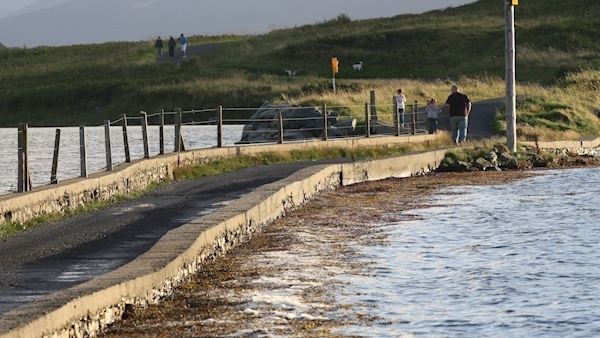
This island is linked by a causeway to the mainland which takes you on the road to Letterkenny.
Where Island Roy differs from other islands that have causeways, such as Ringarogy in West Cork or Gorumna in Co Galway, is that, in very high tides, the low-lying causeway is submerged and its island status is restored. It can’t have been so intended.
It has a few satellite islands, namely Island Reagh, Inishfaugh, Ilaunanoon, and the intriguingly named Donald and Grainia’s Island, which can be accessed at low tide on hard sand.
The island’s population, all 12 of them, mainly live in a cluster of houses in the centre of the island and near a small lake called Moss Lough.
Oileán Ruaidh derives its name either from the autumnal russets and ochres of its deciduous trees or its distinctive red rock, but not anybody famous called Roy.
However, it is indicative of how our landscape changes, as today it has just a few copses on the island which merit the description.
Nowadays it is predominantly farmland. One industry which operated for a while was the harvesting of seaweed, which was sent to a factory in Dungloe but that became uneconomic.
However, there is now a spa on the island which avails of this plentiful natural resource.
The island was formerly known as Oilean na Bhreighe, or Island of the Prisoners. It formerly had links with Doe Castle just up the road at Sheephaven Bay, which was a former stronghold of the leader of the Ulster Army in the 1640s, Owen Roe O’Neill.
The castle was occupied by a succession of owners after this and the unfortunate prisoners may well have been linked with any of these garrisons. The population peaked in 1841 at 74.
The island has just one small road, which is protected from the sea by a reinforced rock wall. It is a lovely walk to circumnavigate Island Roy at low tide underneath the Fanad Mountains.
Ultimately, twinning involves partnership and the intention of natives in each site to visit the other. The locals of Island Roy are unlikely to get the chance to visit Mars, but the other way around? Who knows.
When the League of Imaginary Scientists visited the primary school of Downings in 2010 they were told that the kids would love to visit Mars.
“They’re the right age for it. The first people who will go to Mars are not astronauts… not now. They’re kids who are still in school.” said the head of the Mars Rover mission, Steve Squyres.
Drive. Take the N56 north of Letterkenny, followed by the L1192.
imaginaryscience.org/project/lovely-weather; photojournal.jpl.nasa.gov/catalog/PIA13418; www.donegalcottageholidays.com/islandroy


CONNECT WITH US TODAY



Be the first to know the latest news and updates