Beauty and miraculous evolution of avian flight
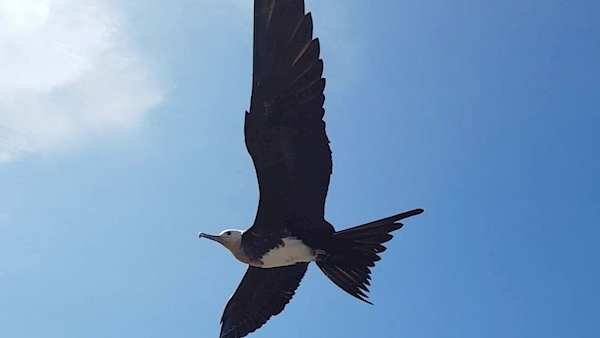
A photo of a frigatebird in flight, sent from Ecuador by my daughter-in-law, set me to thinking about the beauty and miraculous evolution of avian flight.
How extraordinary it is that a creature only minutes hatched from an egg can take to the air, while we humans, however long we’ve been out of the womb, can fly no higher than two feet above the earth, and even Olympiad high jumpers and long jumpers can stay airborne for no more than a few seconds.
Yet there is a barely-fledged fulmar, which only yesterday left its nest 100-feet above the sea, soaring cheekily above me as I stride the cliff top path, looking down on my earthbound inadequacy. It can drift out over the waves, drift in over the land, raise and lower itself as if on an escalator and doesn’t even have to commit a flap.
The aerodynamic design of its body and wings enable it to overcome the drag factor of the air it flies through, the downward pull of gravity on its body and the turbulence its own movement creates. The bones at the leading edge of the wings are stout, rigid and rounded and behind them the wing feathers trail to a point, so that friction is reduced to a minimum.
Wings, we see,are curved so that as they cut through the air, they produce an upward ‘lift’, counterbalancing the tug of gravity. To deal with knockabout air currents and the natural turbulence the flight creates, the wings incorporate slots or ‘alua’, so that large ‘slabs’ of air can be broken up into small ones, passing safely through the wing as each feather becomes a separate aerofoil, acting independently.
When the wind blows on-shore and hits the cliff face, fulmar, black-backed gulls, kittiwakes and others seem to enjoy the sensation of being lifted effortlessly skyward by the updraughts. Who wouldn’t? When the wind blows off-shore, they gain height, again without effort, by riding the eddies hitting the sea surface and curling upward as the wind spills over the edge of the cliff.
Oh, that I had the wings of a dove, that I might fly away, and be at rest...
The line comes from a psalm in the King James Bible, the most poetic of the holy books; some other versions are awkward to a fault.
I’m not so sure doves, with their stubby wings, would tour the thermal airbeds as restfully as would vultures, lammergeiers or condors (which my son and wife now heading for Machu Picchu, at 2,500m in the Andes , might, with luck, get to see).
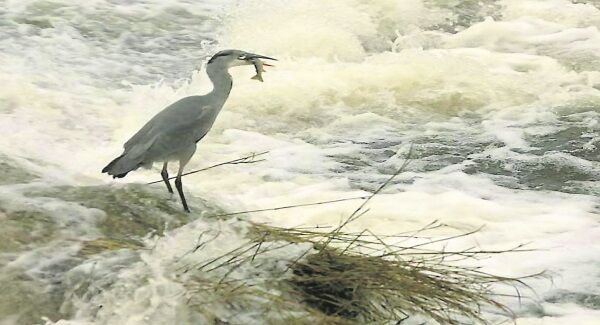
A west Cork heron, floating on its half-umbrella size wings, would have an easy ride also. Swifts, despite having knife-like wings, are expert thermal-users. They do not come to earth at nightfall but sleep on these high-level air currents, going round and round in a slow drift, and mate on them, as on a feather-bed of air. Readers will know that the only time they make landfall is when they nest: and the miracle of instant flight is to be seen when the young spill from the nest but do not reach the ground, cats and catastrophe but flap their wings for the first time and flutter onto some nearby abutment, thence to survey the prospects they find they have been born to.
As for the fulmar, my sometime companions on clifftop walks, they watch me with their landward eye as they cruise past at shoulder-level just a few arm-lengths away, cruising above the churning sea 100m below them.
Winds passing over the sea are slowed by contact with the waves, but increase again in speed as they climb in ‘steps’ to a maximum velocity at about 35m above the surface. Fulmar exploit these ‘steps’, gathering momentum on a high, fast windstream that shoots them to the cliff top where they plane for 100m or more with wings held rigid before they wheel down to a lower level and then, using their momentum, rise again.
The aforementioned magnificent frigatebirds, suitably named, can stay aloft for two months at a time, riding trade winds for hundreds of miles each day. They’re pirates, mugging other birds to disgorge their dinners. Man o’ War birds, they’re also called.
Environmentalist warn that the natural systems that made these avian and other miracles — and ourselves — may be annihilated by human activity within our grandchildren’s lifetimes. “We are still not moving fast enough to prevent irreversible and catastrophic climate disruption,” said UN Secretary-General Antonio Guterres at last week’s climate conference in Poland.
“Leaders of the world, you must lead,” warned David Attenborough. “The collapse of our civilisations is on the horizon.”
Can we save ourselves? I ask...
CONNECT WITH US TODAY



Be the first to know the latest news and updates