The Islands of Ireland: Castle’s fall from Grace
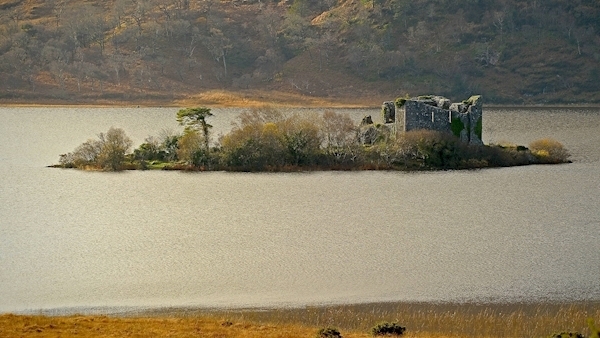
The difficulties in building a castle on the mainland are considerable.

The Islands of Ireland: Castle’s fall from Grace

The difficulties in building a castle on the mainland are considerable. The logistical problems of sourcing stone, cutting it, and having enough skilled labour to put it all together can only be imagined. An incredible achievement whether in the 10th century or the 19th.

But on an island? Where huge slabs have to be brought by boat? An effort of construction where materials, equipment, and workers have to be brought daily, if no accommodation were available, must be marvelled at.

Ireland has some (once) magnificent castles on islands — Cloughoughter Castle, Co Cavan, Castle Island, Co Roscommon, and Lough Corrib’s Castle Kirk Island or Hen Island is up there with them.

Grace O’Malley, or to use her fetching sobriquet Granuaile (Gráinne Mhaol), is renowned for her exploits around the west coast, especially in Mayo and Galway. She had several castles and hundreds, if not thousands, of people under her command engaged chiefly in the collection of taxes from anyone who took to the seas in her realm. She once sailed to the court of Queen Elizabeth to parley with the queen for the release of her two sons, Tibbot Burke and Murrough O’Flaherty.

Her fortress was on Clare Island, where her castle still stands on the pier.

Other castles are dotted around Clew Bay. However, she also had an inland castle, on Lough Corrib to be precise.

This vast lake has dozens of islands with magnificent towering beeches, oaks, and elms. There is seclusion and privacy in abundance on these inshore islands. One of them, Roeillaun, has what appears to be the remnants of a hippy commune with multicoloured caravan but which was in fact an experiment in alternative living by a German industrialist in the 1970s.

Lough Corrib has two main parts: The huge northern lake and the almost equally huge southern counterpart. It is the largest lake in the Republic of Ireland and its eponymous river flows to the sea at Galway. Lough Corrib is 50m deep in places and numerous other rivers flow into it.

There are numerous inlets on the lakes each with their own characteristics.

Granuaile’s castle lies in the extreme northwest of the lake, where the Bealnabrack and Failmore rivers flow into the lake from the quartzite fastness of the Maumturk Mountains.

Castle Kirk lies near the northern shore and the castle occupies a good third of the island, which is encircled by a barrier of trees. It is roofless now but its thick limestone walls and buttresses once formed a formidable defence. This is actually the second castle on the lake. The first was constructed around 1200 but was burnt down a few decades later.

Caisleán na Circe (derived from ‘cearc’ or hen) came into the possession of the O’Connor clan having originally been owned by the O’Flahertys, who were pushed aside in 1225 by the lord chief

justice in return for O’Connor loyalty. The second castle was an elaborate structure and included spiral stairs with the wall on the left as visitors, or the enemy, climbed, which meant their sword hand was ineffective. It also had an internal wooden bridge and square towers at the corners.

Lough Corrib
Lough Corrib

The O’Flahertys later regained control of the castle after it was besieged many times. In 1546 Granuaile married Dónal an Chogaidh Ó Flaithbheartaigh (O’Flaherty). It was a marriage as much about power as love, as she was the daughter of the O’Malley chieftain and he heir to his family title. However, Dónal was killed in 1565 on Hen Island when the Joyce clan attempted to wrest control of the castle and island from the O’Flahertys. The hen nickname derives from the name given to Dónal (An Cullagh) who built the castle, but when he was slain, the hen, his lady Granuaile, was called on to defend it. And defend it she did.

The Annals of the Four Masters mention Castle Kirk and it is regarded as one of the oldest mortared castles in Ireland. In the 19th century, some of the castle was raided for its stone, which was used in local construction projects.

    How to get there: From Maum in Galway take the R345 for 3km.

    www.corribprincess.ie

    www.corribcruises.com

x

More in this section

Revoiced

Newsletter

Sign up to the best reads of the week from irishexaminer.com selected just for you.

Cookie Policy Privacy Policy Brand Safety FAQ Help Contact Us Terms and Conditions

© Examiner Echo Group Limited