The islands of Ireland: Moynish Beg a sinking feeling
THE obliteration of the Hawaiian East Island in Hurricane Walaka in the last few weeks serves as a timely reminder to the vulnerability of many low-lying islands, writes Dan MacCarthy.

The islands of Ireland: Moynish Beg a sinking feeling

THE obliteration of the Hawaiian East Island in Hurricane Walaka in the last few weeks serves as a timely reminder to the vulnerability of many low-lying islands, writes Dan MacCarthy.

There are reputedly 365 islands in Clew Bay, one for each day of the year and many of them are low-lying. In his exhaustive study entitled Croagh Patrick and the Islands of Clew Bay, Michael Cusack says at high tide there are about 100 islands visible. However, sonar analysis has revealed twice that many drowned drumlins and rock outcrops just beneath the surface.


From atop the lofty perch of Croagh Patrick the view of Clew Bay is captivating. Dozens upon dozens of islands lie at your feet: their shapes are round, indented, mis-shapen, but mostly elongated. This is drumlin country in a manner of speaking, or drumlin ocean, perhaps. The classic mounds are glacial deposits left by retreating glaciers during our last ice age, about 10,000 years ago.

There are many lakes to the east of Westport as if an unseen hand simply had ripped them from the land and scattered them in the ocean.

The sea has been gradually rising and threatening not just the mainland but the islands too. The most westernmost island of Clew Bay is Moynish — a big island with plenty of pasture which once supported 99 people. A few hundred metres away is Moynish Beg where no one has ever lived.

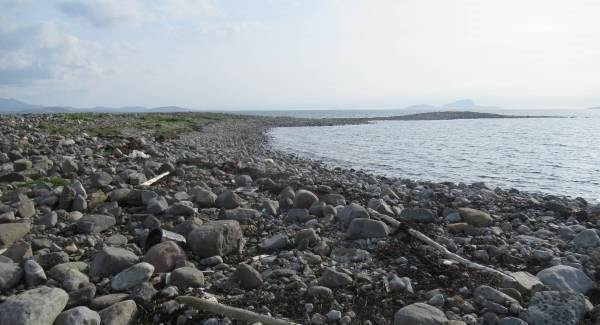
However, the future for Moynish Beg is not looking good. The island is slowly disappearing under the Atlantic, possibly soon to become a memory or even a myth in the manner of Atlantis. Today, the island is a mere bank of pebbles and shingle, with an array of flotsam and jetsam washing up.

The late Jim O’Donnell who used to fish for lobster around Moynish Beg in the 1940s and 50s when the island was much bigger. Picture: John O’Donnell

Mulranny, Co Mayo, man John O’Donnell says his father Jim used to fish for lobster and salmon in the waters of northwestern Clew Bay and can recall a time when Moynish Island was much bigger, possibly up to two acres in the late 1940s. While the waters west of Moynish Beg suddenly become very deep it is possible to stand in the water in between several of the islands as sandbanks prevail.

“I remember when it was much bigger. It’s shaped like a kidney now. My Dad used to have his lobster keep-tank there. Even on a very high spring tide you wouldn’t see out over it in a boat. You couldn’t see Louisburgh or Clare Island,” says John.

HOWEVER, Moynish Beg has been significantly eroded in recent years. At the northwestern corner there was a sheer drop to the sea which is now gone. “It was like an abyss, on a calm day, you could bring the gunnel of the boat in and step off. It was a natural stone pier,” says John.

Once there was even grass enough for grazing. “I can remember sheep grazing on it. They would put in about 10 sheep and put them back in to Moynish again after a week or so.” The storm in 2014 was as significant event and with the peak spring tide it ensured Moynish Beg got a severe battering. “That storm really put the tin hat on it. That was the most devastating storm in modern times that we can remember for damage to Moynish Beg,” says John.

However, Moynish Beg does provide a home for some: terns to be precise, and not just one, but two species, the Arctic and little tern. A survey by the National Parks and Wildlife Service in 2016 identified 41 pairs of Arctic terns and 24 pairs of little terns. There were 10 pairs of common gull.

With little space you might think there is not much room for the birds to nest. However, Birdwatch Ireland conservation officer Stephen Newton says that a small shingle bar above high-water mark is all the terns need.

“After the Inishkea Islands, Clew Bay, including Moynish, is probably the second most important area in Co Mayo for nesting terns.” Moynish Beg used to support a small cormorant colony, 20 pairs in 2000 and 32 in 1985, but these seem to have moved, possibly due to lack of space, he says.

For now, Moynish Beg is hanging on.

- How to get there: Clew Bay tours: thereek.com; westportcruises.com; www.irelandwestseakayaking.com

- Other: Croagh Patrick and the Islands of Clew Bay by Michael Cusack

More in this section

Revoiced

Newsletter

Sign up to the best reads of the week from irishexaminer.com selected just for you.

Cookie Policy Privacy Policy Brand Safety FAQ Help Contact Us Terms and Conditions

© Examiner Echo Group Limited