The Islands of Ireland: MacDermott’s castle in the air
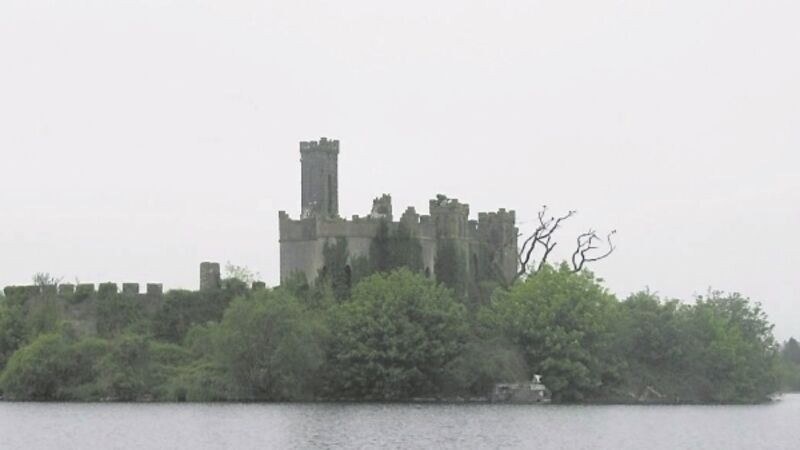
The crows are the kings of Castle Island. Multitudes of them idle in the trees, screeching, or maraud around the battlements. This dark avian display adds to the Gothic nature of the place. Castle Island, Lough Key, Co Roscommon.
High, Norman-type arched windows, a limestone facade blackened over the years. A deserted castle, no one around. Trees and briars make access almost impossible. What on earth happened here? A sign warns hopeful visitors to stay away. The walls are dangerous. Chunks of masonry may come down. Sure enough, inside the castle, an entire wall looks ready to peel away and come crashing down.
This is not a castle in the true sense of the word. It is rather a folly — a whimsical structure. It never served as a castle in the sense of having a resident chieftain or household. It was built on the island in the Rockingham Estate near the town of Boyle in the years after the construction of the main mansion which was built in 1803 on the shores of Lough Key.
Today the mansion is no more, destroyed by a fire in 1957. However, the estate lands have been incorporated into the magnificent public amenity of Lough Key Forest Park which has around 860 acres with mixed woodland and including Lough Key itself as well as many islands including Castle, Trinity, Church, Green, Hermit’s, Lahan, Bullock and Bingham. The Rockingham Estate was centred on Rockingham House, which was built by Robert King, who commissioned the architect John Nash to build a mansion. It was destroyed by fire in 1863, rebuilt, but destroyed in another fire in 1957 and eventually demolished.
As the original house was being constructed, further features were added to the estate by the renowned landscape architect John Sutherland; a walled garden, a hunting lodge, a beech walk, and the folly on Castle Island, which was originally known as MacDermott’s Island.
The MacDermott clan ruled the area for around 400 years, despite coming off worst in an attack by the Norman Richard Mór de Burgh, in 1235. However, they lost their land after the 1601 Battle of Kinsale, when the chieftains’ lands were dispersed to the English settlers. Elizabethan general John King was granted vast tracts of land around Boyle Abbey. Robert King was a descendant of John King’s.
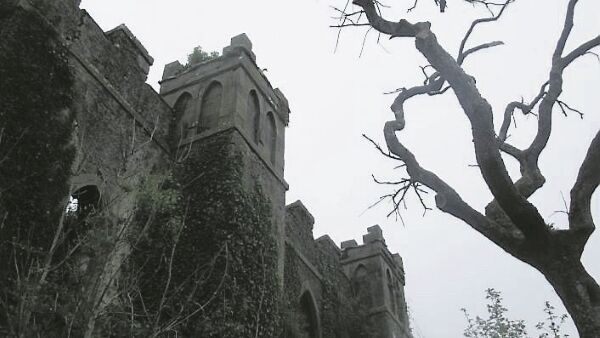
The original fort was not a folly but an inhabited dwelling. It was built in the 12th century by the MacDermotts on what was known as The Rock.
In Rockingham — Memories of a Vanished Mansion, John Clapison writes that “the MacDermotts were renowned hosts and the Rock was considered the seat of hospitality and generosity in the province of Connacht. It is recorded in the Annals of Loch Cé that they gave generously to the arts, to poets and ollamhs [professors], and were most generous patrons of the church. In fact, family tradition decreed that no one calling regardless of social standing was ever refused food and shelter.”
The annals were written on another island in the lake, Church, under the direction of Brian McDermott, and recorded events in Connacht in late medieval times.
In 1184, according to the annals, a lightning bolt struck the MacDermott castle and up to 140 people died in the conflagration including “fifteen men of the race of kings and chieftains, with the wife of Mac Diarmada, i.e. the daughter of Ó hEidhin, and his son’s wife, i.e. the daughter of Domhnall O’Conchobhair, and the daughter of Ó Dubhda, and the son of Donnchadh O’Maelbhrenuinn, and the son of Donn O’Mannachain, and the two daughters of O’Mannachain, and Mac Maenaigh, chieftain of Cenél-Builg, and the priest O’Maelbealtaine”.
WB Yeats visited Castle Island in 1890 and considered setting up an artistic centre there. This was two years after he composed ‘The Lake Isle of Innisfree,’ so Castle Island can’t have been a competitor for the location of his famous poem. Still, it emphasises his love of islands and shows that he was inspired by visits to them.
The folly itself was gutted by a fire during the Second World War.


CONNECT WITH US TODAY



Be the first to know the latest news and updates