Little Skellig — small is beautiful
How misleading names can be. Where a pair of islands occur they are often named greater or little/ lesser: the Greater and Lesser Antilles in the Caribbean; Great Britain and Lesser Britain (Ireland) as described by the Greek cartographer Ptolemy in the second century.
The latter term later fell into disuse. These are geographic terms relating to size not greatness. Otherwise there would be no end to self-congratulating countries: Wonderful Moldova, Fascinating Mongolia; Indescribable India?
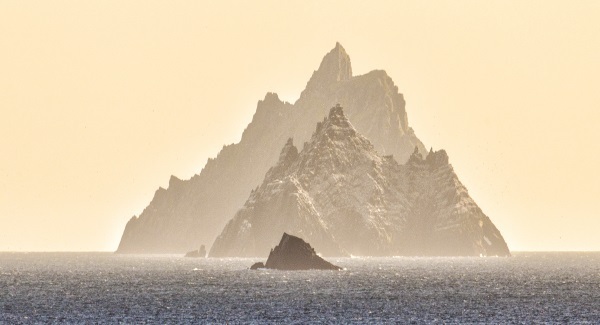
So it is with the Skelligs. Skellig Michael (Sceilig Mhichíl and greater in size) is a magnificent towering near-pyramid of an island but its fellow Little Skellig or Sceilig Bheag is no less impressive.
Together they are unique. Their strength lies in their partnership. It is Little Skellig that defines Skellig Michael and Skellig Michael that defines Little Skellig.
The Atlantic Ocean without one or the other would be a poorer place without their jagged forms.
No humans live, lived or ever could live in this truly wild place. In terms of inhospitableness it’s a toss up between Little Skellig and Rockall in the northwest Atlantic to see how long anyone could survive there.
Gannet spotting on Little Skellig. pic.twitter.com/wc2Z6AgJvu
— VertebratePublishing (@VertebratePub) July 19, 2018
After several circumnavigations of this formidable fortress in a RIB skippered by the no-less formidable Willie Kennedy, it becomes clear that there are no obvious landing points.
Not only are there no obvious landing points but there are none at all — at high tide. At low tide, a rocky platform on which brown seals frolic permits ‘entry’ to this sandstone and quartzite edifice. But then, no landing is permitted as the island is a protected bird colony.
Little Skellig is about half the size of its big brother and at 134m high is about 90m lower. Again, appearances can be deceptive because on approaching the islands they look of similar height.
However, seen through the vantage of the hermitage window on Skellig Michael, deliberately positioned to gain this aspect, the relative sizes become apparent.
Little Skellig is the most important gannetry in Ireland with other significant colonies on the nearby Bull Rock on the Beara Peninsula, the Saltee Islands in Co Wexford and Lambay Island and Ireland’s Eye in Co Dublin.
A view today of Little Skellig from Skellig Michael off the coast of County Kerry of Ireland. Skellig Michael, a monastery from the 7th Century, is a UNESCO World Heritage site. #ireland #irish #history #starwars @TourismIreland pic.twitter.com/F3REzbCZCD
— Barry Butler Photography (@barrybutler9) June 27, 2018
“The best place to see gannets is at Little Skellig, where it is possible to see this impressive bird at very close range, as well as experiencing the comings and goings of the breeding colony.’” says Birdwatch Ireland which leases the island from the state.
The site is a Special Protection Area under the EU Birds Directive. In addition to the black wing-tipped, yellow-headed gannets are fulmar, manx shearwater, storm petrel, kittiwake, razorbill, guillemot and puffin. Little Skellig is best known for its internationally important gannet colony, with around 30,000 pairs.

It is one of the largest colonies in Europe. These remarkable birds can swim to 25m underwater and can hit the water at 100kph. To feel something of a gannet you can don an oxygen tank with skelligboats.com/ diving and plunge beneath the surface and get a gannet’s eye view, as it were.
During the Famine, Blasket Islanders rowed to the Skelligs to harvest the gannets. Where Skellig Michael has several series of steps running down to the water’s edge, Little Skellig only has gullies filled with excrement. In fact, the whole island looks like it has been whitewashed or greenwashed in birdshit. So much so that it resembles snow when seen from the shore.
Robert Lloyd Praeger writes in The Way that I Went (1937), that gannets will use anything handy to build their nests — “strings of onions, blue castor-oil bottles and a child’s tin clockwork steamer”.
Make no mistake about it, the gannets are the rulers of Little Skellig. T’was ever thus and ever thus will be.
Best Film - #Cinematography @CTLFilms "Wild #Ireland"
— waimea ocean film (@WaimeaFilm) January 11, 2018
Photo: Wild Ireland_Little Skellig_©George Karbus#ocean #stunning #film #beautiful pic.twitter.com/dcoaXoW97g
In his 1976 study of somnolence and madness, Heart of Glass, German film director Werner Herzog magnificently filmed both islands from a circling helicopter. Long before drones or spacecraft were ever heard of.
Tours with Willie Kennedy, Ballinskelligs, Co Kerry: 087 222 9787.
www.birdwatchireland.ie; skelligboats.com/diving