Damien Enright: A paradise of plastic ready to be baled to the moon
A friend of mine decided to celebrate his birthday by doing a round-the-world trip and touched down on far-flung islands in the South Pacific.

Damien Enright: A paradise of plastic ready to be baled to the moon

A friend of mine decided to celebrate his birthday by doing a round-the-world trip and touched down on far-flung islands in the South Pacific.

He had sailed in there some decades before, and thought the lagoon where he anchored to be an earthly paradise, crystal water rippling over white sands, multicoloured corals and marine creatures of every shape and stripe. He’d promised himself he’d visit again.

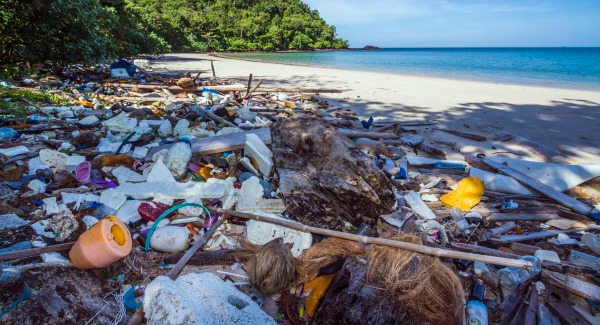
However, upon arriving, he found no paradise. Paradise was gone. The sand, where it could still be seen beneath rafts of rubbish, was no longer white. Colour was entirely bleached from the corals and the coral beds were like the whitened ruins of bombed Syrian cities, towers broken and dead, the inhabitants departed.

Outraged, he wondered how these island people, people of the sea, could use their precious lagoons as garbage dumps. The reefs circling the atolls allowed land to grow in the first place, and nature had decreed that the living corals formed permanent barriers to save the resulting islands from inundation.

Depending on the weather, the ocean leaped or lapped over the reefs but, generally, what was thrown into the once crystal pond within them stayed there. Previously, the throw-aways had been coconut shells, over-ripe fruit, fish bones, turtle shells, even old iron, and waste paper; all were bio-degradable and soon decayed. But then came plastic. And it stayed.

Soon, like everywhere else globally, all shop-bought liquids were bottled in plastic and every fruit, even those with resilient husks or skins, were wrapped in it; and every scrap of this plastic ended up in the lagoon.

What was to be done? my friend asked a local. A hole would be knocked in the reef to let high tides take garbage out into the ocean, he was told. But won’t it come washing back in on the next tide?” my friend enquired “Oh, yes.” chirped the local. “But it’s a temporary measure, you know...”

Yes, my friend knew. We all know. Meaningful efforts to protect the world’s seas are non-existent. Unlike the land and real estate, the oceans have no owners, and no voice. They are anybody’s, available for exploitation to extinction.

We have the technology to strip them of all consumables, all food chains; and human failings, ineptitude, greed and mismanagement is leading to the rapid extinction of everything that lives in them, including the water. What was sea water is no longer sea water, being so densely permeated with microplastics that it is becoming a sort of plastic consommé.

In view of the continuing international disregard for the accelerating death of the oceans and all life in them, may I ironically suggest that we could still find a role that these great, once life-supporting bodies of H2O could play in the planet’s survival. Even in their sterility, the can still be exploitable in the future.

As land-fills threaten to take crop land out of production, dead oceans could make excellent, almost inexhaustible rubbish dumps, ‘sea-fills’ where our refuse could be disposed of out of sight. Think of the garbage capacity of the Marinas Trench, the deepest part of the world’s oceans, in the western Pacific Ocean, an average of 200 kilometres to the east of the Mariana Islands, in the Western Pacific, east of Philippines. For aeons, the seas helped feed the world, took carbon from the air and, in collusion with the sun, provided water to form rain clouds to be carried by the wind to places that had no water, there to sustain human, animal and plant life.

But that was before the-most-useful-product the-world-has- ever-known was found. Plastic would do everything, supply every need — and, unlike almost all other manufactured materials, would last almost forever.

It would seem ungrateful to enquire why the mighty brains that created it didn’t see the ‘forever problem’ and include a planned-obsolescence molecule, giving it a guaranteed break-down date, as nature has given everything it ever created. However, as we continue to manufacture Everest-size mountains of plastic, while having no viable plan for their disposal, the seas may continue to help us survive.

The dying oceans are, after all, already providing rubbish tips. Sea-fill sites can be found around every coast: I see local-label plastic containers washed up in every cove. Surely, with ‘sensitive planning’, weighted, container-sized bales of plastic might be taken offshore and sunk. When continental shelfs fill up, giant plastic-dumper craft could dredge bales into the bottomless depths beyond. Nothing would be harmed by the dumping. There would be no life to harm.

As evidenced in my friend’s paradise lost, natives of islands so small that not a cubic metre of ground can be spared for land-fill continue to use traditional sea-fill solutions. Now, however, these solutions annihilate their natural protection and threaten them with apocalypse.

It may be that, as the oceans become crowded, we’ll find ways to rocket those plastic bales to the moon.

x

More in this section

Revoiced

Newsletter

Sign up to the best reads of the week from irishexaminer.com selected just for you.

Cookie Policy Privacy Policy Brand Safety FAQ Help Contact Us Terms and Conditions

© Examiner Echo Group Limited