The islands of Ireland: Mehigan’s Island -hostage to fortune
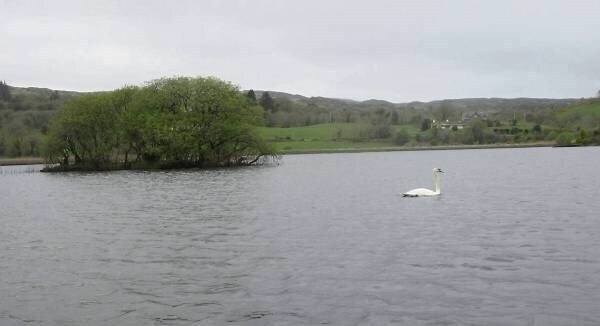
You can walk across this island in five seconds. The lake waters lap around and about 20 hawthorn trees provide cover.
This is Mehigan’s Island in Lough Allua, one of only four discovered crannógs in Co Cork.
The island lies in the upper reaches of the River Lee, near the source at Gougane Barra. The lough has some rare flora such as sneezewort and bird cherry.
The fact that human agency was involved doesn’t make a crannóg any less of an island. True, rising waters in lakes or rivers can compromise their islandness but for hundreds of years they provided as much solid ‘ground’ as any geologic island. Manmade, but still an island.
The recently published Antiquities of Rural Ireland indicates that most crannógs were constructed in the northern half of the country with scant evidence of them in the south.
Their functions ranged from “royal residences, to metalworking and other craft centres, the residences of ecclesiastical communities, safe havens for the storage of valuables, and occasionally island hermitages”.
There are 1,200 recorded crannógs in the country with an estimated 800 others at least. They are usually found in small lakes and were constructed of stone, soil and timber.
The Ordnance Survey six-inch maps of 1842 and 1906 record Mehigan’s island as ‘Illaunyweahagane’ which was translated as ‘Oilean Uí Mhaothagain’ or Meighan’s Island. It may not be much to look at now, but Mehigan’s island once had significant social importance.
Archaeologist Bernadette McCarthy says the year of construction is uncertain, but whoever built it had access to major resources of land and labour. She says this crannog is located on an important boundary between early medieval kingdoms and is visually imposing in the landscape.
“The crannog may have been occupied at least seasonally by the O’Mehigan family if not also visited occasionally by members of a ruling family, or it may have been used by metalworkers associated with this family,” she says.
In early medieval Ireland, ruling chieftains tended to move around between their settlements, or settlements of loyal followers, rather than spending the whole year in one place, says Dr McCarthy.
It is likely that the crannóg was only used for seasonal habitation, perhaps during the summer months. There was probably at least one round structure made of organic material such as wickerwork on the crannog. The crannóg itself had a palisade of timber posts.
The associated wealth came from a ringfort on the shore about 500m to the north.
“This may well have been where the O’Mehigans or whatever noble family was associated with the site more comfortably resided. Thomas Ainslie Lunham, wrote in 1909 that there was a ‘passage raised above the level of the lake’s bed’ leading from the ringfort to the crannóg. However, locals say that when the water is low there is a causeway clearly visible leading from the crannog to the shore,” says Dr McCarthy.
Another possibility is that Mehigan’s Island was used to keep prisoners.
“As it was situated on the border between rival chieftains in early medieval Ireland, hostages were often kept near boundaries as a means of ensuring peace between kingdoms. Some of the hostages could be from ruling families and were relatively well-treated,” she says.
The crannóg lay on the boundary between the large early medieval kingdoms of Uí Echach Mumhan to the south and Muscraige Mittine to the north. Upriver lies Inchigeelagh ‘River Strand of the hostages’.
The three other definite crannógs in Co Cork are: Clashbredane, Kilmichael; Lough Lea in Banteer, while there is a record of another in Corran Lake near Leap. There was even a possible crannóg found at Cornmarket Street in Cork in the 1920s.
Mehigan’s crannóg is unlikely to be excavated any time soon unless a research institute or university takes an interest, says Dr McCarthy.
Observe from road on drive from Inchigeelagh to Ballingeary, Co Cork.
www.facebook.com/KayaksRentalWestCorkK2
Antiquities of Rural Ireland, Muiris Ó Súilleabháin, Liam Downey and Dara Downey, Wordwell; Wildflowers of Cork City and County, Tony O’Mahony, Collins.