Vintage View: Cracking open a very special Easter egg
looks at some very special eggs for Easter — those of Carl Fabergé.
Eggs have been a sacred symbol and favourite device in the arts for millennia.
The tension and vulnerability of the perfect unbroken egg speaks of nature’s promise, fertility, eternity — that deep, secretly held mystery of creation and recreation.

For Hindus the entire world springs from a cosmic egg. In balder terms, the cracking of the egg is a dramatic culinary moment.
That exquisite cracking open of the fragile shell presented artisan craftsmen and jewellers with an inspirational vehicle. So familiar, the egg was something that transcended culture and country, but at Easter it was, and still is, held in the Christian community as a mark of Christ’s Resurrection.
Court jeweller to the Romanovs, Carl Fabergé (1846-1920) was commissioned by the deeply religious and solemn Russian royal family to create an unprecedented wonder.
A century later, with the socio-political curtain ripped down and the spoils of a dynasty fastened behind bulletproof glass, we still share in the Romanov’s human delight.
It’s somewhat poignant that the two Fabergé eggs planned for 1917 were never delivered to the family — the bloody scramble ofrevolution intervened.
Eggs with small figures, flowers or crowns inside were not uncommon in fine jewellery, and as feminine promise-keepers and love lockets, were worn around the neck on beautifully detailed chains, or set as brooches from the 1700s.
The first Fabergé egg in the sizing that we know was commissioned by Tsar Alexander III (1881-1894) as an Easter gift for his wife the Tsarina Maria Feodorovna in 1885.
Maria’s mother Princess Vilhelmine Marie of Denmark and Norway, had kept some sort of ornamental egg on her personal desk, and Maria had never forgotten it, and spoke of the little treasure often. Her husband (well done, Alexander), was determined to honour his wife with something similar.
Beyond the unparalleled beauty of their making, what makes these pieces so moving is that there’s a personal moment, a relationship specific to each one of the Imperial eggs.
The character, interests, patronage and affections of the individuals becomes clear. Every example (some only saved in grainy photographs) is unique and utterly different. Some eggs contained tiny carriages, trains, minute and multiple portraits, crystal blooms troops, yachts and maps of the empire.
Fifty-four imperial eggs known to be attached to the Russian royal family, are known today, some commissioned by Alexander III, the others by Tsar Nicholas II.
The new Tsarina Alexandra Feodorovna received some, and the dowager Maria Feodorovna continued to be gifted Fabergé eggs (Mama received 30 in all), together with other magnificent jewels and trinkets from her adoring son.
These small works of art can only really be compared to the most fabulous jewellery. Eleven others were made for private clients, but it’s these royal Romanov gifts, these intimate moments of celebration, that fascinate us most. Every one is almost beyond comprehension — showing just what the most highly talented artisans can do, with time, materials and patronage behind them.
The most expensive egg known to the family and most valuable today, due to the level of its crafting and constituent ingredients, remains the Winter Egg.
It was laid (if you like) in 1913 and designed by in-house designer Alma Pihl (1888-1976), the only female Fabergé ‘workmaster’.
The Winter Egg sold at auction in Christies of New York in 2002 for (what seems a rather reasonable) $9.6million (€7.7m), to the Emir of Qatar. Go online to just look at this, as no description I give here can reflect its exquisite, fairy-tale majesty.
As the name suggest, the outside of the Winter Egg is made to resemble ice-flowers on a window in 1,660 tiny diamonds over quartz, enamelling (crushed glass) platinum and moonstone.
Once opened, there’s a tiny basket of quartz and demantoid (green garnet) flowers featuring another 1,378 flawless sparklers, platinum and gold all settled in a cloudy, solid gold moss.
So where can you see genuine Fabergé imperial eggs today?
In Russia: Moscow and St Petersburg have the greatest number of eggs attached to the Romanovs. The Kremlin Armory houses 10 ‘surprise’ style Easter eggs.
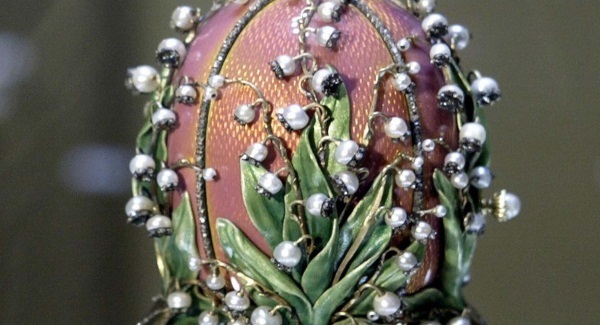
Russian oligarch, Viktor Vekselberg bought 15 eggs over the years and the Vekselberg Collection which includes 11 imperials including the much beloved ‘Lily of the Valley’ egg (1898), is on show to the public in the Fabergé Museum, Shuvalov Palace, St Petersburg.
Others are shown at Russian National Museum and the Fersman Mineralogical Museum at the Russian Academy of Science, during dedicated, arranged tours.
The Mineralogical Museum claim to hold the unfinished Constellation Egg intended for 1917.
Alexander Ivanov, a Russian billionaire is determined he holds a finished version of this egg — now on shown in the Fabergé Museum in Baden-Baden in West Germany.
Whichever is the later, the Constellation is really a globe of cobalt blue glass studded with diamonds set on clouds of billowing quartz.
It contains a clock never destined to tell the desperate Alexandra that her time was at hand.