Don’t be fooled by farmyard fowl

Harvesting the wheat and baking it into bread, she sought their help again, to no avail. When it came to eating the loaf, however, it was a different story. They all wanted a slice but the Little Red Hen let them go hungry.
Chaucer’s Chanticleer was seized by Reynard the fox. While being carried off, pursued by the other farm animals, the rooster persuaded his tormentor to turn and taunt them.
Foxy fell for the trick, opened his mouth and Chanticleer escaped. The authors of these old tales seemed to know that hens are not as stupid as they seem.
Zoologist Lori Marino, described as “an advocate for animal personhood” in National Geographic, worked for 18 years at Emory University, Atlanta.
Writing in the journal Animal Cognition, she claims that hens have abilities ‘similar to what we see in other animals regarded as highly intelligent’.
Their social interactions, she says, are complex and mysterious. These conclusions are based on ‘scientifically documented examples of complex emotional communicative and social behaviour in domestic chickens’.
Farmyard fowl, according to Dr Marino, are not only numerate they are able to rank food items in orders of importance.
Recently-hatched chicks seem to have a concept of object permanence; they know that if something is moved out of sight, it still exists. When chicks are shown two food items differing in size and then hidden suddenly, they remember which of the items was larger and try to find it.
Hens seem to have a sense of the passage of time. They can reason and “are capable of simple forms of transitive inference, a capability that humans develop at approximately the age of seven”.
Each bird has a distinct personality and can discriminate ‘among individuals, exhibiting Machiavellian-like social interactions and learning socially in a complex way that is similar to humans’.
Young chickens are quick to find their place in the pecking order. Hens “demonstrate self-control and self-assessment”.
Dr Marino thinks that “these capacities may indicate self-awareness”.
The birds communicate in complex ways which seem to “depend upon some level of self-awareness and the ability to take in the perspective of another animal”.
Stephen Budiansky’s 1999 book, The Covenant of the Wild: Why Animals Chose Domestication comes to mind.
Manuela Hoelterhoff, writing in The Wall Street Journal, described it as “a persuasive counterweight to the pastoral delusions of sentimentalists intent on seeing humans as malevolently at odds with the noble animal kingdom”.
Is Dr Marino a sentimentalist?
Only a minority of creatures can be domesticated successfully; those whose evolutionary traits make them capable of living with us. Mr Budiansky argued that farm animals are not victims of exploitation but creatures which benefit from allowing us to rule over them. Most domestic animals live longer, and happier, lives than their wild cousins.
Their young have far better survival prospects and death, at our hands, is quick and painless. The world’s most successful large animals, apart from humans, are livestock; about 1.5bn cows graze and chew the cud worldwide, there are around 1bn sheep and twice that many pigs.
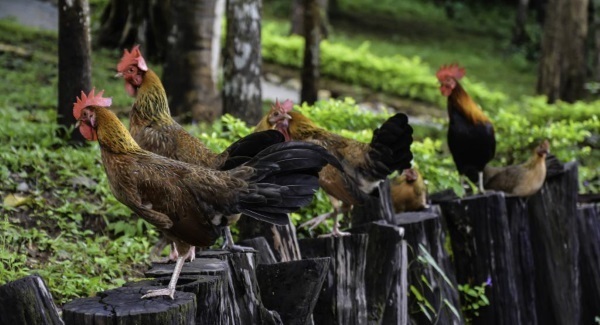
The red jungle fowl, a humble native of the Indus Valley, has become the most successful bird species of all time; estimates of chicken numbers worldwide run to 20bn; there are three for every person on the planet.
That chickens are complex social and adaptable creatures, as Dr Marino suggests, might help account for this obscure creature’s extraordinary success. Perhaps the Little Red Hen and Chanticleer were not entirely fictional characters after all.
- Lori Marino, Thinking Chickens: a Literature Review of Cognition, Emotion, and Behaviour in the Domestic Chicken, Animal Cognition, 2017.

CONNECT WITH US TODAY



Be the first to know the latest news and updates