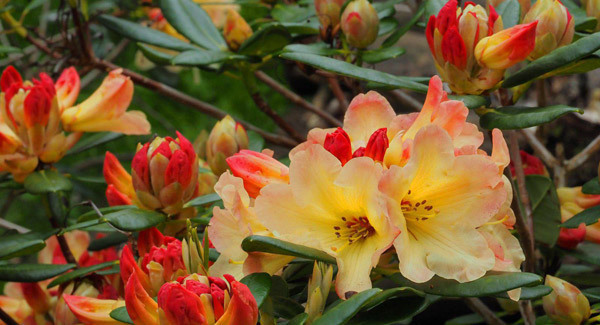
‘Nancy Evans’ is a wonderful Rhododendron for colour but she’s a bit untidy in growth
As if any reason were needed to love the spring, here’s one — its rhododendron time.
This outstanding genus of plants contains over a thousand species most of which will flower between late winter and early to mid-summer.

While the Healy-Raes in Co Kerry have recently called for the army to help with the problem of the invasive Rhododendron ponticum in Killarney National Park — and it is a huge problem in many other parts of the country — don’t let one unruly family member turn you against all its siblings and cousins.
This invasive, common rhododendron existed in Britain and Ireland before the last Ice Age though that cold snap did put paid to it here and the current problem, like most of our invasives, can be attributed to some specimens planted as ornamental plants, the fruits of plant-hunting expeditions probably from Spain and probably in the late 1700s.
The white, ‘egret’, pale pink ‘ginny gee’ and yellow, ‘shamrock’ are three varieties worth growing in any garden as they are among the lowest growing cultivars available with an overall height of less than 50cm — so small as to make them ideal candidates to grow in a pot or container forming lovely little evergreen hummocks which burst into colour each spring.
On the other end of the scale Rhododendron protistum var giganteum, found in the wild in parts of China will grow up to 30m.
Often seen in some of the great gardens of Ireland and the UK, Rhododendron arboretum is another large growing form, reaching 15m and more in time.
In the middle of those two extremes lies the majority of the rhododendrons which are further broken down into different groups like azaleas which are a group of rhododendrons which display similar characteristics, namely the fact that they have only five stamens per flower, unlike other rhododendrons which have 10 or more.
I don’t like to get bogged down on this level of botanical detail, I much prefer to appreciate the flower colour and shape of the plants and leave the technical details to the taxonomists.
To give an idea of how vast this genus is, there are over 10,000 cultivars and varieties of azalea and this is just one group within the genus.
Azaleas are among the showiest and beautiful of all the flowering shrubs and are further divided into sub groups, but namely deciduous and evergreen.
Every part of the plant is toxic and in times gone by they were so well known for their toxicity that to receive a bunch of cut flower azaleas in a black vase was a well- recognised death-threat.
I couldn’t possibly pick a favourite variety, how could anybody when faced with so many to choose from? However, one cultivar that I fell head over heels for when I first met her about 15 years ago, is Nancy Evans.
Growing to about 1.5m in height with a spread of about 1m when mature it is by no means a large shrub and what I love about her is her flower colour.
True rhododendron-type trumpet-shaped buds are produced in coral/pink/yellow and then open up into the most beautiful yellow/orange blooms.
Having being brought up around mostly pink, purple and red rhododendrons, like most of us in Ireland, the first time that I saw a yellow one which was in Mount Congreve when I was a child, and I remain in awe of them ever since.
Nancy Evans is among the best yellow forms but in a small and manageable size with the added beauty of the pink and amber hues.
In truth, her growth habit isn’t the nicest, she doesn’t keep a good bushy habit naturally, more a bit untidy and leggy if left to her own devices, but she does respond well to pruning after flowering.
Nearly all rhododendrons and azaleas like a slightly acidic soil and to that end I would recommend feeding with an ericaceous fertiliser during the growing season if necessary, particularly if there is any yellowing of the leaves.
However, I have found over the years that keeping the soil good and healthy with an annual mulch of seaweed during the winter is the best tonic of all for my rhododendrons, if not for all my plants.
Seaweed contains over 60 trace elements and works as an excellent soil conditioner balancing out any nutrient problems in the soil along with stimulating good, healthy growth.
There are many fertiliser products available which contain seaweed extract and most of these are excellent to use but why not take a trip to the nearest beach next winter, load up and simply mulch around your plants with this gift from nature.