Tasmanian Tiger in line of sight
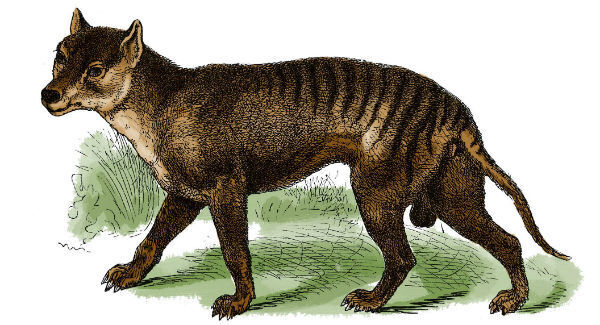
he National Museum’s Mammals of the World exhibit includes a dog-like creature from Australia known as the ‘thylacine’. It’s not a specimen of which the museum should be especially proud.
When curator Roberst Scharff attended a conference in Australia in 1914, he committed what would nowadays be considered an unforgivable wildlife offence. Dublin already had a skeleton of the critically-endangered mammal; a specimen ‘obtained’, ie shot, in 1884. Skulls, dating to 1889, were also in the collection but Scharff wanted to acquire a better example of this rapidly disappearing species. A hunter was asked to find and kill a thylacine, the skin and bones of which were shipped to Dublin for mounting.
The predator is better known as the Tasmanian ‘wolf’ or ‘tiger’ but, although it resembles them superficially, it’s not related to either species. Indeed, over 140m years have passed since it shared a common ancestor with the mammals of the ‘Old World’. All of Australia’s native furry creatures, apart from bats the egg-laying platypus and short-beaked echidna, are marsupials, the best known members of this ‘clade’, or ‘single branch on the tree of life’, being the kangaroos. ‘Roo’ females have pouches in which to carry their ‘joeys’. Thylacines go one better; the males also have a pouch, a scrotal sack which helps protect their genitals. ‘Thylakos’ is Greek for ‘pouch’.
The thylacine, it is thought, became extinct in mainland Australia over 2,000 years ago. It managed to survive in Tasmania until European settlers arrived and sheep-farmers put a bounty on its head. Persecution followed. By the late 1920s, the thylacine was on the brink of extinction. The last known one died in Hobart Zoo, Tasmania, on September 7, 1936. The species was formally declared extinct, after the mandatory absence of 50 years, in 1986.

But is it gone? Some Australians refuse to believe in this, almost mythical, creature’s demise. The Queensland night parrot, they point out, although not seen for 100 years, was rediscovered and photographed in 2013. They argue that the thylacine, another nocturnal and secretive species, could also have survived.
Sightings of dog-like wild animals, other than dingoes and foxes, are reported from time to time. Doubtful car-headlight glimpses, a few grainy photographs and 10 seconds of indistinct 8mm film footage, are not enough to convince scientists that thylacines are still out there.
Organisations devoted to proving the creature’s continued existence, are dismissed as animal equivalents of the Flat Earth Society. Some recent reports, however, are being taken more seriously.
An employee of the Queensland Park Service in the Cape York Peninsula has described a close encounter, in the dead of night, with four animals resembling thylacines.
A person, who camps regularly in forests in the area, has come up with a similar story from a different location. Details of the incidents are being kept secret lest unscrupulous hunters invade the forests. Interviews with the supposed witnesses have impressed scientists from James Cook University.
Cape York seems an unlikely place for the thylacine to have survived; the peninsula is about as far north of the island of Tasmania as you can get in mainland Australia. How could a relatively large animal have been there for thousands of years without some trace of its presence coming to light? Yet, Richard Dawkins, not a man to jump to hasty conclusions, seems intrigued by the possibility; ‘I want it to be true’ he tweeted.
Starting this month, James Cook scientists will set up 50 camera traps in the target area. Although they think it unlikely that thylacines will be photographed, it’s considered worth doing because the devices will produce a wealth of valuable data on the animals of the area.
- Leona McArdle. Thylacine: an extinct marsupial from Tasmania. National Museum of Ireland. www.museum.ie.