Vintage view: Egyptian-Revival style
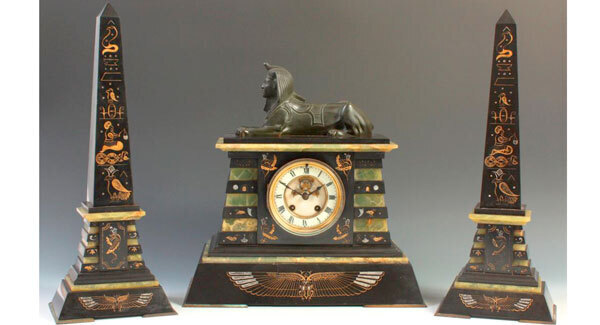
Why would a sphinx sit smug and smiling on the top of a 19th-century French clock flanked with obelisks? How did he ever climb up there?
Great antiques speak of their age.
Some even recall major political and military happenings. For a time, ancient Egypt lived again at royal courts, resplendent on city streets and staged in fashionable salons across the world.
Ladies recumbent in sheer Empire line drapes of silk, entertained like Cleopatra on couches styled as Nile river boats. Pharaohs and gods glared cold-eyed from the slender legs of dainty tables strapped in golden reeds.
Cabinetmaking in the late 18th century saw a rage for luxurious woods dressed up with metal mounts, brass stringing and gilding.
The Prince regent (1762-1830) in England was enthusiastic for the new, the exotic. In France, the restrained Empire Style was in full force by 1800.
It idealised the age and triumphs of Napoleon Bonaparte (1769-1821), elevating him in the symbolic trappings of Ancient Rome, his furrowed brow wreathed in laurels and set in tasteful surroundings suited to a Caesar.
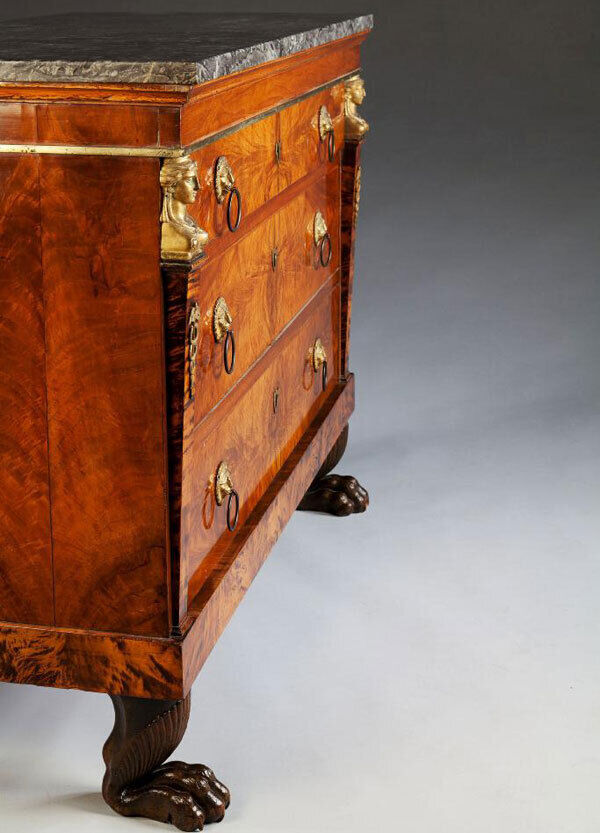
Neoclassical French ‘Directoire’ style ushered in graceful fashions and architecture.
In America this was termed Federal, and its influence on cabinetmaking lasted to the 1980s.
The elegant Karl Johan designs in Scandinavia have held right through to today in its purity of look and line. Stalin, never to be outdone had a muscular go at Stalin Empire style in the 30s.
You can wander around Paris and see dozens of examples of Roman, Greek and Egyptian architectural play from the early 1800s, including the Arc de Triomphe du Carrousel and the Foire du Caire (Fair of Cairo) circa 1798 set with massive Egyptian faces in Nemes headdresses.
Bonaparte is credited with the foundation of modern Egyptology, but that pompous claim has more to do with his surviving cult of personality.
Upright, well-researched, scholarly writings about the Egyptian old world had been available since the late 1600s, already drawing interest in garden features for example.
The Conolly Folly at Castletown House in Co Meath, was out of the ground by 1740 and the Killiney Hill obelisk by 1742.
The great little man does, however, hold a firm place in the wider Egyptian Revival in design and decoration, stirred by his campaigning through north Africa at the turn of the 18th century.
Reflections of the wonders of ancient civilisations would be littered back through France and England, cultural hostages after Napoleon’s audacious (briefly enjoyed), triumphs in north Africa, his daring grab at Malta, and efforts to gain a foothold in the Middle East with his Armée d’Orient from 1798-1801.
Enigmatic, beautiful and remarkable in its sophistication, Egypt’s sensuous surroundings studded with fabulous super-scale antiquities were a spectacle to European eyes.
No-one had yet cracked the puzzle of reading hieroglyphs when Napoleon arrived with 400 ships on July 1, 1798.
Mercurial and curious, he instantly sensed the ego-puffing glamour of the size and overblown style of Egyptian classical statuary and artefacts, the hints these characters and motifs would offer at education, and his place in the ranks of the earth-bound gods.
A genius in political marketing, he also understood as the Romans had, that assimilation was key to peaceful political campaigning in far-flung corners of his new empire.
Ensconced in Cairo, Napoleon appointed himself ‘master’ of the country, and set up an extensive bureaucracy to fuse French and Egyptian history, arts and sciences, deploying 167 ‘savants’ (scholars) he had brought with him to disseminate and gather knowledge.
This was a cunning hearts and minds offensive to win local support and foster glory at home. He even introduced the printing press, attempting, somewhat clumsily, Arabic proclamations about French daring-do and progress.
The splendour of the temples and tombs of Luxor, Dendera, the Valley of the Kings, and the island of Philae, was meticulously recorded and interpreted by his new Egyptian Institute. The Rosetta Stone would prove the key to unravelling hieroglyphics.
The Egyptian Revival that we see in furniture, architecture and decoration through the 1800s, outlived the emperor, and started with the publication of Le Description de l’Égypte (The Description of Egypt) by his Egyptian Institute.
There were a stunning series of 23 illustrated volumes with magnificent engravings and maps, rich with natural and human histories published from 1809-1828.
The proud formality of the pyramids, obelisks, and the beauty of the iconography and artefacts already found during early excavations, was interpreted for decades to follow.
They were seen in public buildings, monuments (including the Washington Monument in the US c1885), in magical Masonic symbolism and gravestones, and in the design of clothing, interior decor, silver and ceramic.
Where you do find bare- bosomed sphinxes or winged paws holding up the arms or legs of table or sofa in a country auction, expect them to be Victorian or even 1930s-80s fantasies for the London to Miami market.
English, French and the Italian makers provided armchair travel in a historical stew of styles.
The original revival plumed in the early to mid 19th century in France and England, sparked a pseudo-Egyptian revival in the 1870s in American furniture-making, and was referenced in Art Deco jewellery during the great discoveries in the Valley of the Kings in the 1920s.
It flared briefly in fashion and make-up the 1960s, following the release of the Taylor and Burton turkey, Cleopatra, the Oscar-winning set decoration flashing with gold and ebonised wood.
Look out at boot sales for inspired costume jewellery, crawling with scarabs, pointy hounds and wings of Horus, recalling their fascinating aesthetic timeline, millennia in the making.
CONNECT WITH US TODAY



Be the first to know the latest news and updates