Autumn is the season of mists, mellow fruitfulness and preserves
Autumn, if you have your eyes open, is the most giving season of them all.
Going for a walk will show you so many free foods, nuts and berries, pears and apples and more.
If youâre one of the many people who might have great intentions but no idea where to start when it comes to making things to eat from natureâs bounty all round us, then a good book is what you need, to point you in the right direction.
Green Aproness and queen of preserve making Theresa Storey often has people turning up at her home, laden with apples that they just donât know what to do with.

âThey say they canât make another apple tart, but there are so many more things that you can do with apples than just tartsâ.
Having made her life turning harvests into delicious jams, cakes and pies, Storey is adept and always at the ready with her preserving pan.
Personally I like to throw some chopped, sweet apples into a jar and cover it with brandy and a cup of sugar and a cinnamon stick and put it in a dark cupboard for a few months and then surprise myself with something amazing to drink when I think I havenât got anything.
Otherwise I lob some grated apples into porridge, or dose grated apples with a little soaked oatmeal and yogurt for a bircher muesli. Apples are native to Ireland and should be devoured when they are in season, which is now.
Save your money and donât buy sprayed, imported, horrible apples that have been shipped half way around the world. Thatâs like importing carrots to Ireland â it just makes no sense.
Fruit on the Table by Theresa is a book that I worked on too, I did all the photos and enjoyed many days with Ms Storey while she toiled and bubbled her delicious concoctions.
Sugar avoiders may balk, but remember that sugar is the best preservative there is, and jam keeps itâs vitamin C so the good outweighs the âbadâ.
Apple jelly
I start making apple jelly as soon as the first unripe apples fall from the trees in August. The eating varieties are still green and sour and have plenty of acid and pectin.
As the season progresses, the eating apples ripen and get sweeter, so I mix them with cooking varieties, which are still sour.
You cannot make a good apple jelly from sweet eating apples only; the jelly wonât set properly. Always add sour apples to the pot â a maximum of 1 part eating to 3 part cookers.
At the end of the season, the cooking apples start to mature and soften and sweeten slightly so I donât add any eaters at all.
I also make a lot of crab-apple jelly from both wild and cultivated crabs. When making crab-apple jelly, I mix cooking apples with the crab apples 50/50 as I find pure crab-apple jelly too tongue-furringly sour for my taste. Makes 4.5 kg (10 lb).
3.5â4.5 kg (8â10 lb) washed apples (whatever fits in your pot)
Water
Sugar
Roughly chop the unpeeled and uncored apples and place them in a large preserving pan.
Add enough cold water to just cover them. (Push the apples down with your hand to judge how much is needed.)
Cook on a medium to high heat for about 45 minutes until the flesh has gone to pulp and the skin has started to disintegrate. The apples will start to swell up as they cook and will try to escape the pot so watch them and keep pushing them back down.
Put the apple pulp in a clean rinsed jelly bag and leave to drain above a large bowl for at least an hour if not overnight. The longer you drain, the more juice you get, but I find that most of it is out within an hour.
Measure the juice. This amount of apples usually produces around 3.4 l (6 pints). Pour into a clean preserving pan with 450 g (1 lb) of sugar for every 600 ml (1 pint) of juice. The juice will be cloudy, but adding the sugar and heating will clear it.
Cook up the jelly on a high heat. It may take anything from 20â40 minutes until it reaches setting point (see p. 192).
Pour into warm sterilised jars to within 6 mm (Œ inch) of the top, lid and seal.
Make a few different flavours from a single batch. Add five cloves, a large pinch of cinnamon or a quarter teaspoon of dry rosemary, mint or chilli to each 225 g or 8-ounce jar.
This is basically a smooth, stiff fruit jam. Spread it on hot buttered toast or scones, add to porridge, or eat with meats (especially pork) and cheeses. You can also use it as a delicious bottom layer in tarts or as a filling for cakes. Makes about 1.6 kg (3œ lb).
900 g (2 lb) cooking apples
300 ml (œ pint) water
Sugar
Œ tsp cinnamon
Chop the apples (skin, seeds, stems and all) and put in a preserving pan with the water. Cook over a medium heat until pulpy. Put the cooked pulp through a mouli to remove seeds and stems. This will produce a thick purée.
Weigh the purée and put it in a preserving pan. For every 450 g (1 lb) of purée, add 450 g (1 lb) of sugar.
Add the cinnamon and cook over a medium to high heat, stirring constantly (it will try to stick to the bottom of the pot) until it reaches setting point. It gets very thick and blurps all over the stove as it approaches this point so cover your arms and wear an oven mitt.
Pour into warm sterilised jars to within 6 mm (Œ inch) of the top, lid and seal.
Try other spices such as cloves, allspice or nutmeg. Add lemon juice if the flavour needs to be sharpened.
I sometimes add alcohol, such as apple schnapps. Add 1â2 tablespoons of alcohol for 450 g (1 lb) of fruit purĂ©e.
I add it after the butter has reached setting point and just before I pour it into the jars.
Fruit butter is another great way to use up the leftover pulp from your jelly bag. Just purĂ©e the pulp, sieve it, weigh it, add sugar and cook it up. (Donât use pulp containing rosehips.)
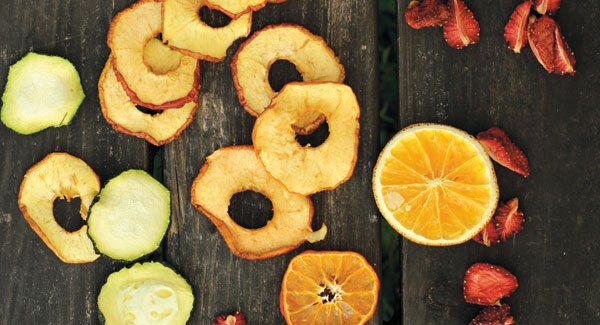
Drying not only preserves fruit, it also intensifies the sweetness and flavour.
Iâve dried oranges, nectarines, peaches, apples, tomatoes, raspberries, strawberries, blackcurrants, blackberries, courgettes, grapes and plums.
I particularly love to dry grapes for raisins and plums for prunes to use in my baking. Throughout the harvest season, the kitchen always smells of warm, sweet fruitiness.
Fruit is usually dried between 45°C (115°F) and 60°C (140°F). To use a regular oven, turn it to its lowest setting. If you have a range cooker, use the warming oven, provided its temperature is under 50°C (120°F), or leave the fruit on a rack on top of the range.
I core apples and slice them into rings, and I wedge nectarines, plums and peaches. Cinnamon is a must on apple slices.
Put a wire rack on a baking tray and a piece of parchment paper on top of that.
Lay the prepared fruit on the parchment, skin side down, and put the whole lot into the oven.
The rack allows the air to circulate underneath the fruit and speeds the drying process.
Apple rings can take up to 14 hours , strawberries anything up to 15, and courgettes can be ready in as little as 4 hours.
The temperature and humidity in the drying area also affect drying time, so donât worry if itâs taking longer than you thought.
Dry the fruit until it has become leathery, almost crisp. If you think itâs ready, pop some into a transparent plastic bag and see if condensation appears within a few minutes.
If no condensation appears, then it is dry. Otherwise, dry it for longer.
Leave to cool for at least an hour and then pack into airtight containers. Your fruit should keep for at least 6 months.