Be inspired by this award-winning Galway home
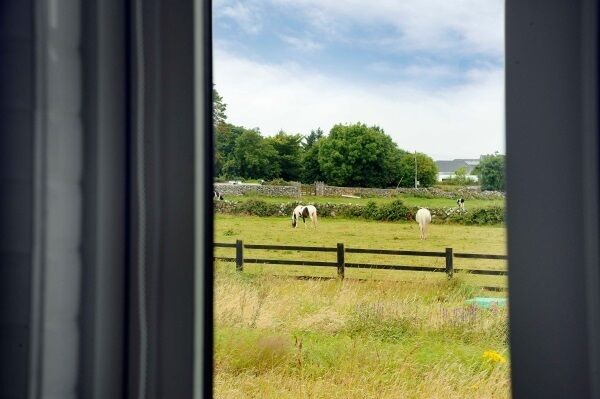
In late summer, the rough boulder walls of Galway are alive with undergrowth. Meadowsweet runs wild from the hedgerows across rough paddocks and the pink tassels of Rosebay Willow herb waft in a soft breeze. Bumping along a boreen dotted with rusting sheds and past cattle pulling lazily from rushy fields, you come across a striking scene. A low form in white sits behind a rendered rath, with monumental chimneys in concrete rising to pierce low skies.
This is the townland of Legaun and this is the house that Mary built. Born and raised here, but with a lifetime spent teaching amongst her late husband’s people in Wexford, Mary Enright knew she wanted a retreat, a home that would fit modestly into the landscape, and one that would be warm, comfortable, and beautiful. A place to be truly at home.
Enter Chicago-raised architect Ryan Kennihan. Despite the surname, he’s American to the bone and has brought the gifts of the premier city of architecture to the soft landscape of Co Galway. Maybe it’s because he sees the vernacular through the eyes of a stranger, and maybe he’s informed by the monolithic structures of his birthplace, but in this Moycullen house he’s created a version of the Irish homestead that’s quite extraordinary.
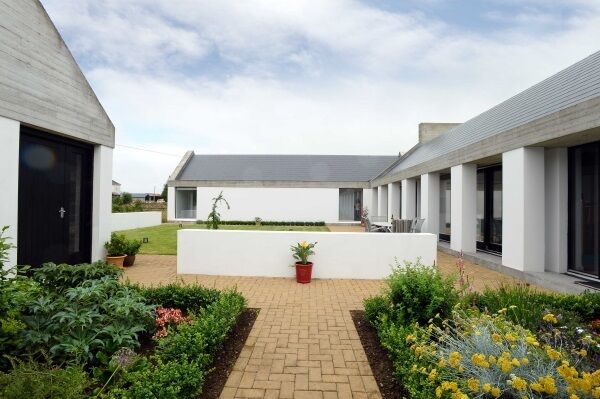
Everything about our normal perceptions of what a house is — the entrance is up the middle, the door is to the front — is turned upside down here. And that’s before you even approach. Yes, there’s a driveway up the middle, but it ends at a small turning near the ‘rath’ wall. The visitor has to get out of the car and approach on foot through an open arch to the central courtyard, where a low hip wall acts as another defensive response to guide the way to the entrance.
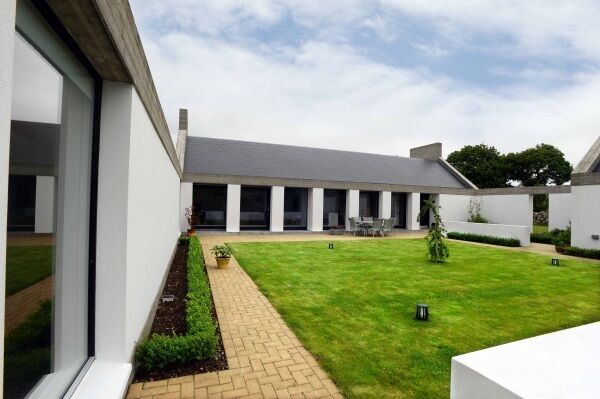
Perhaps defensive is the wrong use of word here — maybe unveiling is more appropriate, because you approach the house in stages: The main drive; the arch, and then the guided walk to the front door. It’s reminiscent of old castles and walled cities, if that’s not a stretch too far. An unfolding of the many considered elements that make up this house.
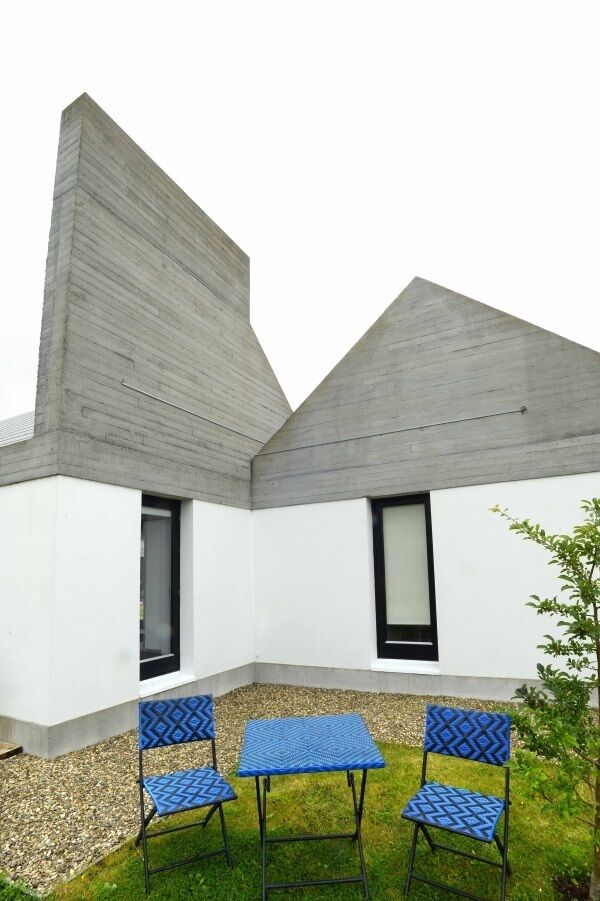
Take that further and you see the stacked, massive chimney breast as a defiant piece of castellation, a declaration of the fortitude of the build and of the sanctuary afforded within. All very high-falutin‘ but this house does sit within a defensive wall — it’s built in three parts around a central, south-facing courtyard; once inside, the space is utterly private and contained. Monastic, even.
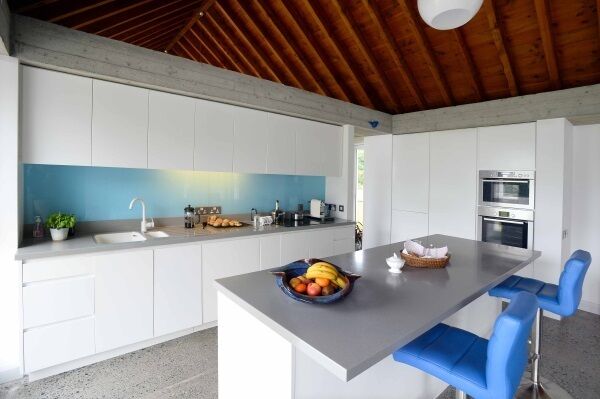
The simplicity of the build materials belies the clever engineering and architectural elegance of construction. It’s a concrete block house with a regular, slate roof, but add a ring beam of shuttering, those huge chimneys, hide all gutters and downpipes, and add a row of collonades to support the roof, while creating Georgian symmetry and you have a deft and impressive dwelling.
Often, when the architect has taken his blueprint to completion and the house is handed over to the client, the design can slip into no-man’s land, where the ambitions of the designer are unmet by the client, or where the client’s ambitions overshoot the aesthetic reticence of the architect. It’s an age-old story. In Legaun, however, there’s a happy and lasting conjunction of visions.
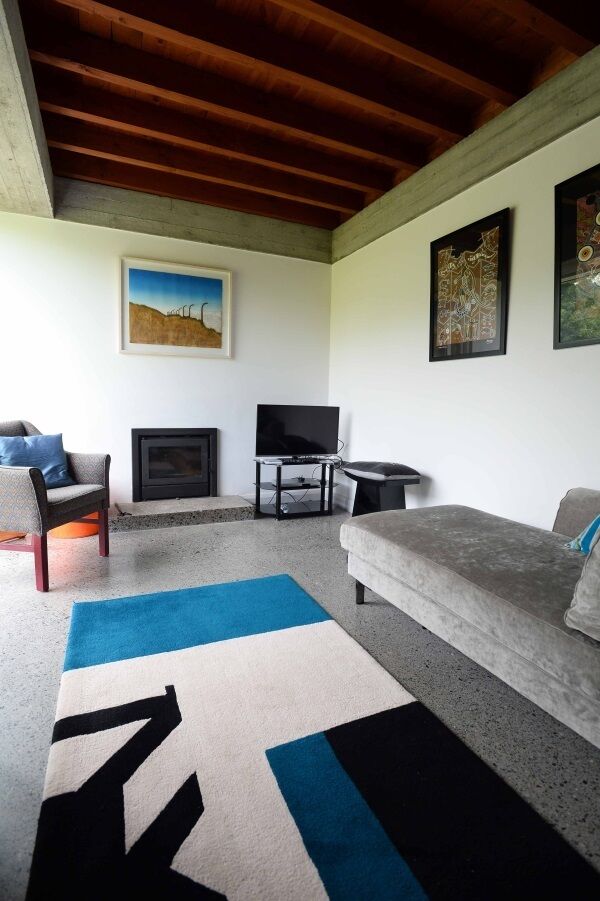
The modesty and clean lines of the build are reflected in the modestly curated collection of furnishings and fittings of the client. The whole house works, inside and out.
Mary wanted a building that connected to the environment and one that suited her needs, but also reflected the local architecture — the farmhouses and farm buildings. Ryan took the nearby yard as a starting point, in particular the rough and ready concrete ring beams poured on old stout walls to keep the pressure of the roof from pushing the structures outward.
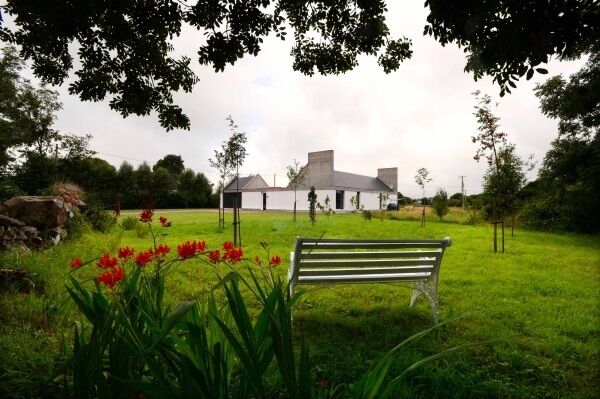
Then there was the style of the buildings, built in twos and threes around a central courtyard, offering security for animals and wind resistance in winter.
So the client and architect settled for a simple construction that allowed for three volumes sheltering a south-facing courtyard and referencing the rough concrete of the old sheds in a characterful way — a building that Ryan says would be ‘comfortable’ in its surroundings.
Those three volumes now comprise the main living room block, bedroom block to the west, and the garage block behind the enclosing ‘rath’ wall.
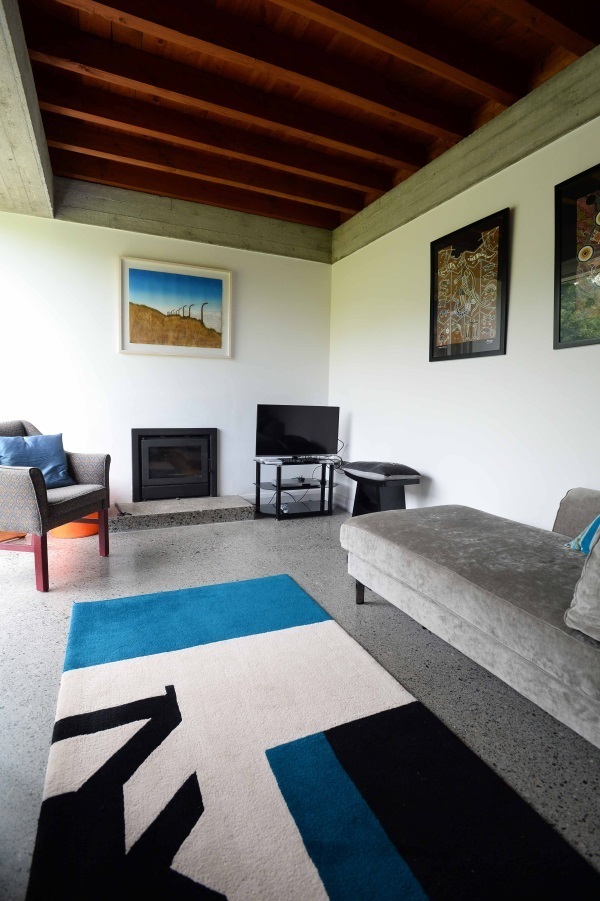
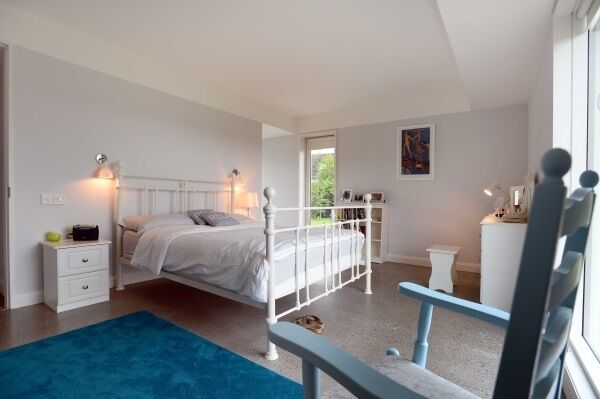
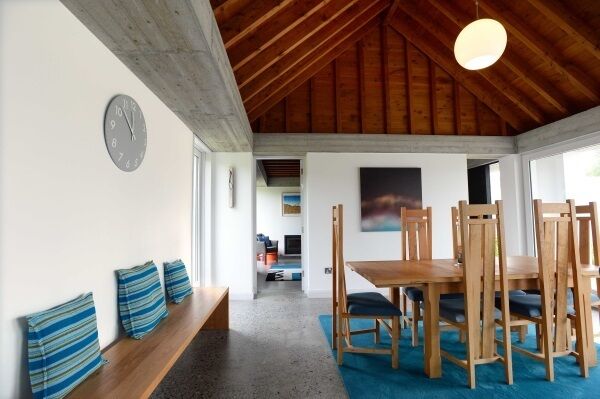
Inside, the single storey dwelling was opened to the rafters, and Mary’s brother, Patrick Davoran, who was the builder, oversaw the sourcing, milling and hand-crafting of the Douglas Fir roof. In this too, Kinnehan inverted the normal approach, exposing the rafters and putting rigid insulation above the sheathing and under the membrane, before tiling on top. The house is heavily insulated and comes with underfloor heating and a glorious, concrete floor seeded with local stone and polished to reflect the soft grey of the boulder walls outside.
The final flourish is the ring beam of concrete which runs internally too, letting the structure of the house show in an earthy, holistic way.
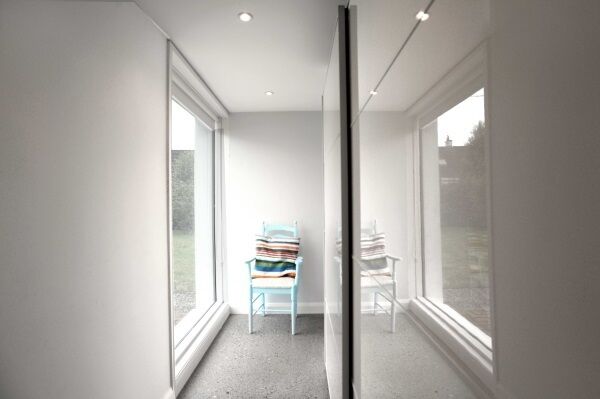
The fittings are simple slotted in with enclosures defining the respective areas — dividing walls do not rise to the roof and openings don’t close, rather there’s a sense openness from floor to ceiling and gable to gable.
Ryan says he’d love to do more average-priced houses in the city and the country: “This was not a big budget house. It’s a fairly standard cost for a standard house, but Mary got something fairly spectacular for the same value as a regular house on a regular street.
“For instance, you could give €250k to a builder and most will go into the build, but put €220k to the building and I could do something spectacular with that.
“This house proves that. Mary’s a teacher — she’s not an art dealer or an architectural connoisseur. Architecture is not just for the banker and the lawyers. Good houses are for everyone.
“The real challenge is to do something with the budget — making a lovely thing but in a standard way.
“Good houses are accessible, it’s just down to how you want to spend the money, and if you choose the right architect you do get more for that money.”
Client and designer speak highly of each other; now that the house has settled in and is nigh-on four years old, (it won an AAI award in 2014 — one of only five buildings in the country), that’s a true test. The only push and pull is around allowing the wild growth of the untended ground running up to the house. Ryan likes the wildness, Mary is in two minds, so there’s a lawn in the enclosed courtyard and the perimeter is mostly wild. Compromise.
And the years have been kind too to the concrete of the chimney stacks, maybe it’s the pure air of the west, but the clear, bleached grey remains, a testament to design without compromise.
www.rwka.com
CONNECT WITH US TODAY



Be the first to know the latest news and updates