All hail the sunflower
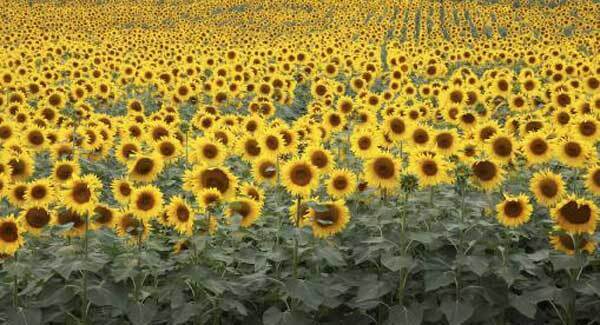
It’s time to plant some Helianthus annuus and hope the weather patterns take the hint, writes Fiann Ó Nualláin.
All hail the sunflower

With all the hail and snow and bitter cold lately I think it is time for a little sympathetic magic or at least some wishful thinking.

For the sake our battered crops and numb fingers I think it’s time to plant some sunflowers (Helianthus annuus) and hope the weather patterns take the hint.

I mean if Oscar Wilde could use it to civilize the Wild West surely we can tame or at least tempt the skies.

It’s all in the nomenclature — helios being the Greek word for sun, and anthos being the Greek word for flower and certainly sunflowers are emblematic of the sun— those petals like the rays of the very object we desire now that summer is allegedly here.

Planting some will stake our claim and then later on we can claim some healthy rewards.

But before we get to that, it is heartbreak time.

I love origin myths –— those fabulous fictions that explain away the world.

The origin myth for sunflowers even explains why the flower moves its head to always face the sun.

It is often said that Roman and Greek mythology have a shared history.

Really the Romans nicked the Greek stuff and changed the names and locations to suit themselves.

So there are versions of this tale.

But the essence is this: Helios, the god of the sun had a palace in the east and each day he would make a journey west, traveling in his chariot of gold and ivory across the skies.

His golden locks flowing, his whatever bulging.

Let’s just say Helios was the Hollywood type but the sort that doesn’t need airbrushing and naturally all the nymphs desired him.

His journey took all day and then in the evening, when his expedition ended at the far sea on the western end of the world he would shake up the commute and take a golden boat home.

Flash geezer.

Anyway, of all the infatuated nymphs, Clytie was the one most deeply in love with him.

She spent her days watching his track from east to west, her head and unblinking eyes keeping him in sight every second. Yeah, big time stalker sort.

Now Helios, aka Apollo, had a bit of thing for the ladies and the lads and had many affairs but he never noticed (or at least didn’t let on ) Clytie.

The pain in her heart grew inconsolable and she petitioned the gods for help.

The gods who had a penchant for turning women into flowers (Daphne, Leucothoe, Acantha, et al ) didn’t spend much think time on it and simply turned her into a flower too.

As a flower she continued to follow Helios and move her head westward as the day progressed — what botanists call heliotropism.

This follower of the sun became known as the sunflower.

Sad.

But also, if ever the phrase “get over it“ was pertinent, this is a perfect illustration of why the lovelorn should move on.

Lately we are all looking for helios’ attention, so that story has been on my mind but this traditionally is also the time to plant sunflowers, any way.

In recent years they’ve be rebranded as a kid’s gardening plant.

And they are brilliant to have a who-can-grow-the-tallest-one competition with all the grandkids, clan or class — a real fun intro to horticulture, but don’t think that they are beyond adults.

Certainly edible gardeners should have them in the garden or allotment.

The edible buds have a bit of a Jerusalem artichoke flavour, while the nutty petals are great to throw a bit of sunshine into a summer salad, then of course, the superfood seeds are delicious and also edible to birdlife.

I normally grow some dwarf varieties but I’m thinking of a monster or two for this year.

The seeds are a particular health boon, being antioxidant, anti-Inflammatory and nutritious.

The healthy aspect is mostly due to the Vitamin E content.

That’s a must have if diabetic, menopausal, PMS-ed, asthmatic, arthritic, waning in the bedroom or weary of looking in the mirror. Not so sure about unrequited love or stalker stress.

Vitamin E as a supplement is popular to prevent free radicals from oxidizing cholesterol and hardening your arteries but long term use is not advised.

However, the E in sunflower seeds is not only safer long term, but it is matched with phytosterols that also lower cholesterol as well as fiber to tone the blood vessels and tune up general health.

It is always better to get what you might lack from food rather than supplement because the food offers extra phytochemicals and minerals and extra benefits.

The big one in this case is that sunflower seeds have good quantities of selenium — essential for DNA repair, so if you are a gardener weather-beaten in autumn and winter (and thanks to climate change, spring and half of summer too).

And if you get sunburnt to bits in the bit of summer we do get, then harvesting some sunflower seed to eat raw or lightly toast in a pan is great addition to your diet to protect your skin.

But selenium also induces apoptosis (the self-destruct process) in abnormal cells and so makes sunflower seeds a nice cancer-protective snack.

Plus they are damn tasty.

If you think you don’t need the health boost, grow them for a trail mix or to make into bread.

Or grow them to fill your bird feeders or to be living birdfeeders after flowering when that big orb becomes a storehouse of seed for our feathered friends.

So how do you grow. Well, there are some rules and some tricks.

They prefer to be in a location that gets six to eight hours of direct sunlight daily.

Excellent in a deep container (they have a long tap root) or direct in the ground — just make the root zone free draining with some horticultural grit or a few scoops of pea pebbles.

They do like a nutritious soil so amend with some rich compost or well-rotted farmyard manure.

They love a bit of comfrey feed over their growing season.

The trick to getting skyscrapers is to start them early and to sew the seed direct into the ground under a cloche (seedlings are prone to frost damage) or if it is artic where you are, then on a window sill or polytunnel but into loo rolls or other biodegradable mechanism to not disturb the tap root once you plant out after germination and a a bit of a growth spurt.

If direct sowing, the rule of three (one for the worm, one for the fairy and one for me), is fine but you will be thinning back to a single stem — I do mine about a hand span apart and still I would thin out later to a good stride between each prospective high-rise plant.

Those really competitive types will sink a skinny waven tube or other bit of hollow pipe about one meter down to sub irrigate and strengthen the root system which if super-strong, cannot just withstand wind and rock, but is the foundation for the epic plant you hope to grow.

You can stake or use tie-in supports. But I love a bit of hort trickery.

They are many varieties in various heights to suit you and in a whole array of colour tones to match, or complement your existing coloured palette.

I love the red ones — they have a charm. If you are after the seed then you will have to net the heads once the petals start to fall in late summer to keep the birds at bay — but also to catch any early shedding seed.

You can cut and dry indoors but best flavour comes if you let the seeds ripen to black on the stalk head. Then its Vive la France — decapitate. Allow to dry indoors a bit more, overnight (or longer if cases are not firm enough as store-bought expectancy) .

You can pry out the seeds with your fingers or a spoon and once washed they are good to eat raw.

Most permaculturalists soak them over night in salty water (plumps up the seed a little) before oven roasting for longer term storage — I like them roasted on a skillet too. Some raw seed can be stored in an envelope to start the whole process off again next year.

x

More in this section

Revoiced

Newsletter

Sign up to the best reads of the week from irishexaminer.com selected just for you.

Cookie Policy Privacy Policy Brand Safety FAQ Help Contact Us Terms and Conditions

© Examiner Echo Group Limited