Look out for fungal leaf infection on winter favourite Mahonia
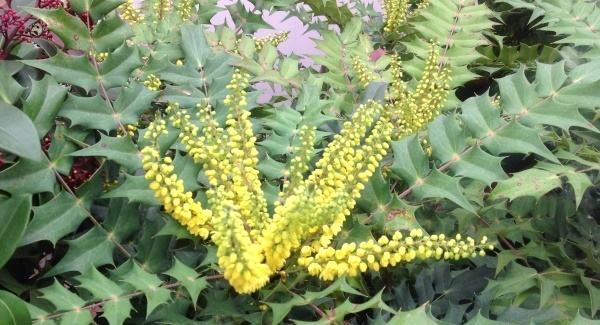
It’s hard to imagine the winter months in our gardens without the striking yellow blooms of Mahonia ‘Charity’ or Mahonia ‘Winter Sun’.
Long racemes of golden flowers produced over evergreen spiky foliage, catch the rays of the low winter sun and reflect the light like a beacon in the winter garden.
The shiny green leaves which protect the plant from losing too much water through transpiration, means that they will tolerate windy, even coastal gardens.
It can even be grown as a hedge to act as a windbreak if desired.
Mahonia x meida ‘Charity’ is probably one of the finest forms of all for flowering.
Growing to over 3 metres in height and over 2 metres wide it certainly creates presence in any winter garden.
Native to Asia, the Himalayas, and Central America, Mahonias are more than happy with our climate coping with any extremes in hot or cold temperatures.
What they tend not to like however, is the excessive rainfall levels that we experience.
The same glossy foliage that makes Mahonias a good choice for windy gardens, also protects the leaves from aphid damage.
However, I have found over the years that it can be nearly impossible to grow one without the plant suffering from some type of fungal leaf infection, such as fungal rust, mildew or leaf spot.
Leaves will often become discoloured with red and orange fungal spores beneath, and brown and black rings and markings on the upperside of the leaves.
Soon parts of the plant will die off and other fungi will colonise this dead wood. Orange-coloured toadstools will be visible around the base of the plant.
These infections are due to soil being too wet — particularly during winter — not something which is going to change in this part of the world. If anything, we are seein wetter conditions during the winter months of late.
Unfortunately, these fungal infections make the plant very unsightly for me, so it is not a plant that warrants a place in a garden for aesthetic reasons alone.
It can become unkempt looking if not pruned properly throughout its life and this mixed with unsightly infected leaves, bring little of note to the ornamental garden.
However the long racemes of scented yellow flowers which are produced from terminal bulbs will later turn into bluish black berries some of which are edible.
Which ones are safe to eat depends on the species of Mahonia, however, but all are loved by the birds and so from the point of view of helping local biodiversity, this is a great plant to have in the garden.
he spiny foliage, too, provides a very safe refuge for nesting birds.
The berries of Mahonia aquifolium, which is a low growing vigorous spreading form, are referred to as Oregon Holly Grape and often used in pies, jams and drinks as they are rich in vitamin C, if a bit tart to the taste.
Mahonia aquifolium. ‘Apollo’ is the variety worth growing for ground cover as the foliage changes to lovely reds and mahogany colours during the autumn and winter months.
The flowers produced are more like clusters or bunches than racemes, and the bright yellow colour contrasts so vividly with the red of the winter foliage, as to make a dramatic show during the dull winter months.
Do beware however, as this ground cover form can outgrow its welcome and doesn’t always know quite where to stop, colonising any area of bare earth that is nearby.
Ideal if you have a difficult bank or area that needs cover, but not so wonderful if you plant it amongst other weaker specimens.
One of the parents of ‘Charity’ is Mahonia lomariifolia or the Chinese Hollygrape. A much bigger beast than any of the others — growing as high as 9m in height with flowers up to 30cm long and often produced in clusters containing up to 30 racemes.
The leaves too are longer than those species that we would be more used to — containing as many as 40 leaflets on each stem which can be 60-70cm long.
M lomarifolia is eyecatching in its size and the fact that it’s so different to other species and varieties — but is rarely available in this part of the world. Certainly, it’s one worth keeping an eye out for, if rare and unusual plants are your thing.
And at the other extreme, the smallest Mahonia that I know of, is the relatively recent introduction, ‘Soft Caress’.
I have been growing this for three years now and it is truly dwarf. Grow it in a simple black coloured pot where the fernlike foliage gives a soft, nearly tropical feel.
Staying very low and flowering earlier than most others, during the months of August and September, I have so far not encountered any problems, fungal or otherwise with ‘Soft Caress’, very possibly because I’ve put it in a pot where excess water is free to drain away.
CONNECT WITH US TODAY



Be the first to know the latest news and updates