Vintage View: Maureen O’Hara and John Ford’s fictional Inisfree
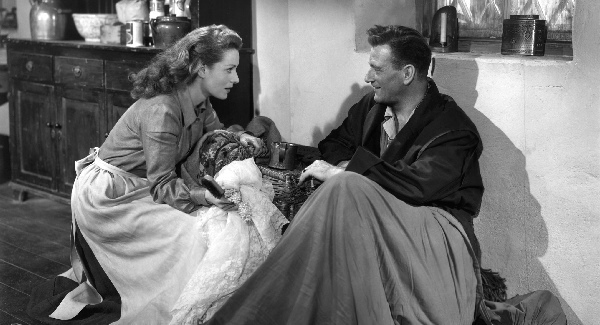
This year one of the last great stars of the Golden Age of Hollywood, Maureen O’Hara (Fitzsimons) passed away at the age of 95.
A transcendent Irish beauty to the end, she made over 60 matinee crowd-pleasers over 40 years alongside legends of stage and screen. These included Charles Laughton (an early and unexpected champion of her career), Tyrone Power; Rex Harrison and Douglas Fairbanks Jnr.
Her magnificent red hair and flawless profile glowed in the new richness of Technicolor, and whatever the role (and she had some challenges), her performances were generally critiqued as solid, and more often as very, very good. Her signature passionate outing for many who remembered O’Hara on her passing, is as Mary Kate Danaher in John Ford’s hymn of praise to the West of Ireland — The Quiet Man (1952). The film was one of five she made with Ford, who directed O’Hara in the equally worthy How Green Was My Valley, in 1941.
And her testy, Irish spinster-of-the-parish, remains heart stirring, hilarious and downright sexy some 63 years on. O’Hara’s effortless chemistry with friend and co-star John Wayne whip-cracks off the screen, from his first sight of her frolicking barefoot down a velvet Connemara hillside with her shampooed flock.
“Was that real?”Wayne as his character, Thornton asks, cheerfully computing her bold expression and fabulous figure. The last suggestive skip towards John Thornton’s fictional home of White O’Morn, wraps up a story still vivid with tenderness, joy and acid one-liners, despite, and perhaps due in part to the impossibly John Hinde quaintness of the scenery and Ford’s paddy-whack clichés of character.
O’Hara was ravishing in the movie and off-screen and was famously referred to by Wayne as ‘a great guy’. She was nobody’s fool when it came to the business of film and surviving as a woman in the octopus-infested offices of its directors’ and producers.
In the 2012 documentary “John Ford: Dreaming the Quiet Man”, (Sé Merry Doyle), Maureen O’Hara said: “I don’t know of any other films that were ever made that were all in love with the one thing — Ireland. It was a love affair.” It was an Ireland Ford wished to be true, and O’Hara was his vision of ideal Irish womanhood, a regard he gave her right through the 1950s, yearning for her personal attention.
For her he was “the meanest and the best — I would rather work with the old bastard, than not,” she reflected. Now that O’Hara has passed away, a sentimental journey to recall her in Quiet Man country is a must.
So what of Inisfree? The film was shot in swathes of gorgeous country between counties Galway and Mayo enfolded by the Maumturk Mountains. Ford stayed in style with Lord Killannin, and together they perused many of the locations made iconic in The Quiet Man.
The train station of Castletown, where Thornton arrives and first meets Michaeleen Oge Flynn (Barry Fitzgerald) is actually Ballyglunin, six miles south of Tuam. According to an RTÉ documentary of 1991, the waiting room at Ballyglunin was used to record the song’s The Wild Colonial Boy and several other hearty choruses used in the picture.
The bridge where John first sees his ancestral home is Leam Bridge near Oughterard (you cannot see White O’Morn from this spot). Take the Sky Road West, out of the town for about 3km, and look left for signposts. The public house in Maam (central to the story and most famously for the gentlemens’ knock-about between Thornton and the blustering brother-in-law Danaher (Victor McLaglen) is still called Pat Cohan.
It was originally a shop and the owner, a Mr Murphy was paid £600 old Irish Pounds for external photography only, and the erection of the signage. Pat Cohan is now a thriving Teach Bia owned by Sharon McGrath and her husband Ray Kenny, serving food throughout the year. White O’Morn itself, the centre of the story, is a couple of kilometres away from the village. Designated a protected structure by Galway County Council and with limited access, little remains of the Feeny homestead (connected by chance to John Ford’s emigrant family), as it has been heavily picked over by visitors.
The cottage and footbridge over the Failmore River is owned by Canadian Greg Ebbit, who is currently being prompted by at least two populist campaigns, including the White O’Morn Cottage Foundation, to allow for its stabilising and restoration.
The village of Cong between Lough Mask and Lough Corrib is Quiet Man central, for tourists from home and abroad. The undulating fields around Cong were used to stage the legendary cave man-style dragging of Mary Kate by John Thornton and the final fight scene between the two men sparring for her fortune and attentions. There are tours year-round featuring extant buildings from the film, such as ‘the Dying Man’s House’.
The area around Ashford Castle used in the filming includes the castellated bridge, and is the land seen in the first sighting of Mary-Kate. Red Will Danaher’s house is also on the castle grounds and changed little except for the addition of a front porch. Back in Cong, The Quiet Man Museum has replicated the White O’Morn’s parlour down to the last detail (the actual interior was a Hollywood set), and memorabilia show what it was like for the locals when the town was invaded by the Hollywood machine in 1951.
As for the glorious Maureen — she came and was welcomed with rapture to the 60th anniversary of the film marked by a Festival in Cong in 2012. Surely she’s gone to somewhere that’s at least “another name for Heaven.”
CONNECT WITH US TODAY



Be the first to know the latest news and updates