We depend on bees to make flowers fruit and plants thrive
This profusion of colour is not only a wonder to behold, but to the honeybee it is a paradise — supplying the bees with early sources of nectar for honey and wax production.
The fields of white that one sees, particularly throughout Tipperary, Cork and Wexford, are the apple orchards in majestic bloom. Without the help of bees and other insects these flowers would wither and drop and no fruit would set.
For a flower to become an apple, the pollen in the flowers on one apple tree must be transferred to the flowers on another tree. The pollen is moved between trees by bees who visit the flowers to collect nectar and pollen.
The movement of pollen between trees is not so straightforward. When a honeybee finds an apple tree that has thousands of flowers on it, the bee will stay on the same tree to collect nectar and pollen.
However, what has been discovered is that honeybees spread pollen to other bees when they return to the hive. If you ever watched honeybees in a hive, you would see that they touch one another almost constantly.
If part of the honeybees in a hive are visiting granny smith apple trees and part are visiting golden delicious trees, there is a good chance that both types of pollen will be on the bodies of most bees in the hive.
Some of these mixed pollen grains remain on the honeybee when they return to collecting more pollen and nectar affording the opportunity to cross pollinate other apple flowers.
Apple growers depend on the service of the honeybee and therefore an industry has grown up around providing honeybees to apple growers during the blossoming season.
Recent research at the University of Reading in the UK, where pollination of two dessert apples was examined, has shown that bee pollination adds value of €7,000 and €9,750 per acre in terms of fruit set and quality of apples produced when compared to non-insect pollinated blossoms.
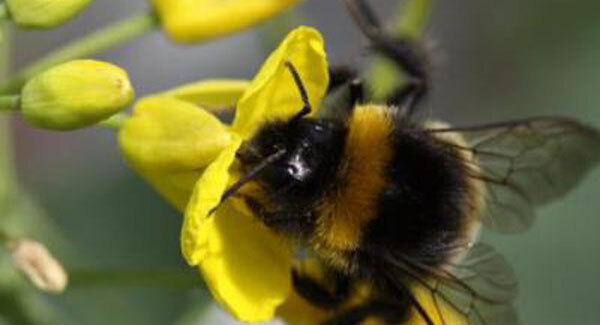
In Ireland. most beekeeping is small-scale and geared towards honey production. There are only enough honeybee hives in Ireland to pollinate a third of crops and increasingly, apple growers are relying on imported managed bumblebees, such as the buff-tailed bumblebee, to provide pollination services.
According to Thomas Quigley, who is a bee-keeper supplying honeybees to orchards in Cork, “we don’t know the impact of importing such bees on our ecosystem and the spread of disease.
But what we do know is that in 2014 there was over 1,500 acres of apple trees in Ireland and extrapolating from the UK study the impact of providing honeybee pollination services to apple growers could enhance the financial return to apple growers by over 30%.
“We urgently need to promote bee-keeping — and although the Department of Agriculture, Food and the Marine provides some investment aid to develop this sector, the level of funding is unfortunately too low to encourage bee-keepers to expand and develop pollination services,” he says.
Similar possibilities exist with rapeseed which provides us with seas of yellow fields in early spring.
Oilseed rape is pollinated adequately by the wind, but, for the first time Irish researchers have shown that foraging bees transferring pollen from flower to flower greatly boost the yield of rapeseed.
In a study in 2013 by Trinity College researchers, bees were found to enhance rapeseed production by, on average, 27%.
For the bee-keeper rapeseed provides an early abundant source of nectar which preferably, should be used for drawing wax to produce comb for the storage of honey later in the season, and pollen.
Rapeseed honey presents some problems as it granulates very rapidly and must be removed from hives and extracted and marketed soon after its production. The honey from rapeseed is light in colour and flavour and it is often marketed as cream or white honey.
We all benefit from the relationship between bees and flowers. The fundamental importance of honeybee pollination to farming has been well illustrated.
Reducing Irish pollination deficits will be dependent on a number of factors including promoting bee-friendly management practices on farms, increasing our number of bee stocks and investment in developing bee-keeping practices and resources.
CONNECT WITH US TODAY



Be the first to know the latest news and updates