Get your teeth into a crunchy home-grown carrot
Raw, juiced, steamed, roasted, or whizzed up in a cake or savoury dish, this versatile veg lends itself to all most all cuisines and meal times.
The difference between home-grown and shop-bought carrots is phenomenal.
Those sitting on the shop shelves all year round are mostly imported and are generally defunct of flavour and nutrients compared to those freshly dug or purchased at a farmers market.
That said, carrots are not one of the easiest vegetables to grow due to their fussy soil requirements.
They detest heavy clay and will do best in medium to light stone-free soil that has been amended with compost or farmyard manure the previous winter. Don’t sow immediately after digging in a green manure crop.
They do not respond well to transplanting so must be direct sown. Carrot seed is tiny and germination sometimes precarious so sowing more thickly than required, to thin later, is the norm.
Thinning is literally the careful pulling out of seedlings that are close together in order to space out plants and avoid overcrowding.
It is essential as it gives carrots the room to grow, resulting in straighter and bigger roots. It also helps keep pests and diseases at bay as they breed and spread in confined spaces. Always water before and after thinning.
There are many carrot colours and cultivars to choose from, with early cultivars giving the quickest crops and main crop carrots being more suited for storage.
In Airfield, we grow a number of carrot varieties in order to extend the season. ‘Amsterdam Forcing’ were sown in February in a polytunnel and will be followed by sowings outside this month to ensure continued supply.
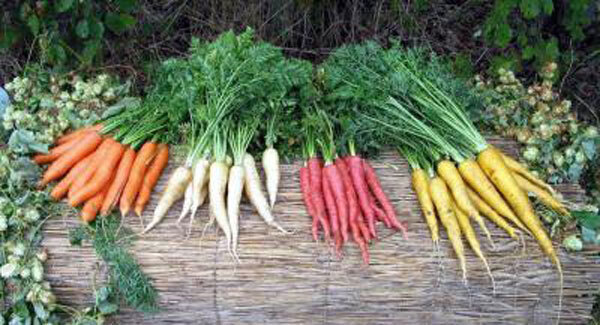
Last year, we trialed ‘Rainbow Mix’ and their colour and flavour proved such a hit with the chefs, this year have decided to expand the theme and experiment with a range of coloured carrots such as ‘Purple Haze’, ‘Atomic Red’, and ‘Solar Yellow’. Traditionals such as ‘Autumn King’ will also be included as these have a sublime flavour and store well.
Inspired by expert grower Klaus Laitenberger’s advice, our carrots will be direct sown in the last week in May or first week in June, as these later sown crops are more likely to avoid the first flying of the carrot root fly. Ground temperatures will also be up, which will boost seed germination.
Quite frankly the carrot root fly is the bane of most carrot growers existence and it is worth taking steps to prevent this arch-carrot nemesis from striking at the get-go. She lays her eggs in the soil near carrots and about a week later the larvae emerge and begin feeding.
First symptoms are a reddening of the carrot leaves and if you lift the root you may see the creamy coloured larvae, which are about 1cm in length, or the tunnels they have created.
There are usually two generations of flies: the first lay their first eggs in May/June and a second lay in August/September. Carrots growing in the ground at these times are vulnerable to attack, with often more damage being caused by the second generation.
1. Covering the crop with a fleece or bionet to prevent the flies from laying eggs is the best solution. Make sure to bury the edges of the fleece to prevent the flies from getting in;
2. When in flight, the carrot root fly stays low to the ground so surrounding the carrot bed with a net reaching at least 60cm high or growing them in raised beds which are more than 2ft can deter them. This method is less effective than bionet but makes maintenance easier;
3. It is thought that this fly is attracted by smell and the scent is particularly strong if you are thinning carrots so ensure to remove thinnings and other waste from the area;
4. Planting rows of onions or garlic between each row of carrots is said to minimise the smell. Another trick is to mix in some annual flower seeds such as Cosmos, Larkspur, and Nigella when sowing to give an attractive show of flowers and confuse the carrot root fly. These methods look great if nothing else!
5. Sow a resistant variety — e.g. ‘Fly Away’ and ‘Resistafly’ — have resistance to larval attack.
With the carrot root fly under control, the other main carrot crop chore is regular weeding as carrots can not stand any competition and weeds also entice slugs to the area to feast on seedlings and developing roots.
The carrot plant (Daucus carota) is primarily cultivated for its taproot, which is harvested a couple of months after sowing. However, do not underestimate the ornamental value of these umbellifers if left to complete their biennial life cycle. Last autumn, head ornamental gardener Colm O’Driscoll planted a number of purple carrots around the base of cardoon plants in Airfield’s entrance garden.
These carrots slowly sprouted over winter and are now lush with green fern like foliage and their fabulous cream umbel flowers are soon to bloom.


CONNECT WITH US TODAY



Be the first to know the latest news and updates