Room to improve: a new beginning for an old building
IN the past, most homeowners honoured a building by slavishly mimicking the original structure when extending it. A highly contemporary addition to a building, be it old or relatively new, can seem a frightening, immodest leap.
Still, it has a creative honesty that allows us to wring so much more from the new square metres, merging the aspect, beauty and light around the site and the house.
Even for a standard suburban home, the extension celebrates a new era for the building. Deirdre McMenamin, of lid-Architecture, practices in Ireland and Berlin: “Copying the original structure actually confuses our reading of the building and its past. New architectural interventions can create very different, but complementary, spaces to the existing building.”
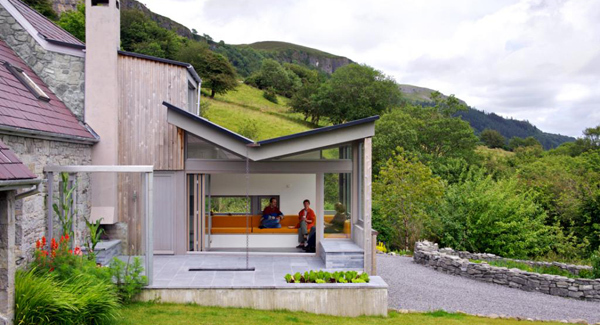
McMenamin won an award for the ‘landscape room’ in 2007 — 40m² added during the refurbishment of an Irish cottage over looking Glencar Lake, in Sligo’s Yeats country (as pictured).
“The existing cottage is characterised by intimate interior space that protects the inhabitants from the rugged landscape and the elements,” she says.
“The new intervention creates a connection and mediation to the scale, light and materiality of this sublime landscape. It demonstrates how a new addition can respect an original building without being subordinate to it.”
What’s left is a wonderful house, which illustrates the harmonious marriage of a period cottage and a glorious extension, as it looks out to the table-top of Ben Bulben. The water, stone and vegetation of the lake, cliffs and woodland, as seen from the house, are articulated in the terrace in the form of the pond, planted bed, and limestone seating platforms.
The best projects address the needs of the whole building, old and new — and this is not simply an aesthetic challenge. What’s already there may need attention to bring the building up to date in structural quality and energy efficiency. The building regulations attached to planning permission will coax a homeowner in the right direction.
McMenamin emphasises the impact of the unexpected on a budget during an extension: “Dealing with an old building always has surprises. Allow a contingency budget, and be flexible to adapt design, where necessary.’
I asked architect Gareth O’Sullivan, of Simply Architecture, about extending a building, be it a stone cottage, 1980s semi’, a farmhouse or 19th century manor house. Were there instances (not simply where protective planning would not allow) when he would not proceed with something utterly new?
“There is rarely an occasion where a contemporary approach will not deliver the most appropriate and authentic answer,” he says.
“Even on a listed building or an historic house, the best solutions are often contemporary. It is always worthwhile acknowledging the history of the building, so that the new extension enhances its original qualities, materials and features.

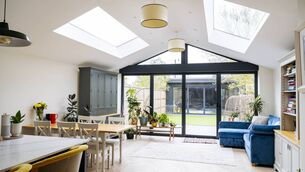
“The sympathetic contemporary approach I encourage allows you to embrace the best current technologies, such as large glazing spans to maximise the connection to a garden or to give an amazing, uninterrupted view.”
Where the architecture of the old and new are balanced, the architect is not conjuring something contemporary just for the sake of visual challenge. These are structures that will alter the enjoyment of the spaces within: for example, adding new sight lines, delivering privacy by shielding us from unwanted views, while inviting in formerly blocked natural light.
“Seamless detailing — including elegant structural details or concealed roof structures — allows large, open-plan living spaces and more sympathetic junctions with the existing house. This rewards prominence to the existing house, but also provides a remarkable addition,” says O’Sullivan.
So what about the existing rooms? There are always opportunities to reconfigure existing space to flow into the new build, but these must be handled well to succeed. Sometimes, what you already have may prove sufficient to your family’s needs.
“When approaching an extension project, it’s crucial to adopt a holistic approach that encompasses the entire dwelling, as opposed to simply focusing on the extension,” he says.
“Often, we find our clients have ample space in their current house, but the configuration of box-like rooms means the entire house is disjointed and doesn’t flow.”
Is an extension all about square metres? This next piece of wisdom is crucial: “An extension should only be incorporated as a conduit to improve the overall use of space, not simply to add another separate room. The key is to examine your house in its totality, and to place most focus on the quality of space a well-designed extension can bring, rather than adding as big a room as possible,” says O’Sullivan.
“Imagine using small, but seminal, changes to totally alter your enjoyment and appreciation of the house you’re already in. An extension may be as small as a corner window or a glass link used to connect two underused rooms into one decent space,” he says.
“Then, a strategy to create a consistency across the entire house must be employed. This may be as simple as changing the floor finishes throughout or rationalising any oddities in ceiling heights and floor levels.
“It is also common to find spaces which have too many doors, in which case they become walk-through spaces and thus not properly used. Simply by blocking up a door to allow better placement of furniture will open up an existing space and create a better flow and connection with the extension.”
Spatial reorganisation is an exciting opportunity, whether realised on its own or conjuncting an extension. Ask all questions of your architect, but, more especially, of yourself, before you sign off on the design — ‘What could we really do to this house’?