Vintage view: Christmas crudities or raising little Furcifers
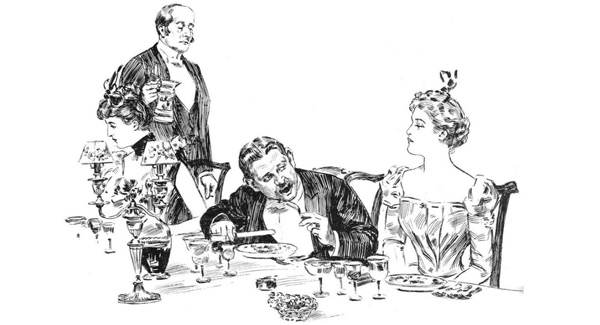
I mean, all that posturing is really a means of conducting food from the plate to the mouth, right?. Why unseat your paper crown and get pop-a-vein about the mechanics? ‘Proper’ behaviour surrounding food is a relatively recent development, but it had its first course in the burgeoning social snobbery of the Renaissance. Do the scruffy little offspring want to get in the way of 500 years of social evolution? Selfies, thong underwear, six year olds with Facebook accounts- but seriously — disrespecting the Renaissance?
The poet Giovanni della Casa, advising his readers on polite behaviour in his book Galateo (1558), emphasises the importance of outward appearance: “One should not comb his hair nor wash his hands in public. The exception to this is the washing of the hands when done before sitting down to dinner, for then it should be done in full sight of others, even if you do not need to wash them at all, so that whoever dips into the same bowl as you will be certain of your cleanliness.” So, you could be gutting rats for breakfast or tidying up your cesspit all weekend, but as long as your fellow guests believed your hands were clean — you were in.

He goes on to point out other common blunders in this essential primer: “I would not want someone to smell even his own drink or food, for fear some things that men find disgusting may drop from his nose.”
Imagine. There was clearly an awareness of the courtesies and hygiene surrounding eating by the 16th century, but it would be another century before the fork even arrived at great and lesser tables, three fingers of one hand being the preferred spear. Still, flinging oneself across the table in a two-fisted attack was deemed not only rude but a sign of being hungry.
Even with a dozen stuffed swans shuttered up behind the linen-fold panelling, royals, aristocrats and nobles were unlikely to show such venal weakness as obvious want for grub. What was needed to slow the sloppy slaughter was an interrupting instrument — etiquette —and above all cutlery.
The dynasties of the Middle East and Byzantium were over a thousand years ahead of our brutish behaviour with forks and knives used at wealthy feasts as early as the 7th century AD.
Catholic priest and Renaissance scholar Erasmus of Rotterdam, is full of useful tips for ravenous youngsters of any century in his seminal Handbook on good manners for children (1530).
Ingested a pinch too much of the M&S trifle? He writes: “To consume whole pieces of food at a gulp is for storks and buffoons — if you happen to eat something that cannot be swallowed, you should discreetly turn away and toss it somewhere else”. And to offer food from the table to other people’s dogs is put down to a lack of tact. Yes, that might upset Aunty Bamwinkle alright — so have some consideration kids, and fling that sucker. Gorging is, Erasmus advises, for brigands. There’s a timely warning that “some stuff their cheeks so full, that they swell like a pair of bellows”, others “opening their jaws so widely in chewing they produce a noise like pigs”.
He finishes this passage kindly by saying that “some people eat or drink because they cannot otherwise moderate their gestures, unless they scratch their head, pick their teeth, gesticulate with their hands, play with their dinner knife, cough, clear their throat or spit”.
Putting this down to “rustic shyness” Erasmus warns that such energeticbehaviour “has the appearance of insanity about them”.
So — the sneers of peers added to the perils of being dragged to the asylum — do I have your attention now m’dears?
Even taking our hands out of the entrails, cutlery remained the subject of acute distrust in royal and religious circles. Catherine de Medici, tucked a personal fork in her trousseau when she married the future Henry II of France, but the Court was not enthusiastic.
The use of a fork by a man was deemed effeminate right up to the 18th century. The clergy remained unimpressed, as in the Middle Ages, it was believed that courtesans would rudely loll about between customers consuming sweet treats with a fork — devilish, decadent behaviour when digits fashioned by The Almighty were available.
When the French did warm up to the idea, they came up with a curved pronged fork with four points and a shallow bowl —a ‘spork’ n’est pas? Prompted by travelling tales including the wonderfully titled, Coryat’s Crudities (1611), the Tudors, in contrast, took a grip of the Italian fashion for table utensils early on, recognising that some stewed, mashed and oily foods such as pickled ginger were not only unsightly by the fistful, but stained expensive clothing.
Author Thomas Coryate, was teased for his affectation of a knife and fork and nick-named ‘Furcifer’ or ‘fork-bearer’ for his gift to universal daintiness. Still individual forks had arrived, adapted from the serving ‘sucket fork’ in iron, steel or even silver. Stuart King, Charles I stabbed the matter to the plate with his declaration in 1633 that ‘it is decent to use a fork.’ If you want to see the very first fork known from the 17th century, take a trip to the Victoria & Albert Museum in London where the Rutland fork, made in 1632 in two still-perfect prongs, is treasured.
Louis XIV found it necessary to ban the pointed tip of French forks, as the passionate diners developed a habit of settling disputes with a lethal application of cutlery.
By this time, the use and operation of the fork and knife while dining was a public performance of social positioning throughout the civilised world.
Just as it is today, slicing the air in the correct trajectory from plate to lip, it separated the happy tine-lickers from the upwardly mobile. ‘Declan- put down that *£**@ knife! You’re destroying mammy and daddy’s future!’
Happy Christmas to all readers of Vintage View. It has been my honour and absolute pleasure to write for you this year.