Vintage view: Coffers
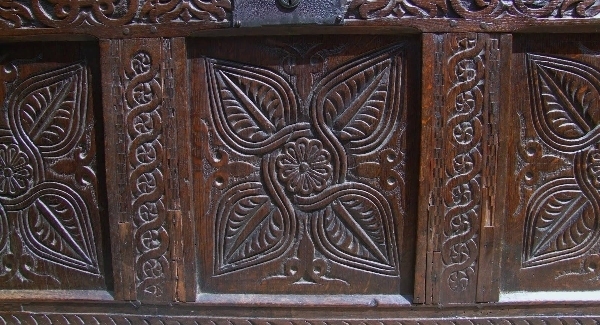
IT APPEARS dark, Mediaeval and pregnant with dastardly possibilities in almost every Agatha Christie screen adaptation.
Generally, it’s staged on the first landing of the staircase in the great country house. It furnishes that void at the bottom of a towering Georgian window, feet planted in an Oriental runner supporting a vase of drooping tea-roses.
The antique coffer has an ancient pedigree. Some are truly old, others a lot younger than their 19th century face-lifts would suggest. Great lumps of furniture, sometimes a couple of metres wide and another metre and a half across, they have little in the way of internal fittings bar a suspended candle-box (used to contain scented dry herbs).
You will find this style of storage furniture described as coffers, blanket boxes, vestment chests, mule chests or simply as trunks, and they are a staple of the quality mixed auction. The word ‘coffer’ generally describes the older pieces rather than 19th century blanket boxes.
Coffers were in their hey-day a multi-purpose piece of furniture, highly prized and personal to the individual and family. A large planked box of timber with a top hinged lid, they could be moved with the household, giving them the reputation of marriage-chests, resolutely carrying the wardrobe and precious domestic pieces of the bride to her new home by bumping cart or gentle carriage.
Relatively simple to construct by a good carpenter, a boarded or jointed coffer served many roles beyond storing household goods and were favoured by all classes across Europe.
Most of the extant Irish and British examples are in oak, a tough, dense wood.
They are constructed either in framed, in tidy jointed panels, or made straight up of six rough panels or a group of planks which run to the floor to form feet — a more simplistic form, but rustic, charming and often carrying a lot of age.
The flat top of the coffer was ideal as a table surface, as extra seating and as an overnight bench bed — so the lid was not usually carved. Lower status members of the household in the 1500s and 1600s, not ranking the importance of a bed, would have slept on some sort of padding on top of their personal coffer.
With large strap hinges and a heavy lock, they closely guarded intimate possessions that might have followed an individual or couple through a lifetime.
The often naively carved dates and initials found on period coffers take us straight back through the centuries to the everyday events and personalities of lost lives.
As other types of storage were promoted in importance in the late 1700s, coffers left the important public spaces of the house and made their way to private chambers, landings and lesser halls.
If you want a piece of Tudor, Stuart or early Georgian piece of period furniture, authentic coffers from the 1600s, but more frequently the 1700s are still widely available, (mostly on the British market).
With simple pegs or hand-made split-nails holding them together, planked and panel coffers are often cracked in places as shrinkage and changes in heat and humidity slowly yanked one direction of grain against another. Don’t worry too much about this honest wear if the coffer still has structural integrity.
More sophisticated panelled coffers made by cabinet-makers were constructed to move inside a supporting frame of horizontal stiles, vertical rails and decorative muntins, [the frame around a part].
Coffer feet, with their open grain left on a damp floor or with the rear set against moist plaster or stone, often rotted out so the piece may be lower than it was when made.
Look for a lovely treacle dark patina rather than flaming orange oak with figuring.
Look for as much original material and condition as possible including the locks, hinges and principal panels (including the lid).
It’s not unusual to find 17th century and 18th coffers and later 19th century chests which have been treated to a fantasy Gothic over-carving by the chisel of an enthusiastic Victorian madam.
This was a quirky pastime for 19th century ladies of class, obsessed with the drama of Jacobean and Elizabethan ornament. Possessing these pointers to a venerable past implied a raggedy castle somewhere up the family tree and impeccable breeding.
Faked up coffers and reproductions have been made since the mid 20th century, using old floor boards and remnants of oak wall panelling. With a half century’s abuse and well stained-up, they can fool the untrained eye.
Buy from a reputable source and ask for a written receipt of authenticity. An important, early coffer with carving dated to its making, which may include dates, names, human figures and animals, will command a premium, starting at €2,000 from a specialist dealer.
Seventeenth century chip-carved or plain-sided coffers are surprisingly inexpensive for their age, starting in the area of €800.
CONNECT WITH US TODAY



Be the first to know the latest news and updates