Three blind rats, see how they run
ARE you ‘the cat’s whiskers’? If so, you have a lot to live up to; feline facial bristles are extraordinary. Whiskers, like other hairs, are just shafts of dead cells growing from skin follicles but they are far from passive. Cold weather gives us goose pimples; our hair ‘stands on end’ when we are frightened.
Follicles, supplied with blood, have tiny muscles which trigger these reactions. Breezes produce a tingling sensation in the scalp; clearly, follicles have nerve connections to the brain. Still, while we can’t consciously move our hairs, the way pussy flexes her facial ones — cat whiskers — help him or her move around safely. Even in broad daylight, pussy won’t enter a narrow space unless the whiskers tell her she won’t get stuck. Most mammals are active by night, relying on touch-sensitive hairs to keep them out of trouble.
Our ape-like ancestors, however, lost their whiskers when they evolved hands. Having opted for a daylight lifestyle, with enhanced colour vision to boot, the night navigation system was no longer needed. We humans went even further, discarding almost all our body hair to walk upright on two legs, using the air and sweating to keep us cool. In any case, whiskers are only effective if you creep about on all fours with your head out in front of you. We miss the assurance they could give when groping clumsily in the dark, arms extended and fingers splayed.
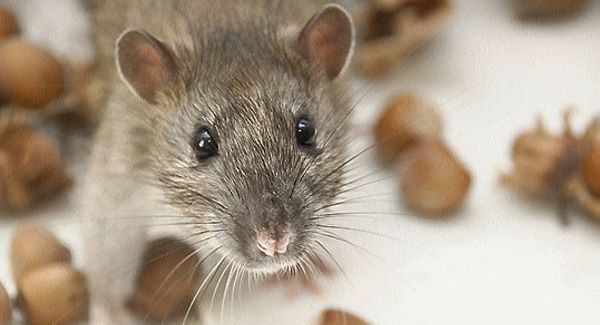
Your average brown rat has more whiskers than a Cold War early warning station has antennae. Long hairs sprout from the nose, the cheeks and the eyebrows. There are rows of shorter ones along the sides of the mouth. At the Active Touch Laboratory in Sheffield, Professor Tony Prescott and colleagues have been studying how rats use these sensors to get around. A paper on the research has just appeared in the journal Current Biology.
The Sheffield team trained rats to run along set courses by rewarding them with food. Then, unexpected obstacles were placed in the animals’ paths and visual clues they might be using, were removed. Whisker movements were recorded using high-speed cameras and the footage played back in slow motion so that the researchers could study them.
The behaviour of seven ‘functionally blind’ rats was examined first. Hopefully, the poor creatures were not deliberately blinded for the experiments. ! At first, the animals behaved cautiously as they ran the course, moving their whiskers constantly in broad exploratory sweeps, which the researchers call ‘whisking’. As they got to know the route, they travelled more quickly.
Then, three blind rats were placed in an open area with randomly placed obstacles. In this unpredictable environment, the rodents changed from whisking to extending their whiskers forward, so as to detect objects immediately in front of them. Clearly, they were aware of the collision risk.
Finally, sighted rats were tested in environments with and without obstacles, under bright conditions and in darkness. Irrespective of whether it was bright or not, the rats used their whiskers to probe the area ahead of them. They moved more quickly in familiar situations than in unfamiliar ones and proceeded more slowly in darkness than in daylight. This is hardly surprising; unable to turn on the light in an unfamiliar room, for fear of waking our partner, we blunder slowly towards the toilet in the dead of night.
It’s clear that rats not only deploy their whiskers, but they control them in a flexible and efficient manner. Able to tell the direction in which a whisker has been moved by contact with something, they seem to rely on whiskers more than sight, integrating their touch sensations with the other senses. “The rat puts its whiskers where it thinks it will get the most useful information, just as we do with our fingertips,” Prescott told the BBC.
-