Feathered friends

You may need to take steps to stop birds from eating your seeds and fruit, writes Kitty Scully.

Feathered friends

VEGETABLE growing could be described as a paradoxical past-time: sites must be open and sunny but sheltered, soil must be free draining yet moisture-retentive and all good gardens must be wildlife friendly.

But what happens when wildlife have very different ideas on garden friendliness than you? Undeniably, every organic gardener has the utmost respect for nature and this obviously extends to birds.

But that doesn’t make it any less frustrating when our avian amigos get the better of freshly transplanted brassicas, clear a whole field of grain, strew onion sets around the garden for fun, or devour a whole bush of ripe currants overnight. Often it is the larger birds such as crows, magpies and pigeons that are the main perpetrators, but nearly all birds will be happy to munch fruit harvests before you do.

However, on the other hand, one must not overlook the many benefits of birds in the vegetable patch.

Birds are natural predators and certainly the insectivorous ones who are happy out eating the other unruly, wild-living garden creatures, like insects, aphids, caterpillars, grubs and slugs, are to be encouraged. Since organic gardening is based upon promoting biodiversity and establishing harmonious relationships with nature, there is no shortage of new and old methods for keeping birds off your crops.

Since Victorian times, fruit cages have been used to protect top and soft fruit, but in the absence of any such permanent structure, bird netting is a very useful resource in any vegetable garden. Netting can be placed over your drills or beds, and a good method suited to raised beds is to use plumbing pipe as support hoops.

This pipe is anchored into the soil with cut re-inforced bars and gives a perfect sturdy frame to drape your net over. You could also try using bendable willow, and remember to adjust the height of hoops and netting to suit the crop you are growing. The only downside is that the netting needs to be taken down for cultivation purposes so make sure to put it up in such a way that it can be moved fairly easily.

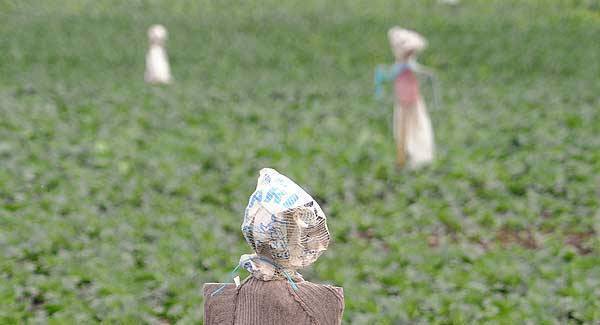
Scarecrows are an old traditional method of scaring birds, with mixed results. A scarecrow will certainly add charm and character to your garden, and you will have lots of creative fun making it, but I wouldn’t depend on one for all your bird-startling needs.

You’ll be surprised how quickly clever birds become accustomed to your new garden-guardian and enjoy perching on an arm to eye up their next garden meal or game. Hanging shiny objects such as old tin cans, DVDs/CDs and wind chimes on a scarecrow may help.

Covering beds with netting is certainly the most reliable method of keeping birds away from crops but other strategies include:

nPlacing tin cans, old CDs and other shiny objects on strings around the garden. These are effective as birds are shy of reflective things and noise. There are commercial products such as humming tape on the market but for small plots a recycled course of action makes sense.

nSuspending a full-size plastic replica of a bird of prey such as a hawk over your garden. This should frighten away potential mischief-makers as the fear of a predator such as a hawk is innate in all birds.

nPlacing upturned bottles painted bright colours on stakes around the garden can help.

nHanging wind chimes and small ringing bells that will make a noise when the wind blows should help deter birds from your garden.

* Placing sharp twigs such as hawthorn around growing crops does not make for hospitable pickings.

nA new product called Delumbri available from Fruit Hill Farm in Bantry (www.fruithillfarm.com) is now on the market. This is a natural liquid repellant to spray on crops and claims to ward off nuisance birds and animals while releasing root stimulating ingredients to the soil. (I’ve just purchased a litre to use on a small patch of grain that has required a second sowing thanks to voracious birds. Let’s just pray it does what it says on the tin. Time will tell!)

Whatever device you employ, variety is best advised as birds acclimatise more quickly to your terrorising tricks than you might think.

Avoid complacency, keep your bird-scaring tactics diverse and do not let those rascally birds get the better of you and your crops.

x

More in this section

Revoiced

Newsletter

Sign up to the best reads of the week from irishexaminer.com selected just for you.

Cookie Policy Privacy Policy Brand Safety FAQ Help Contact Us Terms and Conditions

© Examiner Echo Group Limited