Gray area
Previously showing at the Centre Pompidou, Paris, it promises however, something more compelling — an opportunity to see a body of work straddling furniture design, decorative arts, painting and architecture by one woman, who, when faced repeatedly with the obstacle of a male dominated art and design movement of the day, walked around it and kept going.
Bear in mind this is a woman who wore trousers when her contemporaries were struggling to get out of their stays; who produced designs marked as both masculine and feminine, developed in the world of robust work by Le Corbusier and Marcel Breuer on one hand, and the skills in lacquer work and fine art she sought out and developed to her own style.
Much of her life (1878— 1976) was spent in France, mainly Paris with its highly developed art and design scene, after a period studying art in London.
Operating in a man’s world, however, brought significant challenges for Gray. Exhibiting with Le Corbusier, he omitted her name from the exhibition catalogue, for instance and she navigated this slight by opening a shop in Paris, called Gallerie Jean Désert selling decorative interior goods which was frequented by the likes of couturière, Elsa Schiaparelli.
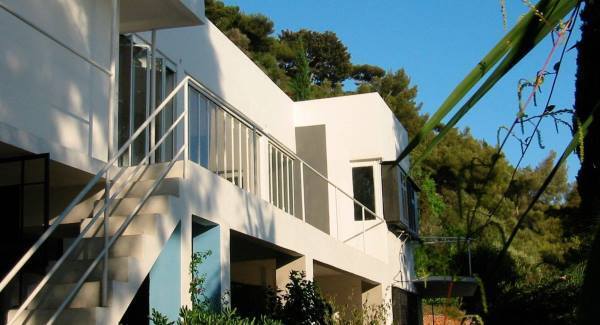
Later, Le Corbusier, who had once been an inspiration to her, would paint murals on the walls of her minimal, design-efficient architectural project, the French villa E1027, in what was seeb as an act of artistic sour grapes
Until then, Gray had designed interior products in the ornate style typical of chic Parisian decorators, (which we named Art Déco much later), using exotic woods, ivory and furs. But during the 1920s, her pieces became aesthetically simpler and incorporated steel, aluminum and other industrial materials.
However, design for design’s sake and experimenting with new materials were not the basis of her work. Instead she constantly adapted the domestic environment to suit human needs, which prompted one of her most noted pieces, the E1027 breakfast table. This was a response to her sister’s need for a breakfast table so she could enjoy eating in bed without getting crumbs on the bed linen.
Lacking the male-dominated support networks, Gray’s maverick approach excluded her from having a male mentor unlike other women designers who were making an impact in the early 20th century. Her sexuality (she was openly bi-sexual), and possibly her privileged Anglo-Irish background also contributed to her isolation.
But isolation in artistic terms produces work faithful to the vision and spirit of its maker, and in the case of Gray, allowed enormous freedom in the development of a unique style — one that is distinctly hers — an artistic sensibility based on a design vocabulary that speaks of true function and an aesthetic which places a light touch on its environment.
CONNECT WITH US TODAY



Be the first to know the latest news and updates