Hot for hydrangeas
I have found there are two definite groups of people in the world: those who love hydrangeas and those who most certainly do not. I cannot think of any other group of plants that elicits such a strong and divisive reaction.
But one thing seems to be universal, show somebody a hydrangea and the answer is always: ‘they remind me of my grandmother’s garden’.
So where does that leave us? Unfortunately for me all my grandparents were gone before I knew them and so no psychological analysis there. However I am most certainly in the group that adores these beautiful, majestic flowering shrubs.
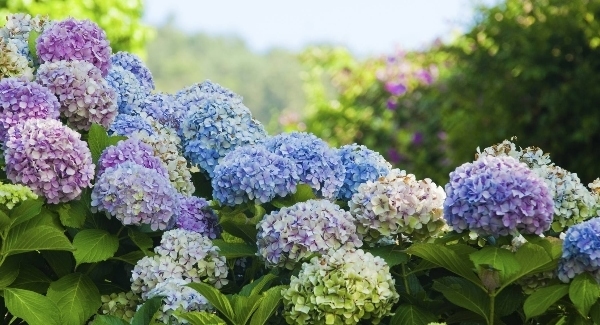
The most popular Hydrangeas are split into two groups: mophead and lacecap. I absolutely love the heavy, majestic, intense blooms of the mophead varieties. We lost our brother many years ago in a road accident when I was a small child and to this day I still remember picking blooms of blue mophead Hydrangeas and arranging them in wreaths for him. Many years later I now always think of James when I see these striking blue flowers.
That’s one of the many things that I love about gardening and the garden, that ability it has to evoke emotions and memories at any time. This to me is what makes the garden a truly living entity. There are so many blues to choose from, two of the best being ‘Altona’ and ‘Blue Danube’.
Pink may be your colour of choice and here too this genus offers so much. So many shades and tones and flowers sizes to choose from. The babypink of ‘Berlin’ and ‘All Summer Beauty’ through the true pink of ‘Rosita’ and the nearly red of ‘Masja’.
Do bear in mind however that the actual colour and shade of the flowers will be determined less by the variety name and moreso by the pH of the soil that it is growing in. Quite simply, limey or alkaline soils will grow pink Hydrangeas and indeed turn blue varieties pink.
On the other hand, acid or soils with a low pH will turn pink varieties to blue. It is this phenomenon which provides us with so many different flower shades as there are as many different shades as there are soils. White varieties will stay white regardless of the soil pH.
Less in your face perhaps than the mophead types, but no less beautiful with their graceful intricate flower details, are the lacecap varieties. It is when you look closely at the lace work of the flowers that you realise once again the wonder of nature and the higher power at work that can turn a simple seed or cutting into something so dramatically beautiful. Keep an eye out for these beauties ‘Blaumeise’, ‘Mariesii’ , ‘Early Sensation’ and ‘Bluebird’
There are several more groups, the paniculata types such as the breathtaking ‘Levana’ and ‘Limelight’, the oak leaved varieties which are also stunning in bloom and climbing Hydrangeas, both the deciduous petiolaris and the evergreen seemanii make great climbers to cover a wall or fence. However I think it is fair to say that my favourite of all the varieties is Hydrangea arborescens ‘Annabelle’. She will grow to about 120cm in height and a mature specimen will have a similar spread.
Once you have discovered ‘Annabelle’ you will know what I mean as it is probably the most showy of all the genus producing extra large flowers of the purest white colour. Indeed the flowers can get so big as to cause the stems supporting them to fall over under their weight. For this reason I would encourage you to cut it back hard to about 30cm in early March to encourage strong stems with bigger blooms.
Do yourself a favour and see ‘Annabelle’ at her best when next you are in Killarney and drive into the car park of the Europe hotel to see groves of this variety planted to the front of the hotel. One of the stars of the Hampton Court Flower Show this year was the dramatic and more unusual ‘Pink Annabelle’, which behaves exactly the same as its white sister, do keep an eye out for one if you can source it.
Admire this season of hydrangeas and late summer colour and most importantly allow yourself the time to get out and enjoy the garden.

CONNECT WITH US TODAY



Be the first to know the latest news and updates