The Form of the Phormium
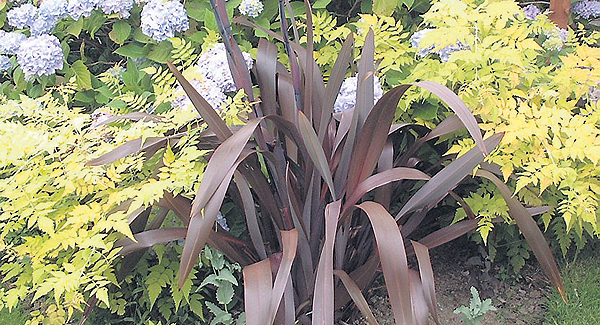
And if they have spiky silhouettes, as Phormiums do, they introduce a particular liveliness to the changing scene.
Phormiums, if you’ll pardon the pun, have grown on me over the years and the older I get, the more I appreciate them. As a younger man, I used to be quite snooty about all sorts of plants; in particular Elephants Ears (Bergenias) hedging Lonicera, all-red dahlias, and New Zealand flax.
The mistake I made then was to dismiss too many things in an attempt to have strong views. However, many flop into this trap at some time in their lives!
Nowadays, when I visit Open Gardens during summer Phormiums are among the first plants I seek out, for apart from their wonderfully romantic sounding names (‘Maori Sunrise’, ‘Maori Chief ’, ‘Sundowner’ ‘Dazzler’ and ‘Yellow Wave’), their tough, leathery leaves almost seem to command attention.
In the wild in New Zealand or on windswept Achill Island where they have naturalised, the leaves are deep green, but cultivated named forms like those mentioned have red, pink, grey, yellow or variously striped leaves. All are very tolerant of wind, salt, and excess wet.
Emphatic when well-grown, and striking no matter where sited, Phormiums need absolutely no maintenance apart from the removal of old, dead leaves during spring. You’ll need to pull these with aggressive determination if they’re to come away freely.
Roll them up and discard by burning or waste disposal for they are far too slow to rot in a conventional compost heap. They’ll also choke the smaller makes of garden shredder, and if allowed to lie on a lawn will damage the cutting blade of the most robust mower.
When clumps grow to fat proportions (this will take a number of years) they may need to be thinned a little to remain comfortable and majestic looking within their allocated space.
Undertake thinning in spring and use a Stanley knife to cut away as many of the outer fan-shaped sections as is necessary. Pull the sections outwards and downwards from the side of the plant and cut as low to the ground as you can.
Thinning can be repeated a number of times over many years, but eventually the Phormium will need lifting and division. To do this in autumn is to invite disaster, for whilst large plants can be pulled apart into quite a number of individual ‘fans’ all will succumb to rotting long before spring arrives. If division becomes necessary, do it in March and pot or plant each offset in moist, sandy soil.
Phormiums contrast well with other plants in large pots, which can be changed around according to whim. I like to use the smaller varieties in this fashion for they retain their dramatic outline whatever the weather, and make little or no demands on the gardener.
It is safe to say that all the named varieties offered for sale will tolerate summer drought and winter wet. The smaller varieties will make a good feature to the front of a border, the larger, a permanent evergreen background. Flowers are formed in summer on tall weird-looking stems.
¦ A Flower Festival with the theme ’From the Rich Earth’ takes place in the Sacred Heart Church Belgooly, Co Cork on the weekend of Oct 5 to 7. Entry is €10 and includes refreshments.
¦ Owenabue Garden Club will meet on Monday next at 8pm. Guest speaker Willie Grainger will speak on the autumn garden and afterwards there will be a selection of plants for sale.
¦ The Pavilion Garden Centre, Ballygarvan is hosting a plant fair on Sept 29/30 from 12-5pm and will offer a series of free workshops, consultations and an artisan food launch. All proceeds raised will go to Irish Guide Dogs for the Blind. www.thepavilion.ie
¦ Kells Bay Gardens will hold guided walks of the gardens today and tomorrow Sunday at 2.30pm. An end-of-season plant sale will also take place and all are welcome to attend.
¦ The Alpine/Hardy Plant Society, Cork Branch, will meet on Thursday next to hear Paul Cutler, Head Gardener, Altamont, Co Carlow speak on bulbs for all seasons and situations.
¦ Blarney and District Flower and Garden Club will attend a talk and supper evening at Griffins of Dripsey on Thursday next at 6.30pm. Open to non-members
¦ Sunday’s Well Flower and Garden Club will hold a floral arranging demonstration entitled coming of autumn by Gene O’Riordan on Wednesday next at 8pm in St Vincent’s Parish Centre. New members welcome.
¦ A one-day autumn seminar takes place in Claregalway Castle, Co. Galway, on Saturday, Oct 6, beginning at 10am. Presentations will be given by Klaus Laitenberger (growing organically), Dr Muriel McCarthy (historic library garden), Irish Seedsavers, and Thomas Pakenham who speaks on trees. Visiting nurseries will attend. Cost €65, includes lunch and coffee breaks. Booking essential from 087-6354747.
CONNECT WITH US TODAY



Be the first to know the latest news and updates