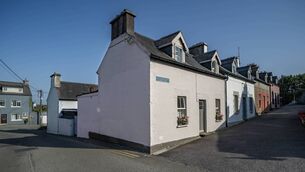
Daily strolls to Atlantic Pond await from stylish Maryville home
No 37 Maryville has been modernised from head to toe to a superior standard that will appeal to many, writes Tommy Barker.
Daily strolls to Atlantic Pond await from stylish Maryville home

Some house upgrades of recent years are visible or obvious from the get-go.

They stand out, from the size, scale or impact of extensions, or paving, or pillars and gates, and you’d see them from the front, side or back.

Some, you’d almost see on Google Earth.

Then, there are the less-obvious ones, they don’t shout out their wares, or the work done and to what standard or spend, but they still have quiet air of, well, not superiority, more of self-possession.

No 37 Maryville is one of the latter, self-possessed, honed, poised, under-stated, well-located — and, up for sale, guided at €365,000 by estate agent Timothy Sullivan, who says its condition is immaculate, and finishes of a superior quality.

Called after a large, period home in now-suburbanised Ballintemple, Maryville’s houses are mid-1900s semi-ds in the main, clustered in a short cul-de-sac running towards Lindville on one side and ranging or looping around a block alongside, where some have full views of the work ongoing in building the new Páirc Uí Chaoimh stadium below, and just to the north toward the River Lee and Marina.

Set out on the actual hill at Maryville, which drops down from Ballintemple village to Monahan Road, the Atlantic Pond and Páirc Uí Chaoimh, No 37’s a three-bed semi-detached home with stripped-back, high quality interior finishes.

It eschewed the big back or side extension route, opting instead to colonise and convert the attached ‘garage’ space (too narrow originally even to fit a car into), which now houses a guest WC and cloakroom with built-ins in front and discrete, glass-block window, and a utility towards the back, reached off a widened kitchen.

That annexe repurposing works really well in adding services and utility to the side of this semi: many other owners of homes of similar vintage and size who’ve converted their domestic garages find the resulting room (typically 8’ wide) just too slender or narrow for comfortable reception room use, so at best they slot into the den/playroom category.

No 37 last changed hands in 2006, and having rented it for a period while living in Dublin, the owners relocated back to Cork and took it in hand in 2010, bringing in builder Ian McGilton and crew for the top-to-toe revamp.

The work included opening the side ‘service’ rooms, and opening up the front and back reception rooms, pushing the kitchen wider across the back of the house for a long, purposeful galley arrangement tying into a dining area, with garden access.

Connecting/dividing opaque glazed double doors between the front and back reception rooms slide back into boxed sections of the wall, meaning when they are out of sight, they are also out of mind and away from finger smears, as well as quite sensibly not blocking or taking up space in either rooms.

So, as a means of dividing use and space either end, it’s a smart solution. Why don’t more builders embrace this?

There’s double glazing, and efficient gas boiler, and external walls have been dry-lined with insulated plaster board, upstairs and down, while the front room’s fireplace now has a gas fire insert. Surprisingly though, despite all of this work, the BER comes in at a C2, which seems a bit anomalous given all the boxes ticked.

The work carries on to another level too, as the standard attic space has been upgraded to home office use, floored, insulated and lit, with Velux to the back and there’s still space left for storage around the perimeter of the 13’ by 12’ office.

Access, though, is just via a pull-down stairs which touches down on the landing.

It’s probably grand for occasional use, but if new owners plan on using this roof level on a daily basis, a more permanent stair solution would be preferable.

The first floor has three bedrooms, two with wall-to-wall mirrored robes, and the third bedroom could fit in a small double bed, so it’s a shade ahead of the sometimes ‘afterthought’ third box room.

The family bathroom is in keeping with the standard set in every other room, with good, white sanitary ware contrasting with large matt black floor tiles, and smaller, as-dark tiles around the bath, which has Grohe tap and shower fittings, and glass side screen.

Decor-wise, Not 37 is deliberately kept to the minimalist end of the scale, with most windows simply dressed with single colour roller blinds, and bedrooms upstairs doen’t even have the expected windowboard treatment and, instead, are just smooth plaster, and painted white, as are all the internal walls.

The house really scores on the storage front: the bedrooms have those capacious sliding robes, and there’s a stepped series of cupboards under the stairs, in the walnut-floored hall which itself feels a foot or two wider than in other semis.

There’s a big bank of built-ins in both the utility room and the guest WC/cloakroom, finished in a solid, matt Farrow and Ball colour, a moccha hue.

It’s a bit darker than the shade in long run of the smooth kitchen units, done by David Lane Kitchens, in the 20’ by 11’ kitchen which ensure that foodstuffs, crockery and all else remain away from sight.

Both reception rooms have shelving left and right of their respective chimney breasts, painted white to disappear into walls, with

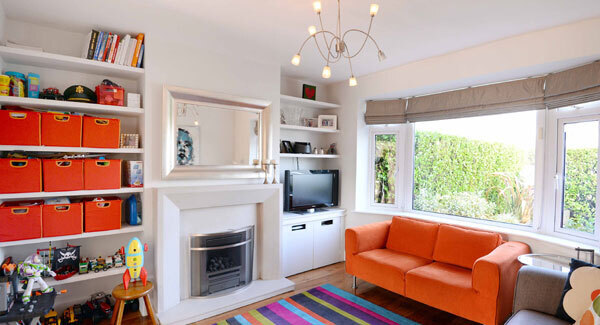
minimal display in the dining area, and with rads underneath. That calming restraint disappears a tad in the front room, where colour’s left run freer, with a wall of stored kids’ toys, striped rug, art work and orange sofa set into the slight bay window, where there’s a linen roman blind.

No 37 faces east in front, looking out on the low-slung Lavanagh Centre across the way on Maryville hill, and it has off-street parking for several cars on its gravelled garden, with raised beds, planting and hedging, all framed by old rail sleepers.

East in front means due west to the back for the garden, which has side access from the utility and via French doors out from the dining/breakfast room to a patio.

This rear garden aspect is spot-on for afternoon and evening sitting out, and the garden has mature boundaries (the original Maryville House is visible to the back too) and then is divided up with raised beds, rendered and painted in shades of gray, and holding a sandpit for play, with shrubs and spring bulb flowers now popping up through gravel, and set for herbs come summer.

On the bigger picture, location is tops, as it’s close enough to walk or cycle to and from the city, closer too is Blackrock village, and the Marina and Atlantic Pond will be daily stroll for many.

There are shops, bars, bank and post office among other services in Ballintemple, as well as several schools and a plethora of sports amenities and pitches.

And, the City Council is set to upgrade the Atlantic Pond hinterland in the next while, to dovetail with the new GAA stadium, where demolition of the old Páirc Uí Chaoimh is now giving way to building anew.

The proximity to the stadium, and the parking pressure at match times which impact a wide catchment around Blackrock and Ballintemple, will be of note to some buyers, and a bonus to others.

VERDICT: Understated.

Ballintemple, Cork City

Price: €365,000

Size: 110 sq m(1,200 sq ft) plus attic

Bedrooms: 3

Bathrooms: 2

BER: C2

Best Feature: Quality job

More in this section

Property & Home

Newsletter

Sign up for our weekly update on residential property and planning news as well the latest trends in homes and gardens.

Cookie Policy Privacy Policy Brand Safety FAQ Help Contact Us Terms and Conditions

© Examiner Echo Group Limited