Adventures in green building
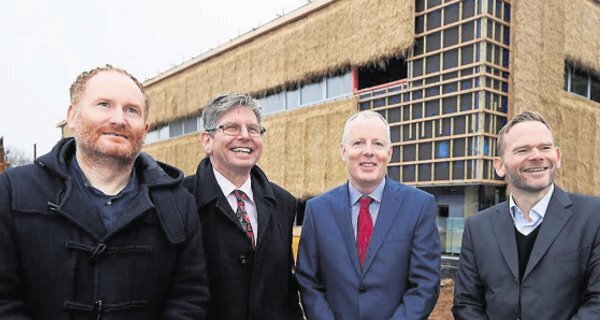
One of the areas in which the university excels is in the promotion of environmentally-friendly building practices, striving to initiate ‘environmental best practice’ when it comes to buildings on campus.
It’s probably not an environment in which you would expect to encounter a timber frame company based in Macroom, Co Cork, but it this is where you will find Cygnum’s (www.cygnum.ie) largest building to date. The company which currently employs 60 people, with plans to expand this to 100 in 2015, has played a significant part in the construction of what is being termed ‘The Greenest Building in Europe.’
The latest campus building, the Enterprise Centre, is classed as an ‘Exemplar Low Carbon Building Project’. Cygnum has engineered, manufactured and erected the timber frame structure for the entire building.
Due for completion in May 2015, it is a ground breaking commercial build in terms of BREEAM (Building Research Establishment Environmental Assessment Methodology — www.breeam.org) and Passivhaus (www.passivhaus.org.uk) environmental standards.
It is also unusual, and quite striking, in that the external walls are clad with wheaten straw thatch.
With an established best-practice benchmark for ‘embodied energy’ in university buildings of 845 kilos of CO2 per square metre, the goal for this building is just 168 — a huge saving of CO2 over the 100-year lifetime of the building.
Cygnum’s involvement can be traced to its 2007 decision to expand operations into the UK.
CEO John Desmond says: “We wanted to leverage our abilities, but it simply wasn’t possible to do this in Ireland at the time.”
The Irish market was contracting so Cygnum set up an office in Suffolk. It subsequently became involved in a range of projects, including schools, apartments and hotels. In 2011, it built the first of a number of Passivhaus schools designed by Architype Architects, leading UK proponents of environmentally friendly construction methods.
In 2013, Cygnum were approached by Architype and main contractors Morgan Sindall regarding the UEA project with an unusual challenge; to use locally sourced, rather than imported, timber in constructing the sizable commercial building.
Desmond sourced high quality Corsican Pine grown in neighbouring Thetford Forest. Cygnum verified that the timber was structurally sound for building, agreed a means of getting the material processed with Cork sawmilling company GP Wood and went on to win the construction contract.
The primary challenges of Passivhaus certification are airtightness, minimising thermal bridging and reducing the U Value to a very low 0.13W/m2k.
Cygnum has innovatively achieved this by introducing Sarket board (allows ventilation and reduces thermal bridging) with blown cellulose (treated recycled paper) as an insulation material. To ensure airtightness, it involved taping of joints and huge attention to detail while fitting on site, hence Cygnum’s insistence on its own installation team.
Desmond outlines the phases in timber frame construction. The first, slowest, and by far most complicated is the engineering and design phase. He says Cygnum’s design team is what sets it apart from most other timber-frame companies. It has the capability to design solutions for very complicated buildings.
Manufacturing wall, floor and roof panels is phase two, which is carried out in their fully automated production assembly lines. Installation is the final phase. Cygnum is also unusual in this aspect of the build as it provides its own fully trained team to build the structure on-site. In the UEA, this began on May 12, 2014, and was completed in late October. At that stage Morgan Sindall took over finishing out the building on the timber frame provided. The construction is due to complete in May 2015 with the official opening in October at the beginning of the 2015/2016 education year.
Of its Irish operation Desmond comments; “We have retained our production facility in the Ireland, notwithstanding the downturn, and remain the largest producer of timber frame here. We expect our activity in Ireland to increase as the recovery continues and uplift in construction takes hold.”
On what this project means for environmentally sustainable commercial buildings he says: “It would be nice to think that it would exhibit to policy makers and particularly those involved in procurement for public building works that it is possible to construct attractive, large-scale, sustainable buildings that are fully functional and can deliver outstanding outcomes in environmental terms.”
Details:www.cygnum.ie
CONNECT WITH US TODAY



Be the first to know the latest news and updates