Cover story: Monkstown, Cork €525,000
Size: Sq m 303 (3,250 sq ft)

Cover story: Monkstown, Cork €525,000

THE current owners of Monkstown’s Summerland moved into it in 1957, about 100 years after this harbourfronting villa was built. And, for most of its life before the family’s long occupancy, it served as a rectory for the local Church of Ireland, from about the 1870s.

Only back on the market, this one-time rectory carries a €525,000 asking price — and huge promise — via agent Malcolm Tyrrell of Cohalan Downing. It’s a quiet, post-Christmas cracker for those with a bit of energy and even more money to lavish on it.

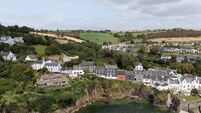
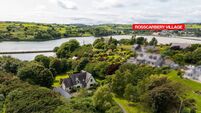
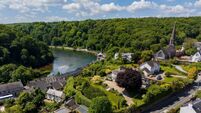
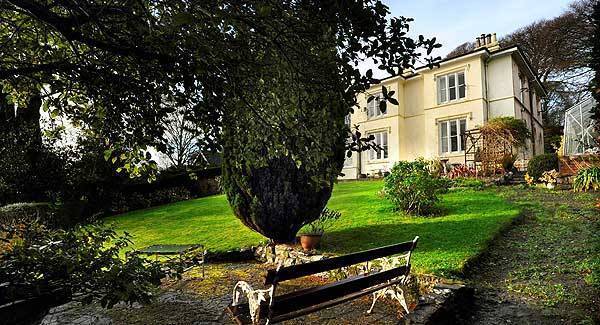
Summerland is one of, and at the end of, a row of fine, period (Victorian, mostly) villa style houses built along a wooded and hilly bend facing out east and south into Cork harbour and its islands at Monkstown. It’s a home that has kept faith with its past, secular and otherwise, and retained virtually all of its important architectural features.

However, the challenge for aspiring new owners will be to make necessary changes for a next generation/half-century of occupation, without negatively impacting its character.

Right now, this is a sturdy two-storey Victorian home, over-basement and so effectively has accommodation on three levels. Its got about 3,250 sq ft of space so far, but some of this is in rather compartmentalised; it deserves some opening up for a few larger, grander rooms — and the basement is probably the place to start.

Right now that is a bit of a museum piece, but has good internal and external access, windows and good ceiling heights to make plans around. There’s a stone-flagged walkway around its back and sides, some coffered stores, and even an old well outside that’s self fulfilling.

Agent Malcolm Tyrrell suggests that the garden/ ground to the house’s front could be lowered a few feet to let the building breathe a bit more openly, onto a newly created terrace, for extra light, air and views. In fact, he can reel off a few Monkstown area period homes where this has been done to good effect. One good example is the Georgian beauty Carrigmahon, which re-sold last year via Lisney’s for €820,000, according to the Price Register, very shortly after a costly and thorough renewal.

By following similar lines, Summerland could also have contemporary spaces (kitchen/ games rooms, family dens and/ or services) beneath the more elegant ground floor reception rooms and the already quite grand hall and stairs.

The National Inventory of Architectural Heritage appraises Summerland as an “elegantly proportioned house,..set on a prominent site overlooking the harbour.” It picks up on its two-storey boxbay windows, tripartite sash frames and hood mouldings, hipped slate roof with clay ridge tiles, as well as some ornate carved timber bargeboards, and gable-fronted canopy at the front door with its stout strap hinges.

Inside and out, it’s kept a slow pace of graceful ageing and has been a fully enjoyed family home for decades, and for three generations within that family who went, and returned, in ebb and flow, and it has accommodated all.

The most major change or addition was the sun-room/ conservatory grafted on by the front door, with harbour views, and it’s reached just off the 18’ by 14’ lounge, which has a white marble fireplace, and ceilings of almost 11’ in height.

The other reception room is slightly larger, used as a dining room, and it too has a good fireplace, bay window and a dumb-waiter as a relic of older, gentler yet harder days, when the kitchen was below stairs, and had staff on hand.

Other rooms include a study, a kitchen which is pretty much below par for any modern use, with or without staff, and a guest WC, while the centre and almost heart of the family home is the large hall and stairs — a fine and elegant space, with graceful window on the turn, and there is also unusual dentilated carving work around the doorway to the basement stairs.

Virtually all windows are old timber sash and look right at home here, but some may need refreshing in a sensitive style, and nearly all have working shutters, a sort of double-glazing/insulating/ draughtproofing measure of their day.

Upstairs is a pleasant landing and four bedrooms, and a few rooms’ shapes up here have altered in recent decades, with a larger shower room now provided for. The two front bedrooms are the best, with bay windows, and the main one is a delight, with double aspect and harbour views to captivate. The owners still recall the surprise opening the shutters one late 1990s morning to see the QE2 appearing in its full 900’ long glory. The 1969-launched ship revisited Cork in 2008, as part of its Farewell Cruise, before being moved to Dubai where it was to become a floating hotel at the nowtroubled Dubai Palm Jumeirah island. (The QE2’s final destination and fate is as yet unclear, after talks about moving it to China, again for a hotel-refit opportunity.)

There’s no escaping Cork harbour’s pleasures, amenities, working past and present in a setting like this, where comings and goings of yachts, dinghies and shipping traffic is a daily ritual. There’s even a poignant link with one of the harbour’s better-known ship groundings/ wrecks, the White Star line’s Celtic, which was the largest liner of its day when built in 1901. The Celtic went aground off Roches Point in 1928, with crew, 500 passengers and cargoes variously saved, savoured or salvaged.

Today, the masthead light from the Celtic (see Get The Look panel, Page 11) has pride of place in Summerland’s hall, having come into the home from a boat building family called the Palmers. The Celtic’s mast lamp will, however, be sailing off with the trading-down occupants who previously owned and ran Robert Days in Cork city. The venerable institution Days started off as a saddlery and harness making enterprise, specialising in fishing tackle, before closing up in 1998,withe family retiring to gardening, angling and boats.

Today, Monkstown’s new marina can be glimpsed just to the east, half way between Summerland and the Sand Quay where there’s a popular dinghy sailing club and its likely that the next owners will, also, be into the sea and boats. If that’s the case, then a pedestrian gate and access at the lower garden boundary, bearing Summerland’s name over its arch, set in an old sandstone wall on the Strand Road will come in handy.

There’s easy proximity to Carrigaline and harbour industries, as well as back to the airport, and there are several routes also back to Cork city itself, either along the water or up and over the hill towards Rochestown: it’s a 15-20 minute commute on a good day.

Relevant comparable sales locally include the purchase of the beguiling 200 year-old red-brick villa Ashleam: in very good overall shape, it was offered on three acres with gate lodge in 2012, guiding €1.35m; it d sold minus its lodge and on less land last year, at a reported €750,000, according to the price register, which records its value on one acre. Ashleam’s new owners traded up from the locality, and other strong sales were their pristine terraced home at Sydenham Terrace for over €600,000, and the afore-mentioned renovated Carrigmahon in Glenbrook for €820,000. Ashleam’s buyer viewed Summerland when hints of its impending sale began to emerge, it’s understood, but stuck with its purchase, so now there’s a clear run at an open market, via Cohalan Downing.

It needs modernising and upgrading, but in its favour is its integrity, and setting, with some of Monkstown’s better views.

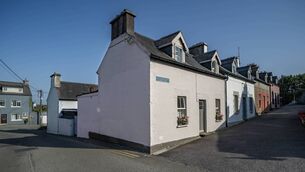
Location is above the Strand Road, at the end of a back lane behind Alta Terrace with its long line of very large period semis, with some detached harbour-facing homes also scattered along the way.

VERDICT: Very original, and probably the better for it, Summerland has accommodated families and clergy — and is ready for more.

More in this section

Property & Home

Newsletter

Sign up for our weekly update on residential property and planning news as well the latest trends in homes and gardens.

Cookie Policy Privacy Policy Brand Safety FAQ Help Contact Us Terms and Conditions

© Examiner Echo Group Limited