Rural rescues on all fronts
MEET the rescuers. Mountain rescue guide Chris Edmonds and his wife Noreen have not only rescued people, dogs, horses and ponies, but they’ve also rescued a chunk of Irish country life, with their Borris Co Carlow homestead suffused with new life and creature comforts.
The Leinster couple, who retired early six years ago and went on seaside, coastal and mountain and hillside hunts for a rural idyll, found what they were looking for at the foot of the Blackstairs Mountains, working wonders with a bit of a wreck.
And now, with house and outbuildings rescued, and a burgeoning menagerie of beasts to mind, they’re on the move to fresh pastures, more acres for the animals, and another cottage to rehabilitate.!
The laid-back couple who had lived at Cuttlestown, Co Wicklow (Noreen was a national school teacher, Chris worked in the motor trade) had children becoming young adults, and energy to burn, and decided on a lifestyle shift back in the mid-2000s.
“We decided to retire early and fulfil a dream of adventure,” says Noreen, who along with Chris has travelled and trekked in Nepal and the Himalayas’ Annapurna, “so we started looking for a project either in the mountains or by the sea.” The mountains, close enough to college-going offspring in Dublin, won out.
“We had a camper van, and spent many weeks going through beauty spots around the countryside. We knew the Blackstairs from our hill-walking, and came down this lovely lane to this beauty spot and house, and said that was it,” recalls Noreen.
The granite stone farmhouse house at Ballymurphy, Knockmalgurry, a few miles from stone-pretty Borris, hadn’t been lived in for year and was sound, but a bit shook, so it was sleeves-up time for enthusiastic Chris and Noreen.
The Edmonds briefly consulted an architect, but worked more happily on their own designs and thoughts, and were fortunate in having one of their three children, daughter Sarah, then a trainee/student architect in Dublin — so she did the drawings and tweaks, adding a nice generational twist to the family project which has rehabilitated a vernacular building cluster with panache.
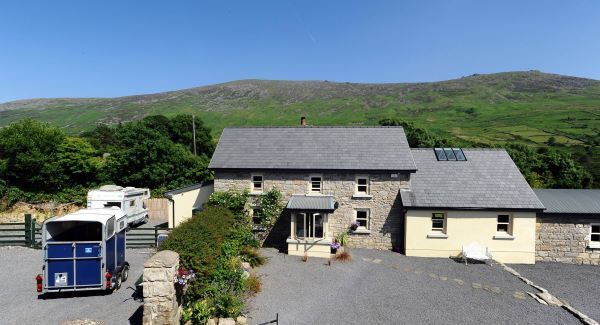
According to Noreen, it has kept pretty exactly to the original yard layout and footprint, with just one lean-to sympathetically added as a store at the left hand gable. She thinks the house dates to the late 1800s, and what’s now a mid-section living room, with overhead roof apex window, was the original house section, and its poorest-quality section done only in rubble stone, so that was demolished and replaced with a better build, marginally taller. The adjoining, larger and later granite stone section had been built as a lofted animal shed or cow-house, and was kept as is in terms of walls and roof profile, only rehabilitated. A second building across the yard nearer the lane, reckoned to have been a pig shed, was converted to human residential use, and is now a self-contained two-bed guest apartment.
The roofs have new timbers, and costly Spanish slate now on top, and one of the most distinctive features is the small, modestly barn-like curved galvanised steel roof on one gable out-building, plus on an even smaller scale, over the main house’s entry porch.
Surprisingly, this design element had the local county planners a bit uncertain, Chris recalls, even though it’s of a type seen up and down the country on barns and outbuildings. Eventually they came around, as did a talented local carpenter Michael Curran, and it was he who put the shape on the roof, and the galvanising cap on the project.
The roof was made on the ground, with up to five sheets of laminated ply bent over a form, glued and screwed to make a rock-solid arched profile, and this was then mechanically lifted into place as a crowning glory, with the galvanised sheeting rolled and shaped by a Portlaoise firm — standard stuff, really, for barns, but unusual on Irish homes.
Chris had been responsible for stripping back the building to a shell state, as well as knocking back the old lime render ready for the various tradespeople to arrive and take up their tasks, and he was also responsible for setting down various floor membranes, and then the original granite walls were tanked for water- and damp-proofing. Now, the finished job has kept faith with a mix of retained old stone and new lime render, thickly laid out and with a sandy, tactile finish as a contrast. It’s seen to great effect around a retained narrow slit window, a real reminder of the time this building housed animals, not humans.
However, since the Edmonds finished the work animals have uncuriously tended to gravitate back: they’ve taken on quite a few rescue animals, including Bella the Scottish deer-hound, and a number of horses — five, so far, and word seems to be spreading. The horses include a Clydesdale/Irish draught horse who served his time towing tourist caravans around the Ring of Kerry, but who’s now dining high on Leinster grass, as well as some Shetland and Falabella miniatures. Another, an Irish cob, literally came down off the mountains behind the house having been turned out to graze on his own devices. Bought for what’s almost cruelly described as ’meat money,’ he’s turned into a fine responsive animal, enthuses Noreen, though she does admit “the place is starting to look like the OK Corral!”
The couple, with animal add-ons and walk-ins, has recently bought another do-er upper property, a smaller cottage on a larger acreage and has already started work, but the acreage is reasonably sensible, it’s not like a farm as “I’d be afraid I’d fill that too,” Noreen laughs.
So, this completely finished-to-a-tee Borris homestead on 1.5 acres comes up for sale in summer 2013, via Remax Waterford Team Fogarty, where agent Margaret Fogarty guides it at €375,000 and says “the quality of finish and attention to detail are second to none.”
“It’s nestled at the foot of the Blackstairs Mountains, and is wonderfully unique, lovingly restored and transformed into something special,” adds Ms Fogarty, who feels it will cast a spell over potential buyers from near and further afield. With its spectacular mountain and rolling countryside views at the foot of the Blackstairs, and relatively easy proximity to Dublin, Carlow and Kilkenny, as well as the south east, it’s going to suit lifestyle relocaters, and downsizers, and those coming or returning from abroad for a slice of the Irish rural good life, where all the grunt and hard work has been done.
With a north-south spine running some 17 miles along the Carlow-Wexford border, the Blackstairs and Mount Leinster (795m high) are hugely popular for outdoor activities such as horse hacking and hill walking (Chris was part of the local guiding team that took the John Murray Radio Show and 1,600 walkers/listeners around some of the glories) as well as pony-trekking, paragliding, fishing and golf, so there’s scope to trade part-time on that. “If you are looking for peace and tranquility, look no further, and this wonderful property offers the possibility for any new owners to run a small business, given its separate accommodation and location,” suggests Margaret Fogarty, adding it is near pretty historic towns.
What’s here right now on the 1.5 acres is a 1,700 sq ft, three-bed main dwelling with immense character, a mix of modernity and the traditional, with a two-bed, two bathrooms guest apartment, for income earning or visitors.
The main house’s flooring is black slate, for the most part, with an impressive range in the reinstated chimney hearth with white painted stone arch.
Doors are done in old latch style, windows are quality hardwood sash with brass blocks, guides and chains by Munster Joinery, and the kitchen in the bright, heavily-glazed side annexe is by Wicklow-based firm Strawbridge, in painted solid timbers and with beech worktops, with a Belfast sink.
Other internal features include high apex and curved ceilings, a cast iron Stanley stove, traditional lime renders and limewash colours, exposed lintels of granite or wood, and lots of exposed granite, newly re-pointed, with granite sills.
The rear limestone Liscannor stone terrace is a sun-trap, with mountain views, and the front yard within the granite front boundary wall is deeply graveled, with some colourful planting allowed almost randomly amid the gravel for a softening touch.
Apart from the c2,600 sq ft of comfortable human accommodation in the two dwellings, there are three stables, a tack room and hay shed, a post and rail sand arena with shelter, a round pen, a small holding paddock and a chalet-style extra too with railed decking for overflow accommodation, human or four legged, needing rescue and rural resuscitation.
VERDICT: Hoof house? Good life beckons.