Blackwater Valley’s hidden mansion
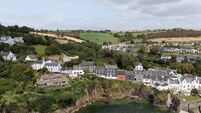
YOU feel the antiquity in the very stones long before you cross the threshold of Rockforest House, in Munster’s Blackwater Valley — the entrance gates alone pre-date the house, dating to Elizabethan times.
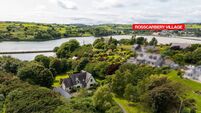
Wind down the approach avenue, with the river valley (oft called the Irish Rhine) beckoning beyond, and you quickly realise that this most authentic and eccentric of period homes has a long, proud pedigree.
In fact, its roots date back 500 years and the main family of owners, the Cotters, were here at least six generation, having been granted hundreds of acres of land by the Anglo-Norman Roche clan. Rockforest was sold in 1916, by the fifth Cotter Baronet, by which time it was on a reduced 150 or so acres: a copy of its then auction sales brochure called it to the attention of “Noblemen, Hunting Men, and Capitalists!”
Now, fresh capitalists are being canvassed as it is about to leave the ownership of the local Mallow business family who’ve had it for around 30 years and who embarked on a slow restoration when they bought it — on just seven acres — from a family who still farm locally.
When first launched for sale, its guide was €1.75 million, and it has been trimmed back several times since and is now guided at €1.25 million by country home specialist Michael Daniels, who lives along the Blackwater and who knows the fascination this famous fishing river exerts at home and abroad.
It is quirky and very much in the true sense of the individualism of preceding eras, and if it seems a bit lop-sided, it is down to the fact that what’s here now is effectively only half of a much larger house, with the eastern wing destroyed by fire and largely removed in the early to mid-1900s.
There’s more than enough left, though, especially when the owners recall stories of the seven years they spent on renovations, all done at a time when the economic tide in Ireland was at a similarly low ebb as today.
The renovation team at Rockforest was effectively one person, local man Donie Ryan, who had long been retired from the army, but who was a talented and driven worker nonetheless.
Because the previous owners had put a long closing date on the 1980s sale to allow them to build a new home, it was three years before any work could start “and that was for the best, because instead of rushing in and making changes, we had a chance to consider carefully what to do. We were going to move the entrance door to the other side, for example, but that would have been completely wrong,” they note.
They brought an expert on period decoration to Rockforest who recommended papers, paints and colours — and there’s hardly a thing white in the entire house, with some unabashed, exuberant colours — strong, deep hues, lush and rich, if not lurid, and completely out of kilter with the era of creamy neutrals. A recent bathroom decoration kept faith with this bravery, with lime green walls, ceiling and shocking pink on lime wallpaper.
Period features are either enhanced or reinstated. The door cases are immense, many internally with fanlights, and almost a novelty is the internal 21ft by 22ft sitting room, with six doors off it, and no windows at all. A good room to weather out a storm!
Essentially two-storey, it has several basement rooms with old quarry tile floors, and among its distinctive architectural features is the curved bow making for a gracious 32’ by 21’ drawing room with similar shaped bedroom overhead. Three of the bedrooms have en-suite bathrooms. Many of the upper floor rooms have distinctive, vaulted ceilings, adding interest and airiness.
The off-set staircase is lit by a Venetian window on the return, while an immense cast-iron stove at the foot of the stairs awaits repair and reinstatement. The house is blessed with fine fireplaces, in slate and stone with fossil prints, with a good Cavan stone chimneypiece in the richly papered dining room with French doors to a south-west facing garden.
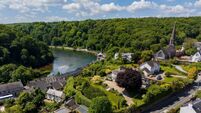
Heading into a spring/summer selling period, Rockforest’s seven acres (with tennis court) are coming into their own, with mature Copper Beech, Chestnut and Walnut and Maple trees, and with old pines and Cedar of Lebanon beyond the boundaries. It’s all enhanced by near views to the Blackwater below, with cliffs and caves in the high limestone bluffs, and distant views of the Ballyhouras, Knockmealdowns and the Galtees.

CONNECT WITH US TODAY



Be the first to know the latest news and updates