Letters to the Editor: Waste disposal should never have been privatised
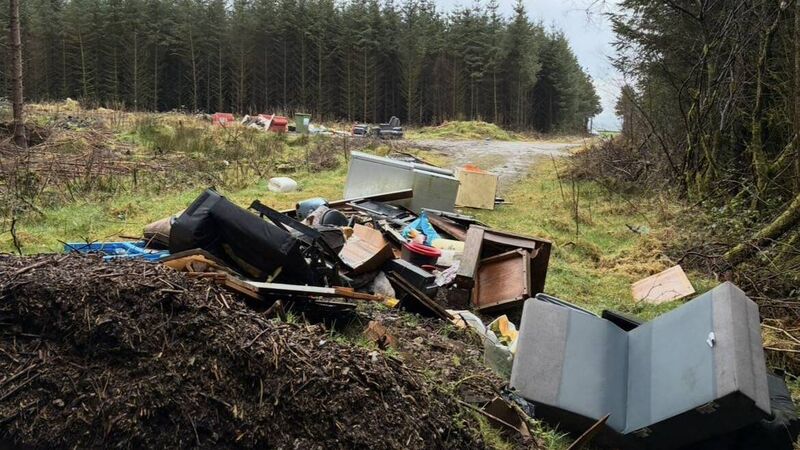
Sean O'Riordan's article on 'fly-tipping' in Cork — otherwise known as illegal dumping — prompted reader Tadhg O’Donovan to contact the Irish Examiner. File picture
I read with interest the column dedicated to the escalating scourge of illegal dumping experienced by Cork County Council throughout the county (Illegal dumping ‘is a scourge on society’, April 11).
Over the years, the practice of illegal dumping, while growing at an alarming rate, has led to much speculation as to the root of the problem.
I am in no doubt that this situation would never have arisen prior to the decision of the government of the day in collaboration with local authorities up and down the country to abdicate on what for generations was a statutory function — namely the collection of all domestic and commercial waste by the local authorities.
If Cork County Council were to revert to the tried and tested method of waste collection that had served us so well for most of the 20th century, then we would not be facing the present scourge of illegal dumping.
To initiate the road to recovery, we must first acknowledge that waste collection is an essential service and should never have been privatised.
The funding for the public sector waste collection workers could be secured under a proactive waste management strategy I have advocated for the last 30 years, based on the principle of taxation of waste at the point of creation in contrast to the present reactionary method where tax on waste is not contemplated until it is about to be disposed. Under such a proactive waste management strategy, society would have influence on the quality and quantity of waste we create, while allowing us to simultaneously resonate with our environmental obligations.
Unfortunately, the alternative is stark in the extreme: Continue with the present reactionary methods that will guarantee ever-increasing amounts being illegally dumped throughout our countryside in urban and rural locations.
As the debate over the International Protection Bill 2026 intensifies, a critical issue of fairness is being overlooked. Thousands of Ukrainians who fled to Ireland in 2022 followed the Government’s guidance in good faith.
We chose Temporary Protection specifically to avoid overwhelming an already strained international protection system. By opting for this streamlined route, we saved the Irish State millions of euro in legal and administrative costs.
Yet, under the proposed changes by the minister for justice, this good faith is being met with a legislative barrier. The Government plans to retroactively ensure that the years spent working, paying taxes, and integrating into Irish communities under temporary protection will count for nothing toward the residency requirement for naturalisation.
This creates a bizarre legal paradox: A person who applied for subsidiary protection — effectively using more state resources for processing — is granted “reckonable residence”, while those who chose the most efficient, co-operative path are excluded.
We are not asking for a shortcut. We are asking for the time we have already contributed to this country to be recognised. Integration is not a tap that can be turned on and off; it is a lived reality in our schools, workplaces, and neighbourhoods.
Petition P00041/25, currently before the Oireachtas, calls for simple justice: Treat our years of residence under the EU directive as the valid legal residency it is.
To do otherwise is not just a legal technicality; it is a breach of the fair play that Ireland prides itself on.
The fallout from the fuel support subsidies campaign is interesting.
A total of €755m has now been allocated as a fuel support package. This allocation has been described as being “at a cost to the State”.
Note the usual note in announcements like this; “....expected to cost the State some x number of millions”. But these are our monies. The citizenry of the State.
Those whom we elect were tardy in reacting to the concerns of people across the country.
The first tranche of supports was clearly inadequate. Until sheer frustration drove the citizenry onto the streets.
With a compliant mainstream media and commentariat, the focus was on the effects of the fuel protests, rather than the reasons for them.
The usual attempts to categorise protesters as far right, or as being manipulated by the far right, did not work.
An Taoiseach agus An Tánaiste have behaved very poorly. No doubt, also, the “permanent government” are furious that anything was conceded. Senior civil servants seem to regard exchequer monies as their own. Keep plenty in reserve. Avoid risk. And, above all, let no groundswell dictate to them.
In announcing the modest concessions, the Government still treated the entire affair as a threat to democracy; as a threat to law and order.
As a citizen of a parliamentary democracy, I respect the mandate of government, and I’ve always used my vote. But perhaps there is a little more to democracy than the marking of a ballot paper every five years?
We are long past the days of being spoken down to by men in suits from the back of a lorry.
We might have temporary relief from the chaos of the past week, but by no means has the problem gone away.
Trump’s proposal for a blockade in Hormuz is going to escalate oil price increases at a level that will put the current increases in the shade.
What happens then?
The Government has to date given €750m in reliefs, money not included in Budget 2026. Compliant taxpayers will have to make good this deficit. But if these benefits are eroded by Trump’s deranged actions, will there be a repeat of last week’s lawless activities?
Last week’s chaos and anarchy was championed by Sinn Féin and, to a lesser extent, by the rest of the opposition. Mary Lou McDonald cheered and emboldened the protesters by her rhetoric and support. When the protests became sinister, amounting to sabotage, not one word of condemnation from the opposition, despite the fact that the democracy of the State was at stake. This from a would-be government in waiting.
Our national broadcaster did not cover itself in glory. One would get the impression from Morning Ireland, Today with David McCullagh, and particularly Prime Time that the Government are the antagonists and the protesters the angels.
Just as I write, Iran is warning of a doubling of global oil prices. Is this country becoming ungovernable?
In his response to a letter from 400 academics urging the Government to abandon plans to remove the triple lock, Barry Andrews expresses the puzzling view that “taking back control of overseas deployment is... an assertion of our neutrality and our sovereignty”.
This is the latest in a chain of shifting government positions on the triple lock — the law limiting Irish overseas deployment to peacekeeping missions authorised by the UN — from Micheál Martin’s 2013 declaration that it was “at the core of our neutrality”; to more recent claims that it has nothing to do with or won’t affect our neutrality; to Mr Andrews’ inventive proposition that sending troops overseas without a UN mandate would be “an assertion of our neutrality”. Which is it?
The UN requirement has been Irish law since 1960 (through much of the Cold War) and was repeatedly sold to citizens as a safeguard of neutrality during the Nice and Lisbon referendum re-runs. It doesn’t cede control of Irish foreign policy, it just limits deployments to missions with international legitimacy. Removing it definitively erodes our neutrality, as it will enable military deployments under the leadership of blocs like Nato and the EU.
Removing the triple lock also seems highly unlikely to improve Irish foreign policy sovereignty when the Government already avoids asserting its existing sovereign right to refuse US military use of Shannon or condemn illegal US wars. Instead, it removes the legal barrier that prevents us from being pressured to participate in such wars.