Letters to the Editor: Trump’s Venezuela oil grab starts the year with a bang
'When Trump said Venezuela was stealing ‘our’ oil, he meant Venezuela was selling to other countries like Russia, but not to the US'
Letters to the Editor: Trump’s Venezuela oil grab starts the year with a bang

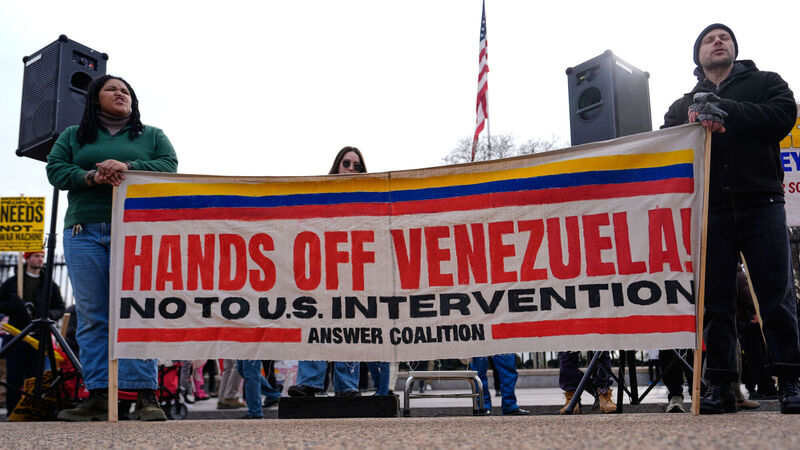
Protesters rally outside the White House in Washington, after the US captured Venezuelan President Nicolás Maduro and his wife in a military operation. Picture: Julia Demaree Nikhinson/AP

The new year has started with a bang. The US raid on Venezuela, protests against Ice officers in the US, ongoing war in Ukraine, and Gaza enduring a winter of cold and rain with most of the population in tents after a three-year war.

Venezuela on the north coast of South America with neighbours Colombia and Guyana and a population of 31m people in 2024 found their capital Caracas intruded upon in the night and early hours of January 3 when Venezuela’s president Maduro (seen by many in Venezuela as elected by a rigged election) and his wife were taken by force and flown out of the country by the US to New York to face charges of drug trafficking to the US.


The mission was so fast by US special military forces — it may get a mention in the Guinness Book of Records. 

It is rarely mentioned in most media analyses since, up to 30 people with Maduro, including his chief aide, and his security team were shot and killed.

What was the real reason for the mission? Venezuela has the largest reserve of oil underground. 

US oil companies are ready to go in and drill for it. A meeting of US president Donald Trump with oil executives was held in the White House last week.

Venezuela, under Maduro’s leadership, had been selling oil to China, Russia, and others, but not so much or not at all to the US. 

This is why Maduro was removed from power. He had been offered safe havens in other countries, but he refused.

When Trump said Venezuela was stealing ‘our’ oil, he meant Venezuela was selling to other countries like Russia, but not to the US.

Trump claimed the US now runs Venezuela for the moment. 

A big undertaking when the US has its problems with millions of Americans worried about big increases to health insurance premiums in January, with many on lower incomes giving up paying. 

They can’t afford it — even though it is crucial to have it.

Mary Sullivan

College Rd, Cork

Donald’s double standard on dissent

When Donald Trump warns that the United States will strike Iran if it kills more protesters, he claims to speak for a universal moral rule.

Governments, he says, do not get to gun down civilians for dissent. When they do, they invite consequences.

If that is truly the standard, then Mr Trump owes the American public an explanation, starting at home.

In Minneapolis, a federal Immigration and Customs Enforcement agent shot and killed Renee Good, a civilian whose death has sparked protests and demands for accountability.

There were no threats of overwhelming force, no moral ultimatums, no declaration that a red line had been crossed. 

Instead, there were statements, internal reviews, and the familiar assurance that the system will quietly judge itself.

So which is for Mr Trump?

People gather in Philadelphia at an anti-immigration enforcement rally and vigil for Renee Good, a Minneapolis woman who was shot and killed by an Immigration and Customs Enforcement officer in Minnesota.Picture: Tassanee Vejpongsa/AP

If killing protesters is an unforgivable crime when done by Iran, why is it treated as an administrative inconvenience when done by his own agents?

If state violence against civilians justifies outrage and punishment abroad, why does it produce only excuses at home in the USA?

He should not answer with scale: One death does not become acceptable because it is domestic.

He should not answer with legality: Laws written to protect power do not absolve its abuse.

And he should not answer with process: Investigating yourself is not accountability; it is evasion with paperwork.

Mr Trump cannot threaten bombs in the name of human rights while tolerating gunfire in their violation.

Either the killing of protesters is wrong everywhere, or his words are not a principle at all, merely a weapon pointed outward.

If there is a red line, then Mr Trump must prove it. Draw it where Renee Good was killed.

Alec O’Connell

Shanagarry, Co Cork

Prepare army for aftermath of war

A letter correspondent writes: “The army [Irish] must be mechanised further and improved in capability and skills. These are achievable for a nation of our size and economy, as proven by Denmark and Norway” — ‘Invest in defence’ ( Irish Examiner, January 12).

If I may comment as a former soldier of the Irish army’s (FCA) Pearce Brigade in the early 1960s: I agree it is a good thing to improve capability and skills in most occupations, including the profession of Irish army soldiering.

However, in a world facing the prospect of nuclear war, especially given the current leadership in Nato — in particular the US and the UK —perhaps the Irish army should be concentrating more on improving their capability and skills to deal with the aftermath and awful indirect consequences that will arise for Ireland’s civilian population, following a nuclear exchange involving, say, our nearest neighbour, the UK.

Regarding the reference to the Danish army’s improved prowess, if the US goes ahead and invades Denmark’s lovely Greenland island, as is threatened by Mr Trump in Washington, I suggest no amount of “improved capability and skills” by Denmark’s loyal army will prevent such a US military takeover; the bravery of the Danish army would be foolhardy in the extreme and ineffective — only leading to the unwarranted killing of many good and brave Danish soldiers.

Micheál O’Cathail

Dún Laoghaire, Co Dublin

Irish sport deserves top billing on RTÉ

The 6pm evening news bulletin on RTÉ One television on Sunday, January 11, was followed, as usual, by the RTÉ sports bulletin. 

The lead sports item covered was the Champions Cup rugby clash between Toulon and Munster, followed by the game between Connacht and Montpellier in the Challenge Cup. 

These reports were followed by a comprehensive report on the FA Cup third round matches from across the water. 

Down the pecking order were the reports on the All-Ireland junior club football final between Ballymacelligott and Clogher Éire Óg and the All-Ireland intermediate football decider between An Ghaeltacht and Glenullin. 

It is unacceptable that reports on FA Cup matches should take precedence over All-Ireland finals from Croke Park.

To reach an All-Ireland hurling, camogie, or football final in any grade is the pinnacle of a GAA player’s career. 

It is a sporting achievement few attain, and should be acknowledged appropriately by the national broadcaster, RTÉ.

These championship club games are the second-most important sports events in the GAA calendar, next only to the inter county All-Ireland senior football, hurling, and camogie championships. 

Rarely do players get a second bite of the All-Ireland cherry.

For generations the clubs in rural townlands, villages, and cities, both in Ireland and abroad, and exclusively on the premise of volunteer participation, has turned the GAA into one of the world’s most successful amateur organisations.

As the national broadcaster, and a publicly funded institution, RTÉ has a duty to project a distinctly Irish world view. 

Giving Irish sports fair coverage on Irish television and radio would be a good start. 

If Irish sporting bodies cannot come out and account for themselves in this matter, are there ordinary members of these bodies prepared to openly protest this anomaly?

Tom Cooper

Templeogue, Dublin 6W

Poor refereeing decide final results

The Easkey manager Padraig Mannion was quite correct when he said that his side was “robbed” and that the red card issued to Andy Kilcullen was a “shocking a decision”. 

It is absolutely terrible that a small club who may never reach an All-Ireland final again were the victim of some terrible refereeing and eventually came out on the losing side.

It has also to be remembered that the sending off of Kilcullen was not the only poor refereeing decision over the weekend, as an Upperchurch-Drombane forward was not penalised having taken 10 steps with the ball in his hand before he hit the ball to the Tooreen net.

A few years ago O’Loughlins Gaels, the Kilkenny club, were also “robbed” in a senior club All-Ireland final when a perfectly legitimate goal was not allowed.

I contend that far too many All-Ireland finals are being decided by poor refereeing, and it will have to stop.

Liam Burke

Dunmore, Co Kilkenny

x

More in this section

Revoiced

Newsletter

Sign up to the best reads of the week from irishexaminer.com selected just for you.

Cookie Policy Privacy Policy Brand Safety FAQ Help Contact Us Terms and Conditions

© Examiner Echo Group Limited