Letters to the Editor: War and militarisation leave us on brink of catastrophe
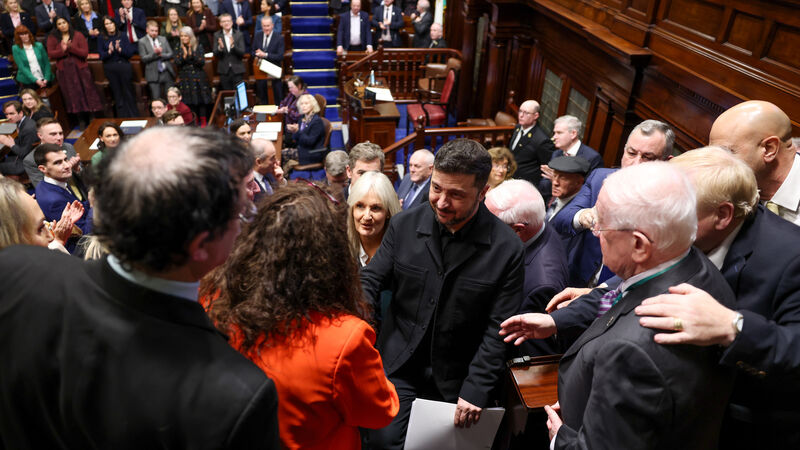
Ukrainian president Volodymyr Zelenskyy is greeted by TDs and senators after his address to the joint houses of the Oireachtas in the Dáil chamber on Tuesday. Picture: Tony Maxwell via PA
Planet Earth is suffering multiple crises inflicted on it by humanity — including wars, global warming, pollution, disease, starvation, and genocide. The good news is that it’s not too late to turn back from the cliff-edge of catastrophe.
The greatest momentum towards such a disaster is the increasing militarisation worldwide.
Despite growing inequality; cutbacks in healthcare; and housing, migration, and other crises, the militarisation of Europe has reached alarming levels, similar to what occurred prior to the First World War and Second World War.
The appetite of the military industrial complexes is insatiable. It needs wars to destroy the weapons already supplied, thereby creating a continuing weapons replacement bonanza. The suicidal aspect to all this is increased by nuclear weapons and the real threat of nuclear war.
Instead of leading the way towards finding and implementing solutions to these problems by using our active neutrality to promote international peace and global justice, our Irish Government is abandoning Irish neutrality and the rule of international laws, including the UN Charter, and joining the coalitions of the willing and the killing.
This was demonstrated on December 2 by the State visit to Ireland by Ukraine’s president Volodymyr Zelenskyy, and by the one-sided military, financial, and political support the Irish Government has given to Ukraine, at a projected cost of over €500m to Irish taxpayers.
An Taoiseach claims that, by doing so, Ireland is defending democracy and that “international borders must not be changed by force”.
Successive Irish governments remained silent, and complicit, when US-led coalitions of the willing attacked the sovereignty of Serbia in 1999 and Afghanistan, Iraq, Libya, Syria, Yemen, and elsewhere since 2001.
The solutions towards avoiding a global holocaust include demilitarisation and replacing wars, injustice, and inequality at all levels with global peace, justice, and equality. There is no alternative.
There is no Planet B that humanity can move to when we destroy Earth.
As a small-scale citizen farmer — more Cincinnatus than commercial operator — I spend my days tending a few acres along the sea in Connemara, keeping bees, and running a UAV-based agricultural survey business that helps local farms monitor pasture health, soil moisture, and vegetation stress. My work lives at the intersection of hands-on rural experience and the agricultural data that increasingly shapes modern land management. From both vantage points, the case for ending fox hunting is clear.
Foxes are not the menace they are often made out to be. Anyone who has lambed ewes knows they remove afterbirth and carrion quickly, reducing disease vectors and discouraging rats. Their daily patrols keep mice and other vermin in check far more effectively than traps or poison. For backyard poultry, the main predators aren’t foxes at all but stoats, mink, and pine martens.
Blaming the fox is easy, but not supported by field evidence or by data from NPWS incident reports.
The forthcoming Animal Health and Welfare (Ban on Fox Hunting) Bill coming before the Dáil is not an attack on rural heritage, and needs our support. It is a necessary correction to a practice long out of step with what we know about ecology, welfare, and sustainable land stewardship. Rural Ireland is changing, and those of us who work the land have a responsibility to shape that change, guided by evidence, not nostalgia.
Readers who agree can make their views known in less than two minutes by contacting their local TDs. Rural voices matter, and if we want to protect the land and wildlife that sustain us, now is the time to let voices be heard.
The Ban on Fox Hunting Bill will be voted on in the Dáil on December 17. Currently, Sinn Féin, Fianna Fáil, and Fine Gael oppose it. But this does not mean all TDs in the parties individually do. The party whip decides how the party will vote. As this is an issue of moral standing, which will decide whether the fox will continue to be terrorised and torn apart by the hunt or allowed to live in peace, shouldn’t the free vote, the “vote of conscience”, be given to the TDs?
That way, they can vote as they feel without the restrictions of the party’s beliefs.
Foxes are essential to keep down the rodent and rabbit population, thus helping plant life to thrive. They are also scavengers, which helps keep the countryside clean of carrion. Fox hunting is a cruel, depraved bloodsport, which is banned in most other countries, including its country of origin, England.
It’s high time we banned it here.
Well done Colin on this fine article (Colin Sheridan: DJ Carey’s wrongdoing not the only unsettling part of 'The Dodger' documentary, Irish Examiner, November 30).
There has been too much of a mob media response to DJ’s transgressions.
None of us are perfect, but I’m sure none of us would like to suffer the glare of publicity that DJ’s transgressions have attracted. Getting a long jail sentence like he got for the offence is punishment enough, besides the public humiliation on television, radio, newspapers, magazines, and social media.
I applaud the generosity of those who, though misdirected, gave so generously to help out a great sporting hero who, it would have appeared at the time, was in great need. I don’t think any of the media need to continue on with this constant tut-tutting and holier-than-thou attitude.
Right now we could do with a comment from Mícheál Ó Muircheartaigh just to let us reset.
If I was travelling by train or wandered into a cafe and saw DJ sitting on his own, I would gladly sit down beside him, and I’m sure I could look forward to a great conversation with arguably one of the top five all-time hurling greats.
The GAA has undoubtedly been at the heart of many communities across the island of Ireland for more than 100 years. People are at its core; they are what makes it work. However, we now learn that the GAA is facing many challenges because, in many parts of the country, people are leaving.
Rural clubs are struggling with declining numbers, while urban clubs face challenges accommodating growing populations and maintaining a sense of community.
A more intense schedule, with higher expectations on players for training and competition, is also contributing to players leaving for other interests. Some rural areas are becoming depopulated as people are leaving for bigger towns and cities. In urban areas, the high cost of living and lack of housing mean some people are leaving the country altogether.
This has a knock-on impact on GAA clubs.
It’s my contention that rural depopulation will wipe out the GAA in large areas of the country unless it is addressed.
Cork City Council would like to address suggestions made by your columnist, Michael Moynihan, in Thursday’s edition that the recent removal of a tree from a former fire substation site on Watercourse Rd in Blackpool, Cork, was an example of the city council “getting rid of trees and green spaces and bringing the concrete”.
Such claims are entirely unfounded and do not reflect the rigorous processes the local authority follows. The decision to remove this tree from what is now a council depot was taken solely in the interests of public safety.
Recent storms had caused the tree to begin lifting, and it had started to lean toward nearby residential properties, posing a potential risk to the general public, to private property, and to council staff. Staff from the council’s cleansing section removed the tree on health and safety grounds.
Cork City Council adopted a tree strategy in 2024, which prioritises the protection and expansion of urban greenery.
However, this strategy also recognises that public safety must come first. Where a tree presents a hazard, removal becomes necessary — always as a last resort and only after expert assessment.
The removal of this specific tree was carried out in line with best practice, statutory obligations, and our commitment to maintaining a safe environment for all.
The council has been involved in the planting of about 5,000 trees so far this year, including the free giveaway of about 2,000 trees at two separate events this year.