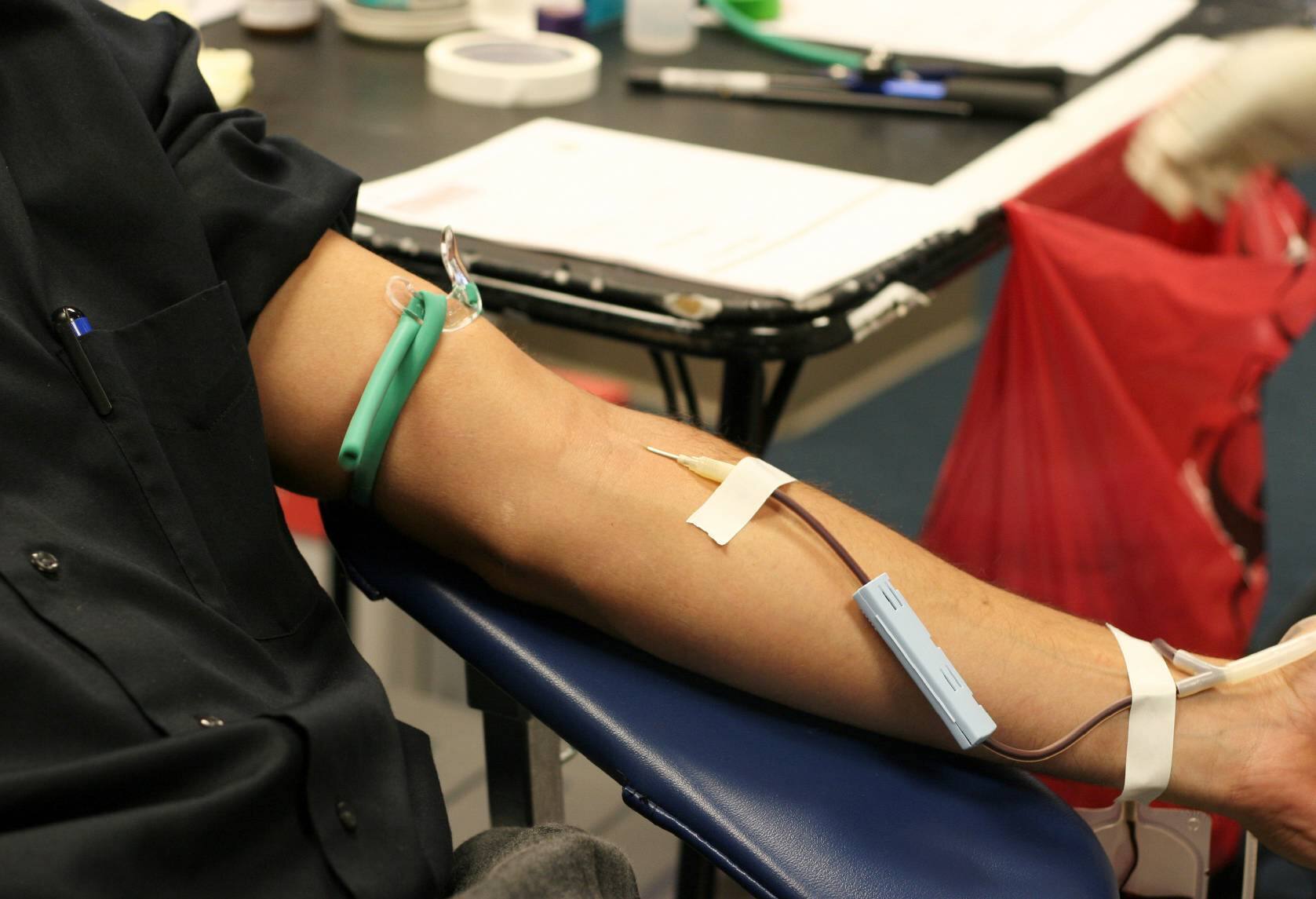
It is deeply concerning that we appear to once again be sliding rapidly into another blood shortage in this country.
Since the end of June last year, 675 units of blood have had to be imported from Britain for use in hospitals and other medical services across Ireland.
It is difficult to align that reality with the other strange reality involving blood donations in Ireland at present.
In December last year, the Irish Blood Transfusion Service (IBTS) and Minister for Health implicitly acknowledged that the process of collecting blood in this country was neither scientific nor fit for purpose.
Three and a half months on, that system remains relatively unchanged — aside from a minor amendment at the end of March which allows gay and bisexual men to donate blood following four months of sexual abstinence.
The policy in Britain and Northern Ireland is to allow donations from sexually active gay and bisexual men. Instead of blanket banning these men, all prospective blood donors are assessed individually, regardless of their sexual orientation or gender, to uphold the safety of the blood supply.
The only reason given to date for the refusal to move immediately and urgently to this individualised risk assessment process in the other 26 counties on this island is that the IBTS wants to wait to change its eligibility rules until it can transfer its pre-donation assessment process to an electronic rather than paper-based platform.
When asked during a radio interview on March 28 why the IBTS was not moving immediately to the scientific individualised risk assessment system, the organisation’s medical & scientific director stated: “To be completely certain, we need an individual risk assessment and to know this risk assessment has been based on population, so that if you are a man having sex with another man, you are excluded or deferred for at least four months from this day on. But when we have the individual risk assessment available, all donors, heterosexual and gay men and lesbian also, will have the same questions and go through the same procedure. So, this will be enabled when we have the system in place.”
Essentially, a shoulder shrug in the form of a rambling paragraph.
As a dedicated and deeply committed blood donor, I would like — and I believe the people of Ireland are entitled to — clarity on why
Ireland refuses to urgently implement an effective and scientific process for the collection of blood.
Tomás Heneghan
East Wall
Dublin 3
Wallace is right to query some motives in Ukraine war
I must say I was taken aback by the vitriolic attack on Mick Wallace by Fergus Finlay . Although I do not always agree with Mr Wallace, I have never had reason to question his good intentions in trying to create a fairer more egalitarian place. Not the same can be said of the party which Mr Finlay has had a long association with.
The attack on Ukraine by Russia cannot be excused and clearly, Russia is the aggressor here.
However, I have become increasingly alarmed at the constant calls for more arms by Mr Zelenskyy while never hearing him call on the West, with any degree of conviction, for the setting up of a process where peace talks can commence.

Rather than him urging the West to convene such a peace conference, all we hear are demands for more and bigger arms.
It must be clear to many that if the West was to respond to Mr Zelenskyy’s requests, the world would be sucked into a conflagration that few would survive.
Surely in that context, Mr Wallace is correct to question the actions and motives of all sides while calling for a cessation of the war.
The fear is that such calls for peace are being drowned out by what seems to be the self-servicing clapping for pugnacious calls to broaden the conflict.
We need to take stock and be very careful what we wish for.
Jim O’Sullivan
Rathedmond
Sligo
Holohan debacle reveals the power of the civil service
The ongoing controversy around the Robert Watt-Tony Holohan secondment shows how much power senior civil servants have in this country.
This story seems more like an episode of the BBC sitcom Yes Minister than reality.
Once the news of this secondment broke, there was a predictable backlash from the public and media regarding who was involved, knew, and signed off on this. Somehow, the minister wasn’t aware of or involved in decisions being taken at the highest level of his own department.
Either his staff are taking decisions beyond their remit, assuming there will be little consequence or he genuinely does not have control of his own department.
Regardless of the reason, it doesn’t speak well of Minister Stephen Donnelly’s ability to communicate within his department, something we already know he suffers with when dealing with the public.
So, as per usual, public outrage leads to political pressure on government ministers leading to the commissioning of a report into the matter.
A report carried out by Robert Watt, into his own behaviour, which of course found his (own) actions to be legitimate and above board.
A report which will likely be argued over for a few days until the media cycle moves on and then it will be quietly shelved before everyone goes back to business as usual.
The run of the mill “lessons have been learned” statement by the Taoiseach, does not cut it.
Why is there such a general inability within the government and senior civil service to delivery accountability and consequence for actions such as this?
Inaction breeds ineptitude and if there are no consequences for these actions, why would behaviour like this ever change?
I thought the civil service was supposed to be a meritocracy, however it increasingly feels like a kleptocracy, which cannot be held to account.
Ben Ryan
Brussels
Belgium
Watt’s salary also deserves scrutiny
Further to the Tony Holohan debacle, we are now informed that the proposed secondment of Dr Holohan to a professorship in Trinity College would have cost the taxpayer €2m over 10 years.
So. Why the 10 years?
Obviously to overstate the case for not seconding him. OK?
Fair enough but if we are going to go into that kind of argument then let us consider that the Secretary General of the Department of Health, Robert Watt, who has a salary of €294,920 per annum, and is costing the taxpayer almost €3m over 10 years.
Brendan Casserly
Bishopstown
Cork
Rebates not enough to ease hardship
This Government will not cap the cost of living in this country and the paltry €200 rebates and the 20% reduction on travel fares will not put much back in people’s pockets.
As for energy bills, a raft of increases will add to the load of hard-hit customers from this month on, with Bord Gáis, Electric Ireland, Energia, SSE Airtricity, and Flogas all set to hike their prices over the coming weeks.
The Carbon Tax is also down for an increase thanks to the so-called Green Party and that is not mentioning outrageous rents on houses flats and childcare. Prices are all above the European average.
It is getting harder and harder for the public to keep their heads above water. This Government must come up with solutions to fix all of this that is what they are paid to do.
Noel Harrington
Kinsale
Co Cork
Is green energy not ‘green’?
How is it that customers on “green energy” plans have the same hikes as ... dirty energy? Sure the wind is blowing at the same cost and the sun hasn’t jacked up its rates.
Or has there been some green-washing going on?
Angela Morris
Turners Cross
Cork