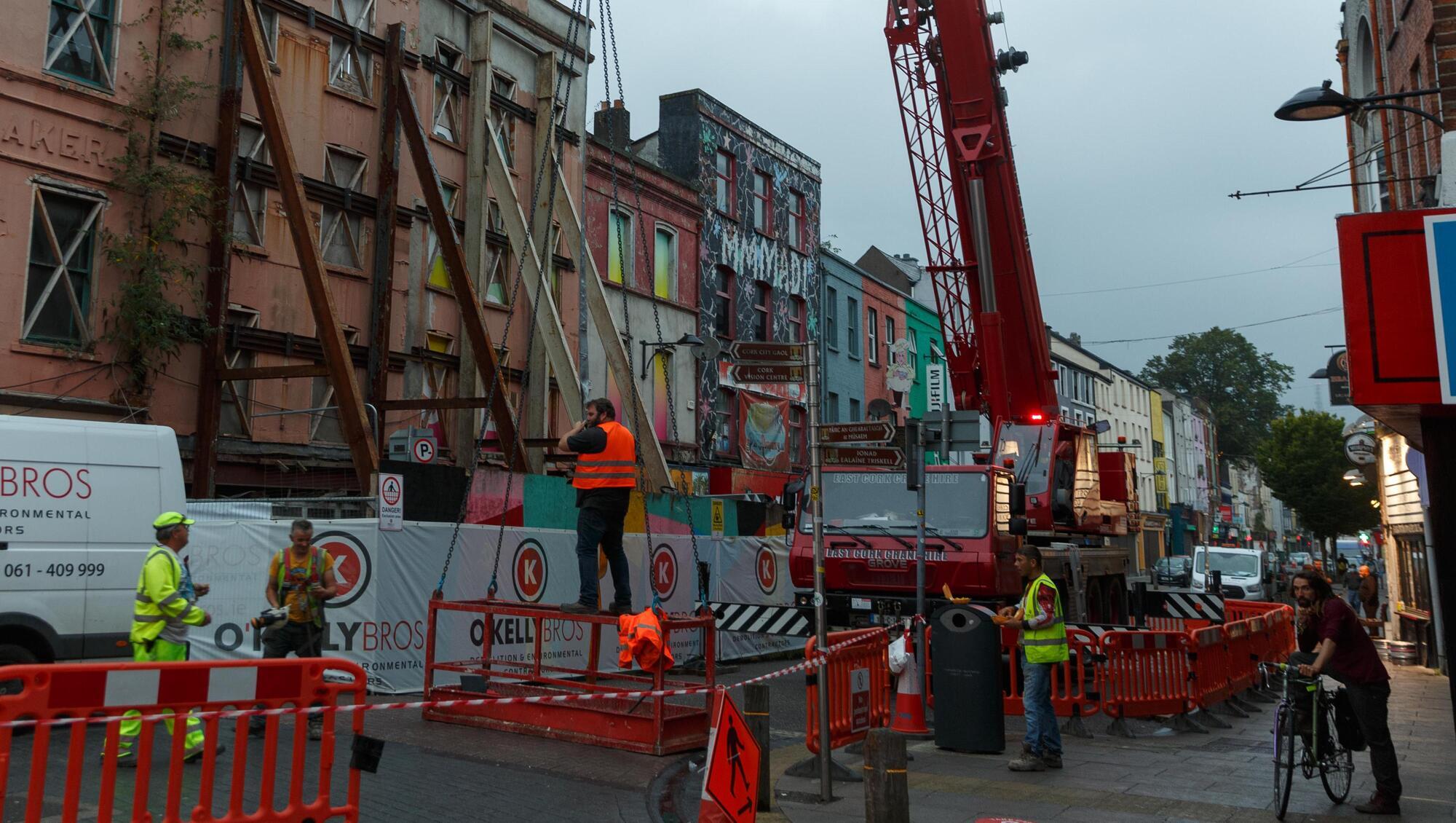
I find the recent revelations that less than 1% of vacant site levies owed to local authorities in 2020 were paid to be deeply disturbing. Local authorities were owed more than €21.5m in 2020, yet only €21,000 was received. This farcical situation means that less than one-tenth of 1% of the total money owed was paid.
Since 2017, local authorities have been required to compile a register of vacant sites, record the value of these sites and collect a levy of up to 7% of the value every year.
Vacant and derelict sites increase levels of unemployment, damage communities, increase rates of crime and anti-social behaviour, and make the housing crisis worse by reducing the availability of possible rental properties and properties to purchase in the State.
Cork is plagued by unacceptably high rates of dereliction that both councils have proved time and time again to be incapable of resolving.
The failure to collect vacant site levies is both unforgivable and an absolute disgrace. In fact, the failure of both councils to collect the vacant site levies reminds me of their failures during the so-called Celtic Tiger times to collect developer levels. This too was a disgrace, which cost the Irish taxpayer millions in the long run.
Local authorities have proven themselves to be completely incapable of enforcing the law when it comes to vacant sites.
The role of collecting the vacant site levy should be immediately transferred to the Revenue Commissioners. At least they have a well-proven track record of collecting money owed to the Irish State, unlike local authorities.
JP Daly
Hollyhill
Cork
‘Table-isation’ of Cork city centre
I refer to the letter ‘Dingle streetscape is being destroyed’ (Irish Examiner, June 18. The same scenario is playing out throughout Cork city. This pandering to the hospitality trade is an over-reaction as restrictions imposed during the pandemic are beginning to lift. It appears that Cork City Council has given no thought as to the long-term disturbance to both the architectural integrity of the city or to the comfort and safety of its citizens. MacCurtain Street is like an obstacle course where one must weave in and out to avoid ugly, cordoned-off eating/drinking spaces or be forced out onto the new phenomenon of board/rubber walk platforms dangerously close to vehicular traffic. Both Princes Street (South Mall end) and sections of Oliver Plunkett Street have been, not pedestrianised, but ‘table-ised’ for eaters and drinkers. Have there been planning notices for these changes? Do all of these businesses have planning permission to block pathways — and indeed streets.
There are businesses in our city other than coffee shops, pubs and eateries. Already the cycleways project has proven to be detrimental to some businesses and dangerous to both pedestrians and cyclists. It would be far more beneficial to the citizens of Cork if the council focussed on the elimination of derelict buildings and the restoration of our heritage buildings as part of a coherent, planned, and well-maintained living environment for us all.
Eugene Currivan
Arbutus
Montenotte
Cork
Accessibility before euthanasia choice
Firstly, I want to express my sincere love for the woman telling her story — ‘Why, oh why can’t I die in peace?’ (Irish Examiner, online, June 20). As a 32-year-old woman living with a terminal, degenerative, neurological
illness I can empathise with her experience.
I live with a neurological disease frequently described as one of the most horrific neurological illnesses. Imagine a mixture of Alzheimer’s, Parkinson’s and ALS in one disease. Yet my life has value.
I will not consent to euthanasia and hope that before euthanasia is legalised in Ireland we will ensure there is full accessibility for all disabled people. We will ensure that accessibility barriers are removed.
By ensuring disabled individuals are included and supported we can ensure that euthanasia is a genuine choice and not simply a reaction to a world that is currently not accessible.
I know what it is like to have to fight to be included. There are spaces and government departments still inaccessible to me. There are still presumptions made about me as a disabled person that I do not agree with. One of the most concerning being that the concept of allyship with the disability community being a pro-euthanasia position. I am not necessarily writing this to try and change anyone’s mind on euthanasia, more as a plea, that all the energy going into giving me and others like me the right to die could be split between the right to die and the right to accessibility while I’m living, because I can’t help but feel that euthanasia is seen as the easier solution then ensuring assistive technology becomes socially normalised.
Carrie Jade Williams
New Market St
Cahersiveen
Kerry
We contribute little to global warming
The farming and rural communities have every right to be concerned about the passage of the Climate Action Bill through the Oireachtas.
The bill is based on the false premise that Ireland, and agriculture, in particular, are major contributors to global warming. The irrefutable fact, according to a United Nations Framework Convention on Climate Change Report (UNFCCC) in 2018, and rarely mentioned by those in favour of the current agenda, is that our contribution to global warming is a mere 0.128% of the total.
Agricultural emissions, being 35% of Ireland's total, therefore contributes a minuscule 0.042% to global warming. To add insult to injury, farmers do not receive any credits for CO2 capture through photosynthesis across their lands, hedges, trees and forests.
In context, Ireland’s total production-based emissions (including CO2, Methane, NOx and Ozone) are of the order of 60 Mt CO2e against a world total of 48,000 Mt CO2e (million tonnes carbon dioxide equivalent).
The other conveniently ignored irrefutable fact is that again according to the UNFCCC, the vast bulk of global warming is generated elsewhere, specifically in the highly industrialised countries of China, USA, EU, India, Russia, Japan, Brazil, and Germany, among many others.
It is also a fact that the growing and serious effects of global warming do not recognise international borders and are therefore largely imported and imposed on our small island.
It follows that the Irish government, rather than resorting to misleading rhetoric and demonising the farming and rural communities here, should direct its energy and diplomatic influence towards the real culprits — those countries historically and presently responsible for the impending climate carnage.
Given that our national debt is around €250bn and climbing, the key issue must be to manage our small contribution to global warming appropriately — in a fair, pragmatic, responsible and timely manner, that does not permanently damage our economy and does not lead us ultimately to bankrupting the country again
John Leahy
Wilton Rd
Cork

Inclusivity should mean acceptance
Joe Dunne is openly dismissive of Edwin Poots’ religious views — ‘Poots: It was all just a matter of time’ (Irish Examiner, Letters, June 19). One is constantly bombarded with oft-spouted claims that Ireland is now a welcoming place for diversity and inclusivity. Really?
One may find others’ views/opinions/thoughts/mannerisms/political leanings at variance with one’s own. Silly me, I thought a genuinely inclusive, diverse society would be accepting of same. But no. The evidence would indicate that it only applies if they dovetail with one’s own mindset
.
I think Mr Dunne’s letter says more about his own mindset than that of Mr Poots.
Aileen Hooper
Stoneybatter
Dublin 7
Vaccinate students for colleges now
Comments made by Colm Henry are very contradictory because if schools and colleges are to open up in September surely it is sensible to start vaccines as soon as possible for the 18 to 25 age group so that they can resume their education?
At the moment, it is 35 to 39 age group. Why not start the 18 to 25 age group, and then at least by the end of July most of the population will have had at least one dose of the vaccine.
It seems to me that the Government and Nepht seem to be telling the under 30s not to travel, and not to gather in large crowds as these are the ones that are more susceptible and are infecting others even though they only have mild symptoms or are asymptomatic.
Susan Burke
Cahir
Tipperary
Publicise peace
There are many reports of ongoing violence in the Middle East — Israeli/Palestinian.
Unfortunately, very little publicity is given to the elements on both sides who advocate peaceful coexistence.
Michael A Moriarty
Rochestown
Cork
CLIMATE & SUSTAINABILITY HUB