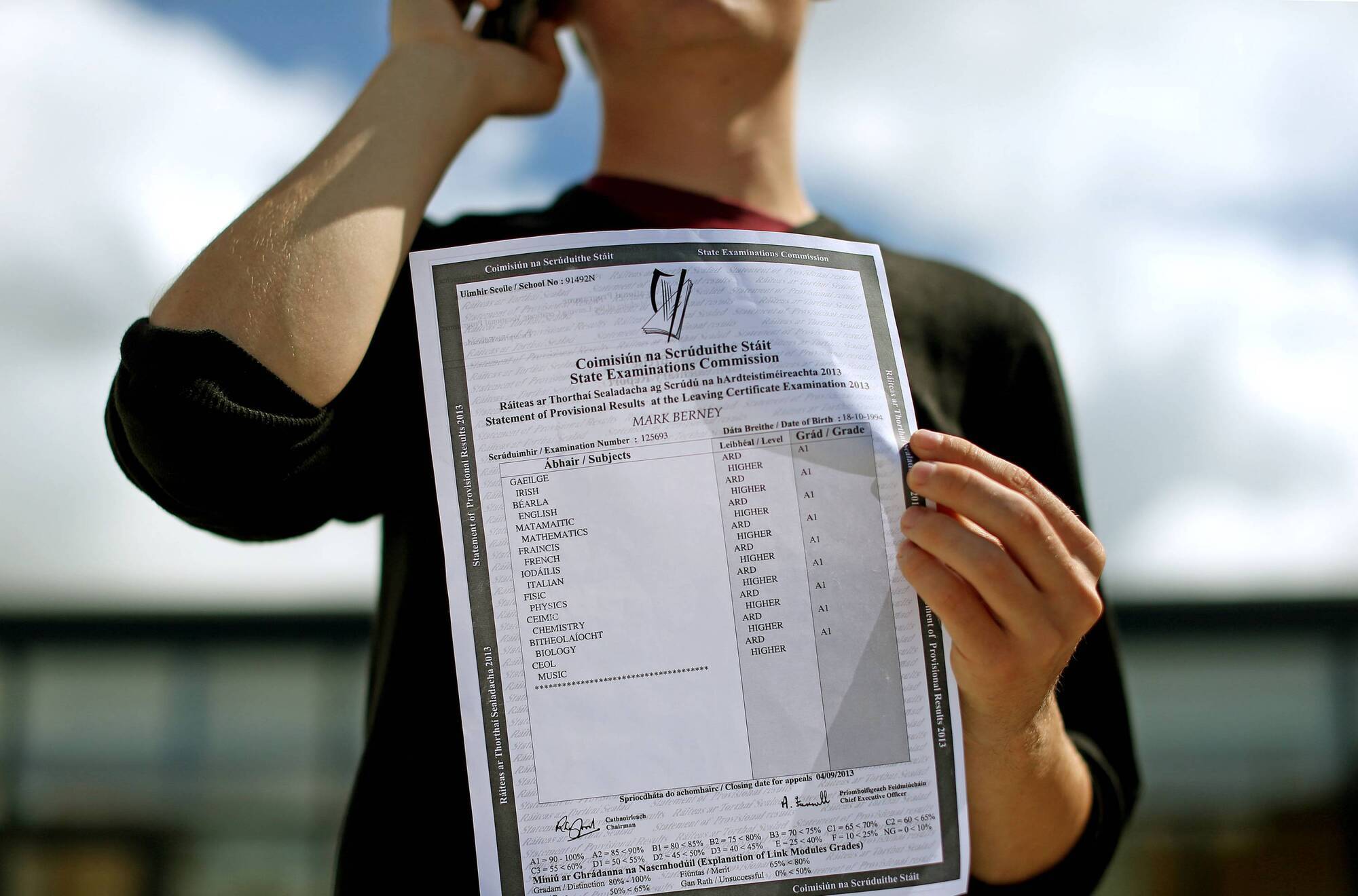
I am a sixth year student. At the moment I should be studying for the exams I will be taking next week; instead, I am writing this letter to you. I am stressed, confused and upset because of the decision by Education Minister Norma Foley to delay the issuing of he Leaving Certificate results to September 3.
Next year, I am hoping to study civil engineering at the University of Twente in the Netherlands. I have already been conditionally accepted, but just have to hand in my Leaving Cert grades — before August 31, as the course starts on September 1.
My dilemma is that with this new announcement I will not be able to take my place in this course. I then have to defer my course for a year, I have to reapply and am not guaranteed a place.
It also eliminates my eligibility for grants and loans given by the Dutch government, as I am then forced to take a gap year.
As I read the statement from Ms Foley it occurred to me that decisions are made based on the assumption that all Irish second level students are applying to third-level education through the CAO system.
What about all of the other students like me who want to study abroad? We are left behind. Most courses abroad start on September 1, and we are now robbed of this choice and opportunity. I have not even applied for universities in Ireland as I knew that I would only want to study in The Netherlands.
Why do I need to be punished for that?
From March on it was already known what this year’s Leaving Cert would look like and yet this information is only coming out now, a week before my exams. Who can explain to me and others why the results need to be delayed?
Less students are sitting exams and the accredited grades are in before the start of the exams so it seems only logical that it would actually take less time than before. Instead it suddenly takes more than two months to mark and organise our grades; it doesn’t make any sense to me.
By changing these dates, Ms Foley has robbed students of their choice to study abroad. She has completely disregarded me and others who want to study in the UK or Europe.
Ina van Opstal
Roscommon
We really can make a difference
“I’m powerless to help,” is what I thought today as I read an interview given by a young Nigerian parish priest. Based in Madagali, Fr Innocent Sunu, was saying that four previous Catholic pastors had been murdered in the town. The church has been burned down by Boko Haram so the people sit on stones and set up a table for an altar. The clinic has been burned, the school has been burned.
Fr Innocent went on to say that the local military is the first to run when Boko Haram comes. Worse than that though, the local military appropriates local businesses and farms, exporting goods needed by the people to nearby Cameroon.
NGOs are terrified of the dangerous area and stay only an hour. There is a shortage of clothes, food, medicines, and water.
Then I read something which filled my heart with pride. The young Nigerian man said that fortunately, Ireland’s St Patrick’s Missionary Society had donated a water system. It’s under pressure though as more than a thousand people use it every day.
We ordinary people in Ireland should never feel like our donations do not get to the people who really need them. Missionaries are in the thick of things. They live there. Often they are on the scene helping before NGOs get in and they are there long after the NGOs flee.
Alma Neary
Castlebar
Co Mayo
Referendum on housing is needed
I think there is not enough transparency about the Land Development Agency (LDA); is it free to sell public land to developers?
Should not all public land be used for either social or publicly generated, owner-occupied housing, or at cost-rental? After the initial building start up needing an EU loan, the latter will fund itself ongoing from the rental.
If the LDA can override a council rather than co-operate with them, that is a recipe for trouble. I also understand that the chief executive of a council can ignore the wishes/votes of councillors, that is hardly democratic.
All these arguments and delays with so many regulatory bodies: planning board, planning regulator, housing agency, LDA, local authority councils, etc, and assistance schemes, could be shortened and a lot of red tape cut out if we had the referendum on housing as included in the Programme for Government.
We would thus stop the never-ending quoted red herring obstacle of “infringing constitutional property rights”.
Ingrid Masterson
Churchtown
Dublin 14
God need not disturb the science
With reference to TP O Mahony’s thought-provoking article Themes of religion and science still clashing. While the bible is one of the most reproduced and quoted books ever written the authors of the tome didn’t have access to the knowledge that we have today so we can’t fault them for their oversimplistic view of the world.
But to think that in light of the modern advances in the fields of science there are still people clinging to these archaic points of view seems incredulous.
Darwin’s theory of evolution was a gamechanger in our understanding of ourselves and the world around us but many scientific questions remain unanswered.
Firstly, is our world unique or are we part of a much larger multiverse system? Secondly, where did all the missing anti-matter go to? Thirdly, will the universe continue to expand or at some point will it contract back down to its original state in the so called Big Crunch or most importantly what existed before the Big Bang?
Because of these and other gaps in our knowledge I think it is still possible to squeeze God into the equation without disturbing the science.
Michael Henchion
Ballincollig
Cork city
Contradictory states on solution
Elaine Loughlin's article —Ireland’s stand on Israeli ‘annexation’ pushes Palestine up the EU agenda — claims erroneously that politicians from PBP-Solidarity have been pushing a two-state solution.
In fact, PBP’s long-term policy statement on Israel and Palestine explicitly states the need to “focus on an agreed political end, namely the One State Solution, democratic and secular”.
This policy contradicts the mainstream view of the Irish government parties, most Western governments, and the United Nations all of whom support a two state solution.
It also contradicts majority opinion amongst Israelis and Palestinians.
Treasa Trainor
Dublin 16
No future in our privatised nation
The abdication of responsibility in so many areas by governments over the years will prove to be very costly in the coming years with the cost of living considerably more disproportionate to the standard of living for far too many of our citizens.
The ultimate betrayal of those who aspire to rent or buy their own home — and now find themselves unknowingly paying taxes which are being used to fund private investment companies which buy complete housing estates for the private rental market — beggars belief.
In October 2015 the League of Credit Unions submitted an offer of €5bn to government offering funding for the building of 26,000 homes for social housing by 2021.
The League expressed its willingness to create this fund for ‘community-enhancing investments’ in keeping with its long-established ethos.
By March 2016 an official response to the offer had still not come from government. It was around the time of a coalition government of Fine Gael and the Labour Party with Enda Kenny as taoiseach and Michael Noonan as minister for finance.
Our nation has never so badly needed a party to counter the greed of rogue banks, boardrooms, liberal economics, and casino-like markets which continue to dictate the futures of far too many people and which are being facilitated by like-minded political parties.
To achieve real competition in our failed banking sector the credit unions must be given more powers and the AIB, now over 70% owned by the people, should be nationalised.
Because of stability of tenure and fair government-controlled rents the social housing achievements of the 1940s, ’50s and ’60s gave us achievers in the trades, the arts, sciences, and academia which together with a sound educational system provided the launch pad for many a successful career together with humanitarian organisations which have helped the most needy people both at home and across the planet.
This visionless government of ‘privateers’ has left us with hospital waiting lists (830,000) and growing housing waiting lists together with a level of national debt which is heading towards €250bn and (€300bn post Covid). They have taken ownership of our natural resources, energy fields, and communications networks out of the hands of the Irish people and placed them, including jobs and livelihoods, in the hands of boardrooms and private shareholders.
Joe Brennan
Ballinspittle
Co Cork