Letters to the Editor: As a woman, I felt unsafe on the streets 30 years ago
Letters to the Editor: As a woman, I felt unsafe on the streets 30 years ago

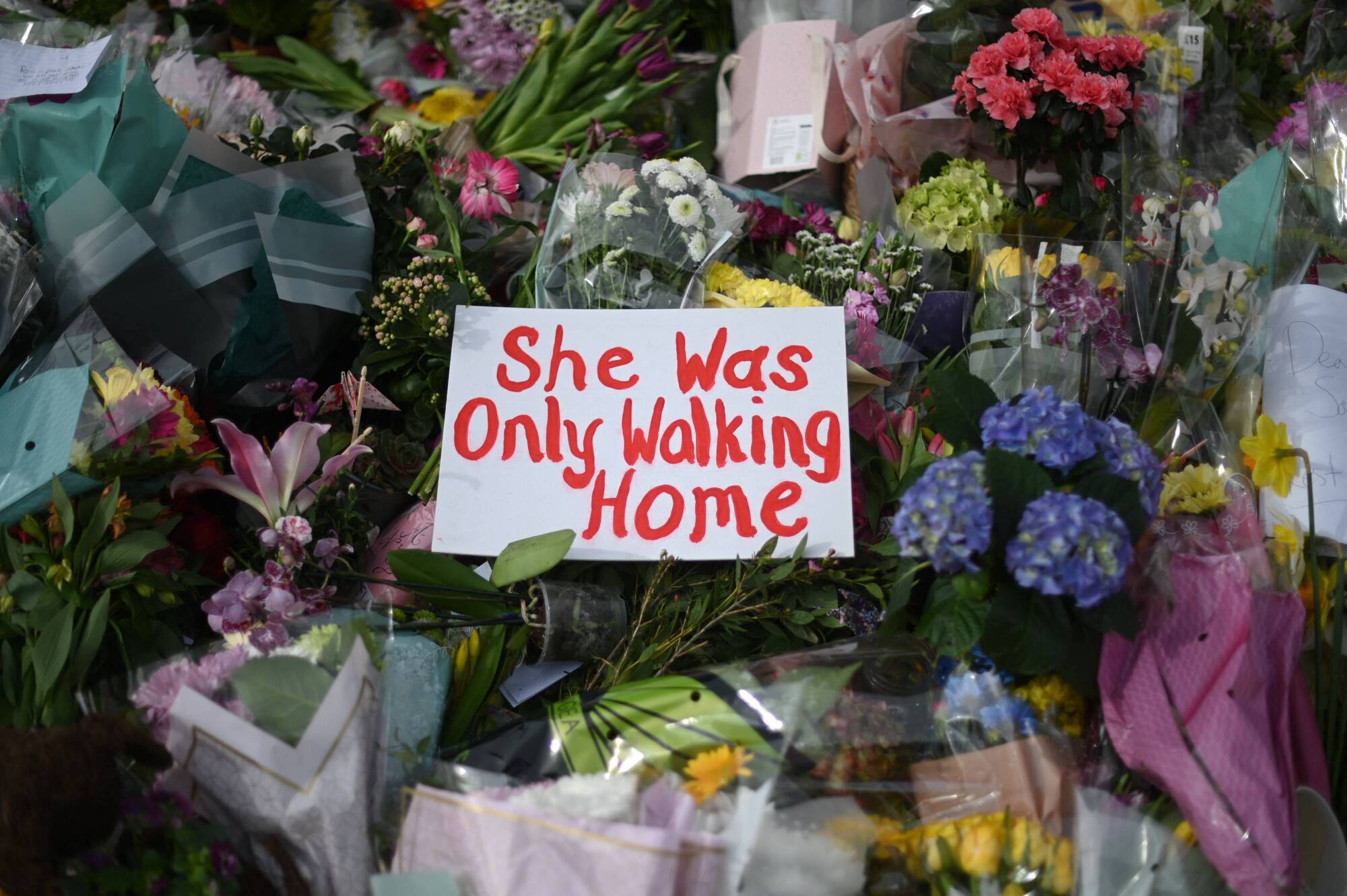
Messages and floral tributes left by well-wishers to honour murder victim Sarah Everard at the bandstand on Clapham Common in south London Picture:  DANIEL LEAL-OLIVAS/AFP via Getty Images

Since the killing of Sarah Everard, women in London have spoken about feeling unsafe and of reclaiming the streets. Thirty years ago, I lived in Tralee. I was walking home one night alone. Two men passed me on the path. Then, one stopped to tie his shoelace and I had to pass them. And when I walked by, I picked up my pace and then I heard them pick up their pace.

I started to run and they started to run after me. I wasn’t far from where I lived: I was at the top of the road and where I lived was at the bottom of the road. I ran like hell. And they were catching up. The street felt like it was the longest in the world. There was nobody around. The street was not predominantly residential; it was abandoned buildings and a car-park type set-up. I got to the gate of my house and made a sharp turn, and lucky I did, because one of the guys grabbed my arm just as I turned and the force of me turning meant that he couldn’t hang on. I just bolted to my door. I lived in a flat at the back of a house, and went inside.

I never got a look at the two men. I never told anyone. I didn’t report it. How could I report it? I couldn’t describe the two guys. And, in a way, nothing happened.

Obviously, not all men are a threat; most are not. But women have to make judgement calls all the time, especially at night, and we shouldn’t have to. That was a terrifying experience for me that night and it has stayed with me all these years. I’ll never forget it. I dread to think what would have happened if I hadn’t run as fast as I did.

Adrienne Parsons

Clifden,

Co Galway

Violence pervasive, including in home

All of a sudden, it is unspeakable, the violence. We need a 50:50 gender balance in politics, media, health, and education, for starters. We need a definite ‘no’ to sexual violence, perpetrated against anyone. We should give short shrift to porn and the sex industry. There should be non-violence training in schools. There has to be a radical change in attitudes and in what is tolerated towards people of any gender.

Domestic violence could be a separate category of crime, as 12 women, on average, have been killed in their homes every year since 1985. Women’s Aid compiled the statistics. What is the male-dominated government doing about the violence? We are witnessing the dreadful consequences of the incarceration of thousands of women and girls for decades in mother-and-baby homes.

We need change now for a more humane society for all.

Máire Úna Ní Bheaglaoich

Aonach Mhargadh na Feirme,

BÁC 7

Men are stronger. That’s just a fact

Physical strength is not a social construct. Colin Sheridan (Irish Examiner, March 8) asked if the conventional wisdom that men are stronger than women had diminished the value of women’s sport, and asked if strength was a social construct.

Men are stronger than women. This is a biological and physiological fact and well-documented in scientific literature. Men are physically stronger than women, who have, on average, less total muscle mass, both in absolute terms and relative to total body mass. Men also have denser, stronger bones, tendons, and ligaments.

This week, the stark reality of women’s physical vulnerability unfolded in London with the killing of Sarah Everard. The fear of attack and the vulnerability that women experience is very much based on their awareness that men are stronger.

Language is a powerful tool. Deconstructing the word ‘strength’, as Mr Sheridan did in his article, to refer to inner determination, risks blurring reality and creates confusion and doubt in basic biological fact.

The reason women’s sport is undervalued has to do with the social construct of money.

C Harpur

Glounthaune,

Co Cork

IRA influence in the Irish media

Former Guardian media columnist Roy Greenslade has admitted his support for the IRA, though its former editor Alan Rusbridger has denied that there was an “IRA cell” within the newspaper. Rusbridger said he was unaware of Greenslade’s affiliations. Rusbridger said it was a ‘red herring’, because Greenslade did not write any Guardian editorials on Northern Ireland. But is it possible that the IRA had any influence within the media here?

Some Irish media outlets seemed to take a softer approach than others to the IRA and the Troubles.

Pat O’Mahony

Harbour Mill,

Westport,

Co Mayo

Government’s job is to get vaccines

As of today, I am no longer playing the ‘game’. For the past year, I, like everyone in this joke of a country, have been living in a never-ending lockdown, my movements and freedom greatly restricted, while the world and his brother can come here and wander freely. The priority is the protection of a health system that has been systematically decimated and privatised. The much-heralded, game-changing vaccine seems to be adverse to appearing in Ireland in large quantities or frequency but has no problem gracing the shores of the UK and of the US. The only explanation from our confused government is that they are doing all they can.

Well, do more. The only way to end the misery and the death is for our political leaders to do what they were elected to do: Lead and get the vaccines here, by hook or by crook.

Jim Byrne

Silverhieghts Drive,

Cork

Wait your turn and you’ll get your jab

Why all the hubbub and jockeying for position to get vaccinated a bit sooner than your neighbour?

The HSE can only give out what they get, and they have. Everyone who wants a vaccine will get it in the next couple of months. Nothing God or man can do will speed up your turn; it will come when it will come. Unrequited expectations will wreck your head.

Think of your neighbour, and relax people, relax.

Kevin T Finn

Kingston Close,

Mitchelstown,

Co Cork

 HSE CEO Paul Reid at Dr Steevens’ Hospital for the weekly HSE operational update on the response to Covid-19. Picture: Leon Farrell / Photocall Ireland
 HSE CEO Paul Reid at Dr Steevens’ Hospital for the weekly HSE operational update on the response to Covid-19. Picture: Leon Farrell / Photocall Ireland

Paul Reid salary is money well spent

True to form, the outrage went into overdrive when the annual salary paid to Paul Reid, CEO of the HSE, was made known. I ran my eyes over the salary scales of public-service workers across the spectrum. As a lifelong PAYE taxpayer and a former Progressive Democrat politician, I tend to measure these matters in terms of value for money. Information about salaries in RTÉ, the national broadcaster, is easy enough to access. Their top presenter is paid €495,000 per annum. Next in line, a male presenter again, of course, is paid €450,000.

Meanwhile, Paul Reid, the CEO of a workforce in excess of 100,000, in the most demanding and valued of all of our public services, gets €420,000. Now, there’s value for money.

MairĂ­n Quill

Wellesley Terrace,

Wellington Road,

Cork

Tories don’t care about the North

The North is still a dangerous and complex political patient, after 50 years of strife. It needs a surgeon’s deft hand.

In comes UK prime minister, Boris Johnson, who is all thumbs and vacuous ‘bully for Britain’ anachronisms. He did not meet with Michelle O’Neill, the North’s deputy first minister. Imagine An Taoiseach Micheál Martin journeying to Belfast and not meeting the first minister, Arlene Foster? We have more sense.

That’s just another instalment in the long, ignominious story of Tory attitudes to the North. The region is a pawn on the Westminster chessboard. Nothing more. Leave someone else to sort it out.

Boris Johnson is a walking, talking, breathing embodiment of Westminster’s lack of interest in the welfare of the nearly two million people in Northern Ireland.

The North is complicated. Boris couldn’t care less.

Michael Deasy

Carrigart,

Co Donegal

Parents should agree to vaccinate

There is a likelihood of court cases involving separated parents arguing as to whether their children should be vaccinated against Covid-19.

The answer is simple: Yes, they should be, and full custody should be given to the parent who wants the vaccination, as they are the more responsible.

Dennis Fitzgerald

28 Landale St Box Hill,

Vic Melbourne,

Australia

More in this section

Revoiced

Newsletter

Sign up to the best reads of the week from irishexaminer.com selected just for you.

Cookie Policy Privacy Policy Brand Safety FAQ Help Contact Us Terms and Conditions

© Examiner Echo Group Limited