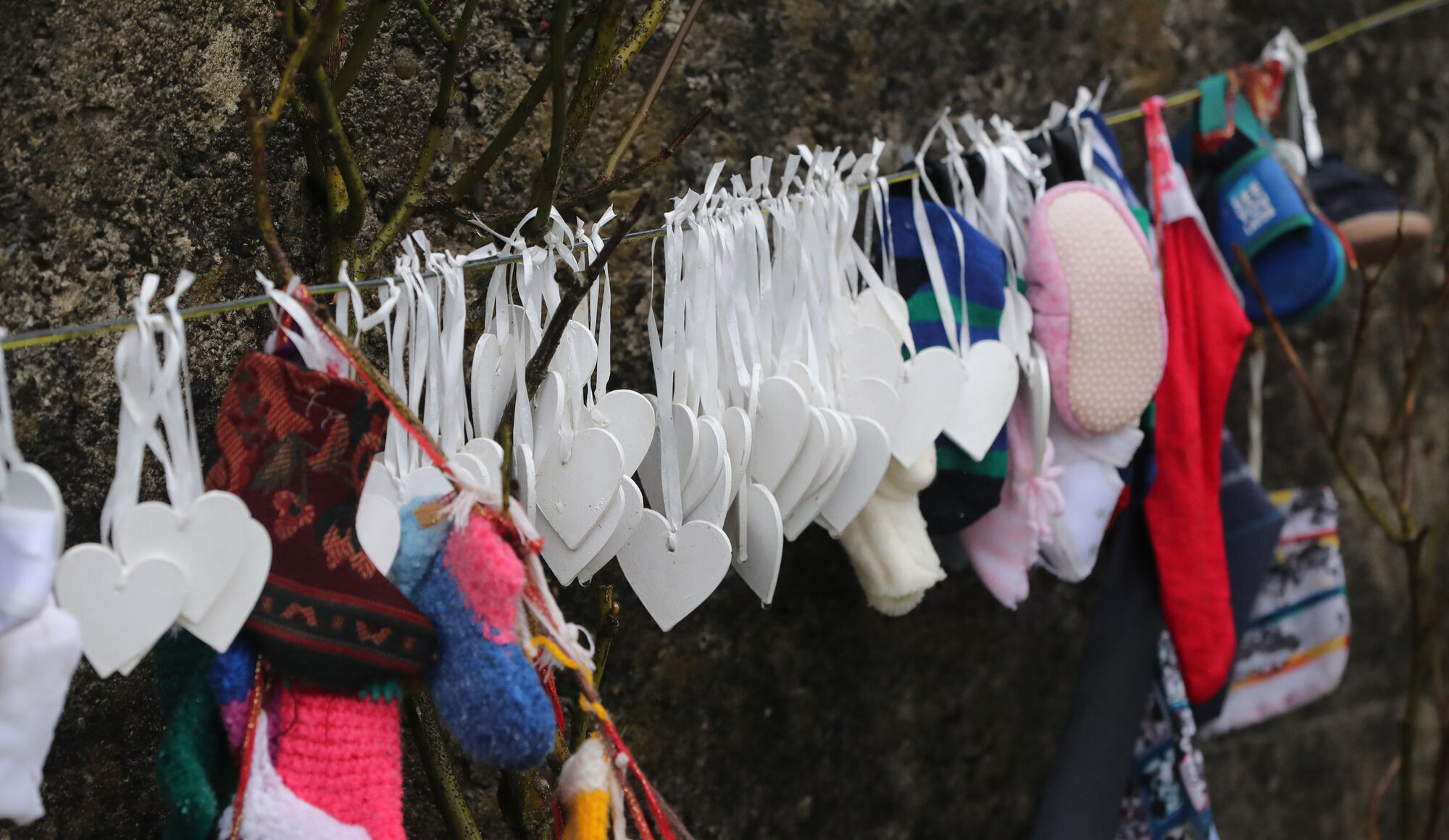
Aoife Moore is partially right that the mother and baby homes ‘were never about sin at all’ (Where are the men? Irish Examiner, January 16). It would be revisionist to claim that, at the time, there wasn’t a widespread view — largely absent today — that sex outside marriage was sinful and shameful.
However, telling us it all boils down to patriarchy is equally reductionist and simplistic. Certainly, the fathers had broken social rules, or “sinned”, too, but the women’s pregnancies and resulting children were the most visible, incontrovertible evidence; and it was this evidence that the society wished to hide.
The fathers were often able to evade the consequences of their actions; in those days before DNA tests, it would have been harder to identity them. No doubt there were men who were roughed up by the girls’ families, or who went into voluntary exile.
Equally critical to understanding that time is the impact of the 19th century and Victorian society. A socially climbing, lower middle class arose from the industrial revolution and craved respectability and conformity.
WB Yeats described this well in his poem September 1913.
The mother and baby homes, industrial schools, and workhouses were not an invention of the Catholic Church, from the time of the Free State, as many journalists seem to be claiming now, but a product of this Victorian drive for “social reform”.
All of them have their roots in early 19th century Protestant British rule here, along with the national schools, which were begun in 1832. Such institutions existed across the rest of Britain, along the same lines and for much the same reasons.
The Free State inherited them in 1922, just as it inherited much of Britain’s judicial and administrative machinery.
There was a punitive element to all of these institutions, founded on a Protestant notion of “prosperity gospel”, the idea that material success is a sign of God’s favour (notwithstanding Jesus Christ’s own dire poverty).
Read More
In Protestant Victorian society, social misfortune was interpreted as the consequence of personal sin. Therefore, unmarried mothers, alcoholics, the poor, homeless, and jobless needed to be “reformed” and “saved from themselves”, through punitive measures and hard work.
But this was principally to prevent them being a burden on the rest
of a society that had scraped its way up by the bootstraps and made it, materially.
It is sometimes said that the most conservative minds are those that have just enough, materially, to lose.
That mean-spirited sentiment is still widespread in our society, and while the religious dimension has fallen out of favour, it manifests in other ways.
So, instead of promoting conspiracy theories about “the patriarchy”, if we wish to understand how the mother-and-baby homes came about, we only need look at ourselves, today. Aoife Moore ends by saying, “It’s about time men spoke up”. I agree, and I hope I have done my bit.
Nick Folley
Carrigaline
Co Cork
Damage limitation by the Church?
In his interview on RTÉ’s This Week programme (Sunday, January 17), Archbishop Eamon Martin suggested that religious congregations may be scapegoated for their role in mother and baby homes and said: “They were commissioned by the State and local authorities, county councils, and expected to intervene when the rest of society had, basically, banished these mothers.”
He seemed to be apportioning significant blame to “the rest of society”, in the way that Fianna Fáil did during the economic crash of 2008.
By using the phrase, “they found themselves in the frontline”, he even seemed to suggest that these religious congregations were performing a similar role to health workers during the Covid-19 pandemic.
His statement that, “If it’s just, proportionate, and if it’s an account of the findings of the commission, I do feel the Church needs to do reparation for this” also seems to limit any such reparation payment, especially as the commission’s findings with regard to accountability have been widely criticised.
His interview sounded more like a carefully crafted, damage-limitation exercise than an effort to right the dreadful wrongs perpetrated on so many women and children.
Edward Horgan
Castletroy
Limerick City
A pregnancy can still be a crisis
So much angst at what happened to crisis pregnancies in the past and so many declarations that such injustices must never again be perpetrated on the innocent and helpless. The mother and baby homes scandal, and subsequent state apology, have brought this issue to the fore again.
How does modern, confident, empathetic Irish society deal with crisis pregnancies now?
Will survivors of the contemporary response to crisis pregnancies berate us in years to come? Plus ca change.
Aileen Hooper
Stoneybatter
Dublin 7
State apology not sorry enough
Micheál Martin has denied that the Commission of Investigation report shifed some blame for the mother and baby homes onto society, but I think it did. We all know what went on down through the years when the Catholic Church had power for decades over successive governments and the people of this country.
The wrongdoers of the Church and of those Irish governments tried to hide what was going on and to bury any such investigation.
Noel Harrington
Kinsale
Co Cork
Leaving Cert pupils need certainty
I completed the traditional Leaving Certificate exam three times.
One has to be decisive to do well in these exams: Decisive in one’s subject choice and level (honours or pass) and decisive when sitting the exams, since there is usually a choice of questions and a limited amount of time in which to answer. Decisiveness is critical to one’s success in any exam.
It is shocking and disappointing, therefore, to see the Government’s indecisiveness in their approach to this year’s Leaving Certificate, given the pandemic and social-distancing requirements. Talking about “contingency plans” and “consulting all stakeholders” makes for great PR, but, ultimately, it’s just a lot of shilly-shallying.
Throughout all the complexities of completing the Leaving Certificate, one thing I, and my fellow students, could rely on was that the date, time, and venue of the exams had been set well in advance; we didn’t have to worry about any of that.
Such is not the case now, so a definite decision on the format of this year’s exams needs to be made and it needs to be made immediately.
There is an appalling level of uncertainty surrounding the Leaving Certificate and students shouldn’t be exposed to it.
Tim Buckley
White St
Cork City
Hospitals overrun for a turkey dinner
We have been through all the emotions and restrictions of the pandemic and the lockdowns, and still we had to deal with the lax behaviour last December and the subsequent, frightening rise in deaths and Covid-19 cases in January.
And for what? A turkey dinner on December 25.
As responsible Irish citizens, we should be keeping ourselves healthy and distanced.
To this end, I would like to see more public information on keeping a healthy body and immune system, like a Covid-19 first-aid kit. This virus is not going anywhere just yet, so let’s see more relevant public service information on how we are to live with it and keep healthy and sane.
Hazel Goode
Blackrock,
Dublin City
US united for a day, in Covid-19 grief
Today, on the eve of his inauguration, the US president-elect, Joe Biden, will lead a service for the 400,000 American lives lost to coronavirus.
The lighting ceremony at the Lincoln Memorial reflecting pool will culminate with a “national moment of unity and remembrance” and bells will toll across the US.
While some nations have had memorials for the Covid-19 dead — Spain, for example, had a 10-day remembrance period — this will be the first moment that Americans will have come together to share their collective pain. In some countries, Covid-19 has become so politicised it sometimes feels that the simple act of grieving has become partisan.
But grief has no political colours.
The memorial service in the US should be a moment for us all to reflect on those we have lost to the pandemic.
Grief is the flip side of love.
The more deeply you love, the more painful the grief and, unless it is processed, grief can turn into anger or depression.
For one day, the people of the US will be united in grief, and, around the world, we will unite with them in collective sorrow.
Stefan Simanowitz
Covid Memorial Day (covidmemorialday.org),
Willow Road, London