Irish Examiner view: Protest may be harming those it seeks to support
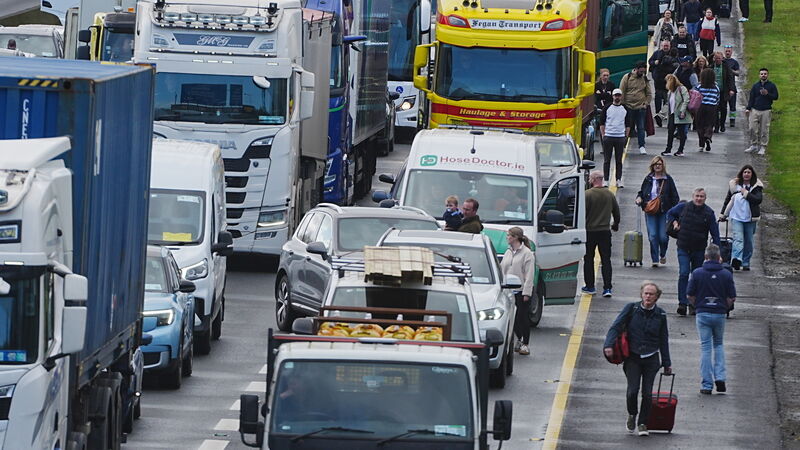
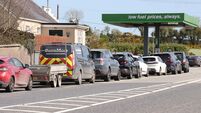
People with their luggage walk past the heavy traffic on Dublin's M50 Northbound, due to vehicles taking part on the third day of a national fuel protest against rising fuel prices. Picture: Philip Toscano/PA
The scenes unfolding across the country in recent days point to a deep well of frustration that cannot be dismissed. Those taking to the streets, blocking roads, and disrupting critical infrastructure are not acting in a vacuum.
Their grievances, whatever their precise form, resonate with a public that has grown weary of rising costs, uneven opportunities, and a sense that decision-makers are too often distant from the realities of everyday life. In that sense, the protestors are not without sympathy. Indeed, they enjoy a considerable degree of it.
But sympathy is not unconditional. The right to protest is fundamental in a democratic society, yet it is neither absolute nor immune from consequence. When demonstrations cross certain lines, they risk undermining the very support that sustains them.
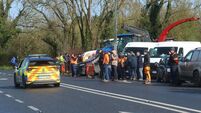
The blocking of fuel depots, oil refineries, key ports, and main urban routes is not merely disruptive; it carries real and immediate consequences for ordinary people and the country as a whole. Reports of emergency services struggling to navigate obstructed roads are particularly troubling. Whatever the cause, no protest can justify endangering lives.
There is also a broader economic dimension. Interruptions to supply chains and the free movement of goods and workers do not only inconvenience; they threaten livelihoods. Small businesses, shift workers, and those already living on tight margins bear the brunt of such actions. If protesters claim to speak for the ‘ordinary person’, they must reckon with the reality that their tactics may harm those very individuals. Public goodwill, once lost, is difficult to regain.
Yet it would be a mistake to place the burden of responsibility solely on those protesting. The Government’s response has been, at best, uneven and, at worst, inadequate. There is a palpable sense of drift, as though the State is out of practice in dealing with protests of this scale and nature and sleep-walked into a deepening crisis.
That in itself is revealing. Effective governance requires preparedness for moments of disruption, not improvised reactions once disruption takes hold.
Mixed messaging, coupled with reports of potential involvement of the Defence Forces, has sown confusion rather than confidence. Such signals risk escalating tensions rather than calming them. In times of unrest, clarity and consistency are essential. Neither has been sufficiently evident.
Complicating matters further is the diffuse nature of the protest movement. There is no single leadership structure or representative body through which dialogue can easily be conducted. This presents genuine challenges for engagement. Governments are accustomed to negotiating with unions or organised groups, not loose coalitions with varying demands. But difficulty does not absolve responsibility. The absence of a formal structure does not mean engagement is impossible, nor does it justify inaction. If anything, it demands greater effort to establish channels of communication.
Ultimately, neither side can afford to misjudge the moment. Protesters must recognise that tactics which alienate the public will weaken their cause. The Government, for its part, cannot rely on inertia or hope that the disruption will simply dissipate. Chaos may serve as a tool of protest, but it cannot be a strategy of governance.
What is required now is a recalibration — a return to proportionality, responsibility, and, above all, dialogue.
On Wednesday morning, many Lebanese civilians woke believing they, too, would be spared the daily threat of airstrikes, further occupation, and constant drone surveillance. After nearly two years of relentless bombardment, the prospect of relief — however fragile — seemed real. It lasted only hours. What followed was not restraint, but a brutal escalation; one of the bloodiest days in Lebanon’s recent history, in a country that knows far too well what such days look like.
Despite lame protests to the contrary, this was no misunderstanding, it is an abject moral failure. A ceasefire that excludes a sovereign nation — yet allows it to believe, even briefly, that it is included — is not diplomacy, it is deception. Worse still, it created a moment of hope and justifiable complacency that was immediately weaponised.
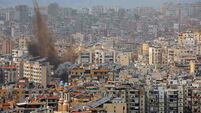
Lebanon is not a footnote. It is a sovereign, democratic state, shaped by a complex tapestry of cultures, faiths, and political traditions. Despite decades of external interference and internal strain, it endures — largely through the resilience of its people. That resilience should not be mistaken for an infinite threshold for pain. The images from Beirut and beyond are stomach-turning: Civilians killed, infrastructure shattered, entire communities terrorised. To call this part of a ‘ceasefire’ is to drain the word of all meaning.
At what point does language catch up with reality? When will Western leaders move beyond equivocation and confront the brutality unfolding before them? A deal that permits such flagrant aggression is not peace. It is imperialist violence, repackaged — and Lebanon continues to pay the price.
roadcasters lost their nerve.
Sketch shows — messy, risky, gloriously uneven — require investment and, more importantly, faith. For years, both have been in short supply. Which is why the arrival of feels oddly significant.
Expectations were low. The American original has long been treated with near-religious reverence in the US, a status that often mystifies audiences on this side of the Atlantic. Its rhythms, its humour, even its sense of importance can feel distinctly foreign to Irish and British sensibilities.
Yet the early signs from the British version are, if not spectacular, then quietly encouraging. Critics noted it “didn’t fail” — faint praise perhaps, but telling. What matters is it tried. And in trying, it has reminded commissioners of something they appeared to forget: Audiences still want to laugh.
If finds its voice, it may do more than entertain. It may persuade RTÉ and others to take a risk on funny again. That alone would be no small achievement.


CONNECT WITH US TODAY



Be the first to know the latest news and updates