Irish Examiner view: War is pushing millions towards acute hunger
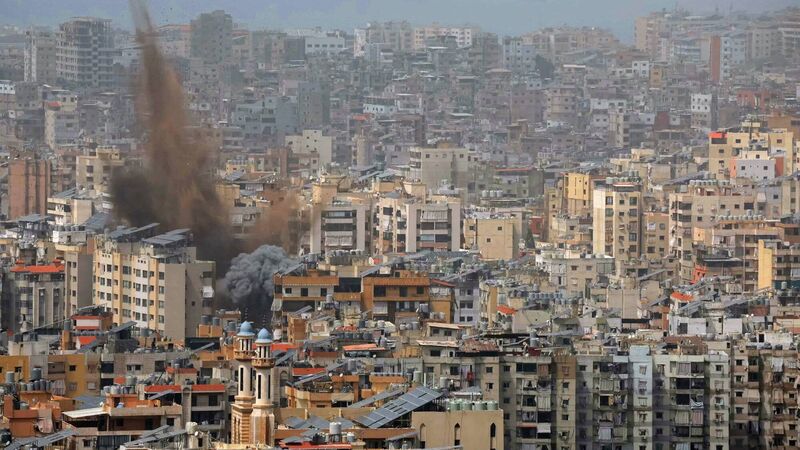
Smoke rises from the site of an Israeli airstrike that targeted an area in Beirut's southern suburbs, on April 5. Picture: ibrahim Amro/AFP/Getty
As Donald Trump and Benjamin Netanyahu’s unnecessary, deadly, and expensive war against Iran continues into its second month — contrary to the wild predictions coming out of the White House — many other, innocent, victims are emerging as a result of the conflict. It has been revealed that the war is now causing the worst disruption to lifesaving human work since covid.
Amid seemingly impotent US Security Council resolutions demanding an end to the conflict, including Iran’s retaliatory strikes on neighbouring Gulf states, the net effect is that the war is pushing 45m people into acute hunger.
Not only has the war created a global energy crisis and cut off vital shipping routes, it is now disrupting supply chains for many aid groups, forcing them to find other ways to deliver food and medicine to millions worldwide.
With the Strait of Hormuz effectively closed and strategic hubs in Abu Dhabi, Doha, and Dubai also impacted, aid organisations are fighting their own corner, despite higher fuel, transport, and insurance costs which mean fewer necessary deliveries for the thinning amounts of money available to humanitarian organisations.
Steep US cuts to foreign aid programmes have already hobbled many aid agencies and the World Food Programme says it has tens of thousands of tonnes of food heavily delayed in transit.
Aside altogether from aid destined for war-torn Sudan and food for millions of malnourished children in Somalia, the 1m displaced people in Lebanon and unknown numbers of people suffering in Iran, are creating further strains on the distribution of much needed food and pharmaceutical supplies.
The US and Israeli war on Iran and Tel Aviv’s concurrent assault on South Lebanon are pushing humanitarian operations beyond their limits. The strangulation of supplies of fertiliser is also threatening food production across vast swathes of Africa, South and Central America, Asia, Europe, and, ironically, the US itself.
Aid organisations are now having to make the appalling choice between the numbers of people they are trying to reach or the number of products they can afford to purchase.
This is a dreadful side-effect of a war for which there appears to be no end, and is yet another indication of the lack of thought, pre-planning, and preparation for the fall-out from the actions of both the US and Israel.
If the conflict continues into June, the UN’s World Food Programme estimates 45m more people will be added to the 320m people facing hunger globally.
Woefully, it appears, there seems to be little concern for their plight, either in Washington or Tel Aviv.
The implementation by this summer of the Government’s Critical Infrastructure Bill is very welcome, even if it will place a legal requirement on all statutory agencies and bodies to identify large capital projects.
Under the laws, the Government will be able to identify projects in the national and public interest as critical
infrastructure. Each can then jump to the top of the queue at every stage of the project approval and delivery processes.
A key element, however, is that all relevant statutory bodies and attendant agencies will be legally required to prioritise designated projects in their decision-making
procedures, helping to significantly shorten project life cycles.
These laws have been criticised by opposition parties and various environmental groups because they will short-circuit the planning process and allow some infrastructural developments to be railroaded into being without adequate checks and balances, but the intention of the legislation still has considerable merit.
We have long criticised the delays in building vital and long-overdue road building, rail development, energy
infrastructure, and harbour redevelopment. Now that the necessary tools are in place to fast-track such work, there can be no real room for complaint.
The fact the Government had to use its majority to force a vote and get the Oireachtas committee on infrastructure to waive pre-legislative scrutiny of the new bill, illustrates it is finally getting the finger out when it comes to the provision of vital national projects.
It has taken considerable flak in recent months as a do-nothing administration.
We are finally seeing some ambition and intent to get things done, and it is about time too.
The annual extravaganzas that are the Easter conferences for the three main teachers’ unions take place in Killarney and Wexford with the main talking points focussing on the effects of AI and the scourge of social media.
Certainly, the usual menu of pay, school resources, special needs education, and work conditions will feature strongly at each of the Teachers’ Union of Ireland, Association of Secondary Teachers in Ireland (ASTI), and the Irish National Teachers’ Organisation annual gatherings.
Although viewed by some as a jamboree for long-winded and sustained criticism of Government education policies, these are vital forums for measuring the health and well-being of our education system and will have a significant impact on the thinking of all the major political parties when it comes to forging policy.
There will be plenty of politics on show — the ASTI has not invited the minister for education this year — but the influence wielded by the teacher unions is not to be underestimated. Research has illustrated that the effectiveness of individual teachers on students is more important in the development of students and is more important than class sizes, infrastructure or curriculum changes.
Their views, therefore, on such as the influence of AI and social media, not to mention the effect of smart phone use by students, are going to be hugely important in shaping political thinking on these issues going forward.
That there are a substantial number of our public representatives who were formerly teachers, means the views expressed at this week’s conferences will hold more weight than those of many other professions.
Given the importance of the sector for Ireland Inc. going forward, that is possibly no bad thing.
CONNECT WITH US TODAY



Be the first to know the latest news and updates