Irish Examiner view: Statements of concern for Lebanon ring hollow  
The statements emerging from Tel Aviv in recent days are stark, explicit, and chilling
Irish Examiner view: Statements of concern for Lebanon ring hollow  

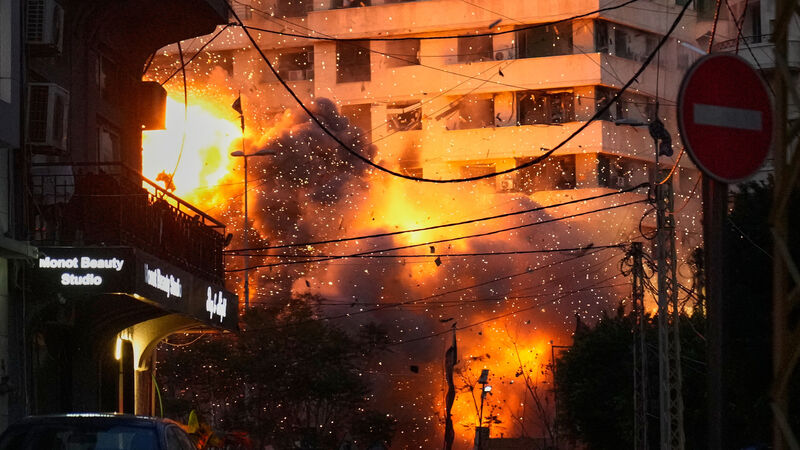
An explosion erupts from a building following an Israeli strike in central Beirut, Lebanon on March 18. File picture: Hussein Malla/AP

There comes a point in international affairs when the language of concern and restraint becomes a moral evasion rather than a diplomatic necessity, and we have long past it.

Israel’s declared intention to expand its occupation across southern Lebanon is further proof — lest it be needed — that it is a country intent on reshaping the geography of a region, all while enabled by a cast of compliant world leaders unwilling to show a morsel of moral courage by preventing it. The statements emerging from Tel Aviv in recent days are not couched in the coded language of security or deterrence. They are stark, explicit, and chilling.

Entire Lebanese villages, we are told, may be wiped “off the face of the earth” as part of an expanded occupation. Let us be clear: When you invade a sovereign country, when civilian areas are deliberately targeted for removal, when communities are erased to make way for military control, there are words for that. Those words are ethnic cleansing.

For decades, Lebanon has lived in the shadow of Israeli incursions, invasions, and occupations. Its southern region, in particular, has been treated as expendable terrain in a wider geopolitical struggle. Yet what is now being proposed goes further than before — not merely the policing of a border, but the systematic emptying of a landscape and the permanent subjugation of its people. At the centre of this escalation is the government of Benjamin Netanyahu, a leadership that appears increasingly unrestrained. This is not a reluctant campaign undertaken in haste or fear, it is a declared strategy. A strategy of expansion, of domination, and of destruction. More alarming still is the apparent breadth of domestic support within Israel for this course — a sign of a polity drifting toward a dangerous consensus.

None of this is happening in a vacuum. It is unfolding with the tacit acceptance — if not outright enabling — of an international community that has grown accustomed to looking away. Statements of ‘deep concern’ ring hollow when they are not matched by meaningful consequences. For Ireland, the stakes are not abstract. For nearly half a century, Irish peacekeepers have served in Lebanon under the UN flag. They have stood between communities and conflict, often at great personal risk. Many did not return home. Their legacy is one of courage, neutrality, and commitment to peace.

What, then, does it say if Ireland remains silent now?

To say nothing is not neutrality, it is to abandon the very people our soldiers were sent to protect, and to dishonour the memory of those who gave their lives in that cause. Ireland’s voice has long carried weight beyond its size — precisely because it has been willing to speak when others would not.

That legacy is now being tested. If the Government fails to condemn what is being proposed in southern Lebanon — never mind sanction those responsible for it — then it risks becoming complicit in the erosion of the very principles it claims to uphold. There is still time to act. But time, like the villages of southern Lebanon, may soon run out.

Delayed justice erodes trust

More than three years on from the explosion that tore through Creeslough and claimed 10 lives, the families of those lost are still waiting for answers, for accountability, and for justice. This week’s development, with justice minister Jim O’Callaghan finally agreeing to meet bereaved relatives, is welcome — but it is also telling. It comes only after sustained pressure from families who have had to fight, relentlessly and publicly, simply to be heard.

Ireland knows too well the cost of delay, obfuscation, and institutional reluctance when tragedy strikes. From Stardust to Ballymurphy, justice deferred has too often become justice denied. Creeslough risks joining that grim lineage.

The facts remain stark. Ten people died in what is believed to have been a gas explosion. Years later, investigations continue, compensation remains unresolved, and families are left in limbo — some still without even the basic closure of inquests. In that vacuum, frustration has turned to anguish.

The Government insists that a public inquiry must wait until criminal processes conclude. That is a defensible legal position, but it is not a sufficient moral one. The two are not mutually exclusive. Transparency delayed will inevitably result in trust being diminished.

Creeslough presents the State with a choice. It can repeat the mistakes of the past or it can act decisively: Establishing an independent inquiry that places victims and their families at its centre. Anything less risks compounding tragedy with neglect. The people of Creeslough have shown extraordinary dignity. They should not have to show endless patience.

Providing a shift of perspective

At a time when the view on Earth feels increasingly bleak, it is perhaps no coincidence that eyes are once again turning skyward. This week’s launch of the National Aeronautics and Space Administration’s Artemis 2 mission carries four astronauts on a 10-day voyage around the moon. It is, in technical terms, a test flight: A proving ground for systems that may one day return humans to the lunar surface and beyond.

But it is also something else.

At a moment of geopolitical tension, climate anxiety, and grinding conflict, Artemis offers a rare reminder of perspective. Suspended in the vastness of space, Earth is reduced to a distant, fragile sphere — borderless, indivisible, and utterly indifferent to our quarrels. That shift in perspective matters.

The astronauts aboard Artemis 2 will travel farther from Earth than any humans in decades, looping behind the moon before returning home. In doing so, they revive not just a programme, but a mindset — one that sees humanity as a shared endeavour rather than a collection of competing interests.

It is easy to dismiss such missions as costly indulgences. Yet they also serve as quiet correctives. They remind us how small we are, how fleeting our disputes, and how much we stand to gain from co-operation rather than division. In that sense, Artemis 2 is not an escape from Earth’s problems. It is a lens through which to reconsider them.

x

More in this section

Revoiced

Newsletter

Sign up to the best reads of the week from irishexaminer.com selected just for you.

Cookie Policy Privacy Policy Brand Safety FAQ Help Contact Us Terms and Conditions

© Examiner Echo Group Limited