Irish Examiner view: Europe must show unity and cohesion in the face of this global crisis
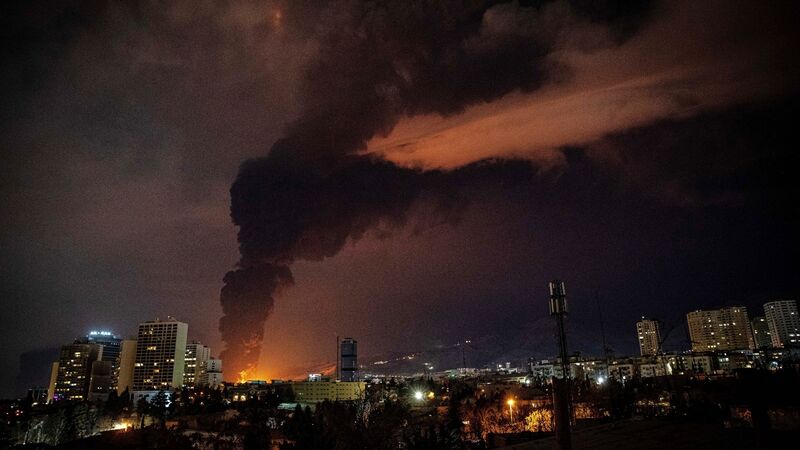
Flames and smoke rising from an oil storage facility in Teheran struck amid the US–Israeli air strikes on Iran's capital late on Saturday. Picture: Arileza Sotakbar/ISNA/AP
At a time of global crisis, with accepted diplomatic and political norms having been cast aside in favour of blunderbuss bullying and incoherent messaging coming from the White House, it has never been more important for Europe to show unity and cohesion.
We are not, however, seeing anything like that as uncertainty, individual national priorities, and fears of a global inflation shock caused by the Iran war, courses through the veins of Europe’s political classes, provoking division and rancour among those who should be standing up for the rule of international law.
Amid America and Israel’s punishing military campaign against Iran, the legality of which remains questionable, appears to have no coherent endgame and has worrying echoes of Russia’s invasion of Ukraine, few European leaders appear to have the appetite to stand up to Donald Trump’s aggression, or are otherwise focussed.
Mette Frederiksen in Denmark has already rebuffed American designs on Greenland but has a domestic election to contend with; Donald Tusk in Poland has a right-wing president who is vetoing all and any legislation; Keir Starmer in Britain is already up to his neck in it with Trump and has huge domestic issues; Giorgia Meloni in Italy is trying to stay away from war; German chancellor Friedrich Merz stands accused of prioritising domestic issues over European ones, and Emmanuel Macron in France is trying his best in the face of huge internal problems.
Of the major European political players, only Spain’s Pedro Sanchez has had the cojones to tell Trump about the reality of his war on Iran and has already been threatened with a trade ban by the US for having the gall to refuse to allow two Andalucian air bases be used to strike Iran.
In doing so, Sanchez has been one of the very few European leaders to openly reject the demands of a US president whose negotiation tactics involve an unpredictable mix of bullying, humiliation, and self-promotion.
Sanchez has been brave enough not simply to stand up to Trump, but his message has also been pointedly personal, further incurring the wrath of the White House. He said the overriding responsibility of any government was to protect and improve the lives of its citizens and not to manipulate global conflicts into profit.
He maintained that it was “absolutely unacceptable” for those leaders incapable of fulfilling that duty to use the smokescreen of war to hide their failure and — in the process — line the pockets of a select few who profit when the world stops building hospitals and starts building missiles.
The Spanish prime minister was at his most pointed when he said that it was naïve to believe “democracies or respect among nations can spring from ruins” and added “ to think practicing blind and servile obedience” was some form of leadership.
His position that Spain would not be complicit in something that is bad for the world and is also contrary to their values and interests, simply out of fear of reprisals by someone — he did not have to say who that someone was — one that every European leader should embrace.
We have long known that the Irish prison system is in turmoil, wracked by overcrowding and Dickensian conditions.
The news therefore that plans for the introduction of electronic tagging for convicted offenders has been further delayed — after a tender for the supply and managements of the monitoring devices had failed to attract any prospective contractors — is not good.
Having promised that electronic tagging would be rolled out by 2025 “at the latest”, justice minister Jim O’Callaghan, is now in something of a pickle. He has even admitted it was embarrassing such a system had not been introduced earlier.
The Department of Justice had proposed a €1.58m contract for up to 50 electronic monitors and put it to tender last year for a 12-month pilot programme.
If even those 50 monitors were in place, drastic prison overcrowding could be reduced somewhat. A full rollout might have solved the issue for good. It now appears that the second half of this year will be the earliest we will see electronic tagging introduced.
It cannot come quick enough.
While actively condemning foreign fishers for denuding Irish fish stocks and emptying Irish waters of fish species necessary to keep marine wildlife bountiful and thriving, the Government has actually done little to prevent it happening.
However, a pilot plan to be trialled in the waters off Cork and Kerry may just succeed where others have failed.
It is probably not ideal that this plan will be put into effect by tour operators, but if it can protect sensitive wildlife from unnecessary disturbance and encourage thoughtful and sustainable tourism operations, then it will be worthwhile.
The initiative will set out best practices for approaching marine species including whales, dolphins, seabirds, basking sharks, seals, and turtles and is aimed at reducing activities which cause a disturbance to these animals, including noise, the presence of vessels and personal watercraft, irresponsible use of drones, and visitor pressure.
Developed by a group of water tour operators, who have been very vocal in recent months about not alone the dangers to marine wildlife of over-fishing, but of the presence of inconsiderate and often numb sculled boaters, it is at least a start in protecting what has become a very valuable tourist resource.
While many species are protected anyway, they are still vulnerable to disturbance and we desperately need them to continue to breed and thrive around our entire coastline.
In the absence of any coherent government plan to protect our waters and the animal life that thrives in them, at least those making a living from highlighting the beauty and awe they inspire are making some effort to do so.


CONNECT WITH US TODAY



Be the first to know the latest news and updates