Irish Examiner view: Taoiseach's Future Cork speech opens door to new vision for Páirc Uí Chaoimh
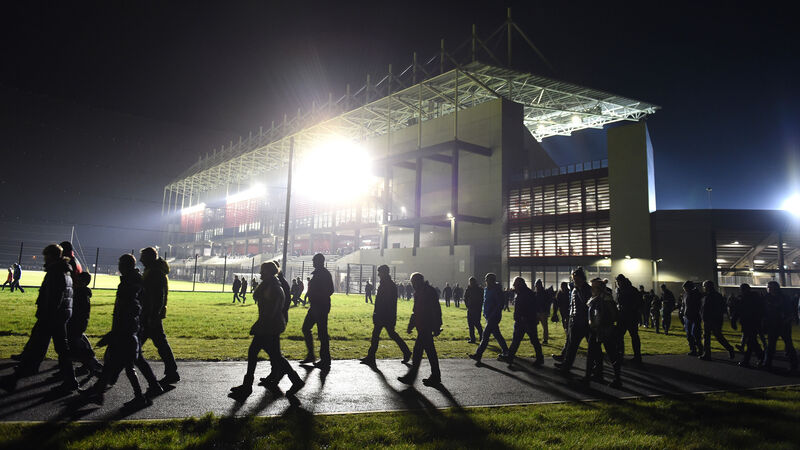
Taoiseach Micheál Martin told the Future Cork event that stadiums such as Virgin Media Park, Turner's Cross, and Páirc Uí Chaoimh (above) ought to be regarded as municipal venues. File picture: File picture: Larry Cummins
The Irish Examiner’s Future Cork event on Friday in the Metropole Hotel was an opportunity to consider the city’s future.
Business, administrative, and transport leaders offered their perspectives on Cork’s development over the coming decades, and there was a palpable sense of anticipation about the future.
Taoiseach Micheál Martin was among those offering his views, and one of his opinions is sure to resonate with many people far beyond Leeside.
The Taoiseach, a long-standing Gaelic games supporter and one-time club officer with Nemo Rangers, suggested the county’s principal GAA venue, Páirc Uí Chaoimh, should become a municipal venue, adding that the day was gone when sporting organisations looked at such facilities as ‘their’ stadium.
For context, the State contributed €30m towards the extensive redevelopment works in the stadium.
Yesterday, the Taoiseach did not revisit the controversy two years ago when renaming the stadium as Supervalu Park was discussed, but at that time he pointed out that the State had provided that sizeable sum without seeking naming rights to the venue.
Read More
Should it seek a bigger say in how the stadium is operated?
The situation is complicated further by the fact that Páirc Uí Chaoimh has struggled with a huge cost overrun on that redevelopment, and a subsequent debt of over €30m.
Any arrangement which would alleviate that debt, such as a municipal partnership, would need to be seriously considered.
The nuts and bolts of any such partnership would need to be teased out carefully.
Would it entail the local authority taking responsibility for that debt, or would that be a matter for central Government? Would one or other of those entities take ownership of the stadium and therefore dictate its use completely? How would the needs of other sporting organisations be accommodated, and whose fixtures would take priority?
These are valid questions which could surely be addressed with goodwill and open engagement on all sides.
The municipal stadium model has long been in use in other European countries with as many different sports as Ireland, if not more.
There is no good reason why it cannot work here also.
More than 10,000 people had signed a petition calling for a complete ban on sulky racing, a form of harness racing.
The petition was begun after the recent death of a pregnant horse after sulky races at Dollymount Strand in Dublin and on a stretch of road near the N4 in Ballyfermot, also in the capital.

Witnesses claim the horse was repeatedly kicked to force her to stand after falling in a race and was then abandoned, covered in blood. Though vets treated the animal, she and her unborn foal died soon afterwards.
Readers may recall the outcry recently when Greyhound Racing Ireland signed a memorandum of understanding with Technical University of the Shannon to establish courses in greyhound husbandry and welfare. The move was seen by some as cynical, with critics pointing to the high mortality rate in greyhound racing — pressure groups claim that almost half of racing greyhounds born in 2021 are either dead or unaccounted for.
Read More
That is a shocking statistic, and the backlash it provoked was entirely justified. However, it seems extraordinary that while greyhound racing — an activity which is legal and regulated — faces such scrutiny and criticism, an activity which is illegal is allowed to continue with impunity.
Sulky racing is unlawful on public roads and clearly poses a significant danger to those using those roads, before one even begins to consider the animal welfare implications of this pastime.
In a recent Seanad debate on sulky racing, Senator Chris Andrews made an obvious point: “Owners say they love their horses, but when you see the conditions they’re living in, you have to wonder if that’s true.”
On that occasion, minister of state for agriculture Timmy Dooley said policy in that area was a matter for the transport minister, and that he would raise those concerns with him.
However, surely this issue needs to be treated with more urgency for the safety of road users and the welfare of the animals involved.
February 28 is Ireland Reads Day, which means that today, everyone in the country is being encouraged to take the time to read.
Ireland Reads is a Government initiative which aims to promote and celebrate the joy of reading.

It is funded by Healthy Ireland and supported by public libraries and many organisations that promote reading, literacy, and the arts — many of those organisations and libraries are running events to coincide with Ireland Reads Day.
There is no shortage of good reasons to read, of course. Those range from health boosts — studies have shown that reading boosts your mental health by reducing stress by up to 68% — to intellectual reinforcement.
It is clear that the ways in which we take on information are changing. The proliferation of social media apps illustrates the growth in visual learning, for instance, and the growth in the popularity of podcasts underlines how much data and knowledge are now disseminated aurally.
Reading retains its primacy, however. It is cheap, and often free, and books do not need earphones, wifi signals, or fully-charged batteries. Generations of Irish people have made ours one of the most literate, and literary, societies in the world.
That enthusiasm for reading expresses itself in many different ways — such as enjoying this very newspaper in print or online.
CONNECT WITH US TODAY



Be the first to know the latest news and updates