Irish Examiner view: Putin and Zelenskyy must have face-to-face peace talks
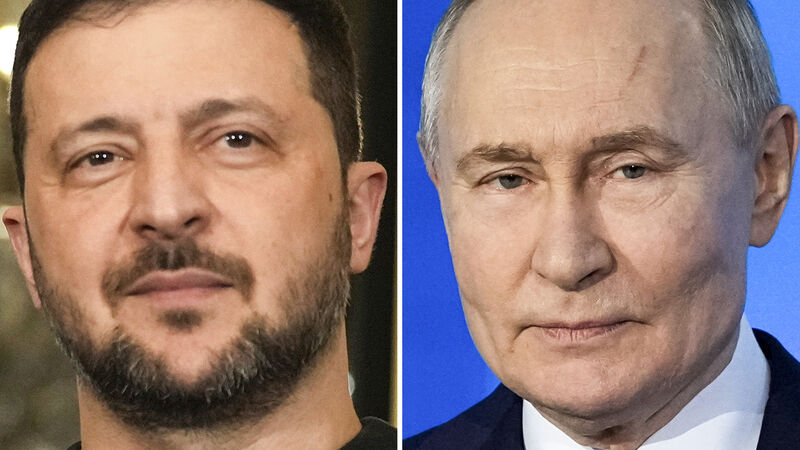
Ukraine's president Volodymyr Zelenskyy and Russian president Vladimir Putin. File pictures: Aurelien Morissard and Pavel Bednyakov/AP
It will be four years tomorrow, Tuesday, since Vladimir Putin’s Russia launched a wholly illegal war on its neighbour and former vassal state, Ukraine. It expected victory within hours — and at most, days.
That, as we know, did not happen. The partly failed invasion has now stretched into four years — two shy of the catastrophic Second World War — and has cost a cumulative total approaching 2m lives, destroyed large tracts of previously peaceful cities, brought both countries to the brink of financial ruin, upended world order, partially divided the EU, and strained Nato to the point of near dissolution.
The Second World War had given birth to an unprecedented era of peace and prosperity across the globe. The dying embers of the Nazi Third Reich had unified the world in horror against the effects of all-out war, the terrors of authoritarianism, and the unacceptable vulgarity of genocide — a crime so heinous the word had to be coined to describe German atrocities.
That period gave birth to a superpower era which ended in 1991 with the collapse of the Soviet Union and the secession of its former constituent republics, including Ukraine. However, under Putin — an autocrat who remains an admirer of Soviet-style leadership — Russia has rejected the realities of the new order and craved regaining control over Kyiv, engaging both in support for pro-Russian politicians and for pro Russia militias in Ukraine’s Russian-speaking eastern regions. Such ambitions sparked this war, and the intransigence of the leadership in the Kremlin has fuelled it. Despite repeated threats, entreaties, and soft-touch diplomacy, there appears to be no end to Putin’s appetite to wage it.
Russia has paid an enormous price for minimal gains, and what was once a major global economic power has become a state beset by slow growth, weak productivity, declining manufacturing, and a severe cost-of-living problem.
Ukraine has suffered economic fallout too, largely thanks to the systematic destruction of large sectors of its energy infrastructure, the draining of its financial resources, and the complete destabilisation of day-to-day life.
Ukraine has refused to yield and, it appears, Russia will not back down either.
Various attempts have floundered on the rock of Russian obduracy; the most recent of these was in Geneva last week, where viable efforts to end the conflict were once more dismissed out of hand by Moscow.
Ukraine’s president, Volodymyr Zelenskyy, has suffered the indignity of an Oval Office dressing down by US president Donald Trump for not being “grateful” for US aid, but has retained almost unanimous support globally for his nation’s dogged defence of its territories. Trump seems afraid to impose on Russia the measures necessary to bring it to the negotiating table with any sense of wanting peace.
Mr Zelenskyy says his country is “definitely not losing” — while Russia has made slow gains over the past few months Ukraine has retaken some territory in recent weeks — and Ukraine has been desperate not to cede territory to Moscow since the outset of war. Nonetheless, this past weekend Mr Zelenskyy again said his country’s responses to “the most difficult questions” are ready. He has previously signalled, for instance, a willingness to consider freezing the frontlines as part of a ceasefire.
Putin has yet to sit face-to-face with his Ukrainian counterpart and there is a sense that this needs to happen if this war is to be ended. Tripartite talks, chaired by the US, seem the most likely route to a cessation of hostilities, but neither the US nor Russia have explored that path.
Calling for further talks this month, Mr Zelenskyy said it is the leaders’ format that could prove decisive and that Ukraine is ready for such a format. America and Russia remain silent on that path, but if they are serious about ending this seemingly endless conflict, it seems an obvious path to follow.
As Donald Trump’s unprecedented trade tariff regime descends into further chaos following last Friday’s rebuttal by the US Supreme Court, one aspect of his presidential reign remains unfettered — deploying the power of state to expand his personal brand.
The world knows by now that the 47th president of the United States is thin-skinned, narcissistic, revengeful, greedy, and an often-childlike figure — whose ability to accept blame, or swallow accusations of wrongdoing, is non-existent.
In the past week, however, a dark shadow has fallen on Washington which has direct authoritarian overtones and suggests an emerging dystopian vision of American authoritarianism. A long grey/blue banner featuring a gigantic portrait of Trump was last week hung on the headquarters of the Department of Justice on Pennsylvania Ave. The department has long functioned independently of direct political or presidential control.
Now, however, it joins the Department of Agriculture and the Department of Labour as a venue where grandly scaled images of Trump are displayed. It is a bold statement by the president of power and influence over government.
The advance of this shadow has proceeded with considerable speed over the past 13 months. The president has placed his image not just on buildings, but on season passes for the National Park Service and on coins that may be coming from the US Treasury — despite a law forbidding such a thing.
His name was physically added to the John F Kennedy Centre for the Performing Arts and the US Institute of Peace. In Florida, Republican lawmakers have voted to rename the airport in West Palm Beach, which is adjacent to Trump’s Mar-a-Lago lair, the ‘President Donald J Trump International Airport’. In the last few weeks, it has emerged that Trump has promised to unfreeze billions of dollars in funding for major infrastructural projects in the north-east of the country, only if New York’s famous Penn Station railway hub is named after him. He also wants Washington’s Dulles Airport to be renamed in his honour.
He also commissioned a ‘golden fleet’ of warships which will be known as ‘Trump-class destroyers’ and wants the NFL’s Washington Commanders to rename their new $3.7bn (€3.12bn) 65,000-seat domed stadium named after him.
His most recent wheeze is to suggest the building of a 250-foot arch in Washington — the so-called ‘Arc De Trump’ — on the banks of the Potomac river, something critics suggest has a “dictator for life” vibe. Trump himself says it is a crucial ingredient of domestic policy.
Outside of North Korea, nowhere — at least in any normal democracy — are leaders celebrated in such an overtly hagiographic fashion. Should we be surprised? Probably not.

CONNECT WITH US TODAY



Be the first to know the latest news and updates